
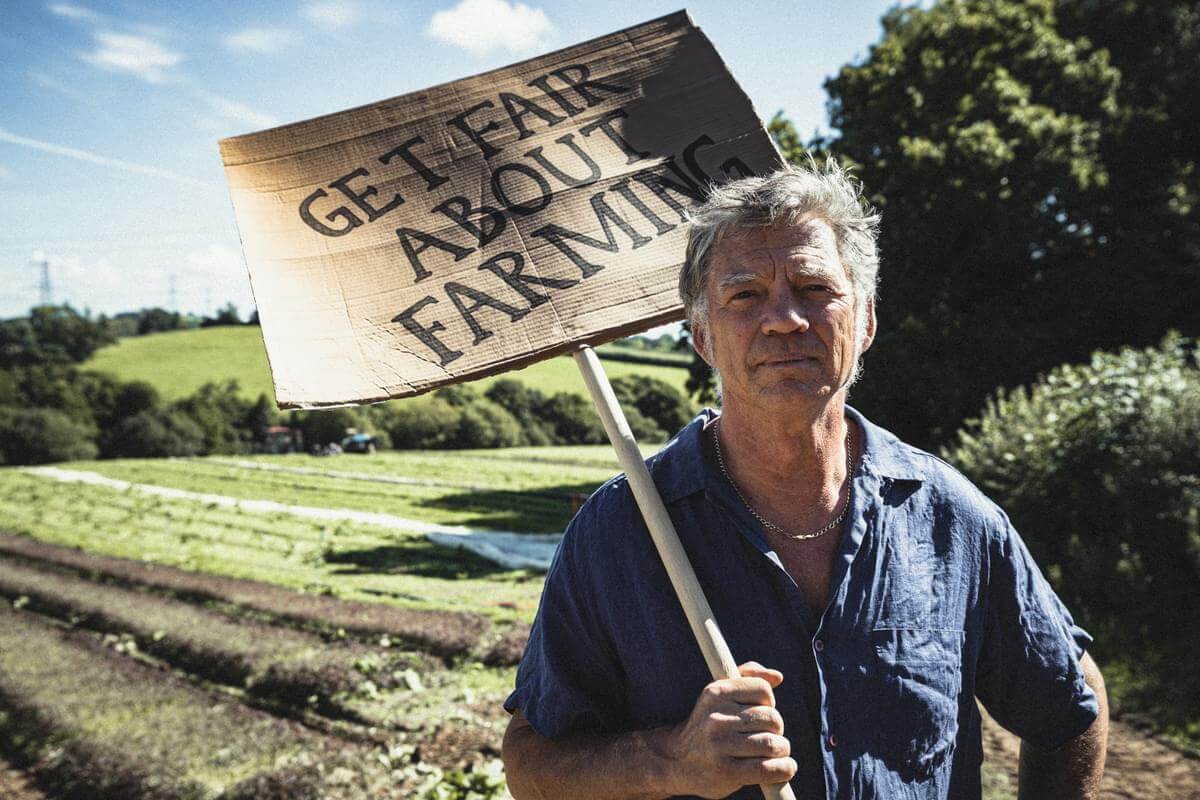
When you listen to some of the farmers who deal with the big supermarkets and their buyers – and learn more about the contracts they must sign if they want to sell their produce – the stories are heartbreaking. The power imbalance is palpable. And if farmers don’t accept strict terms, late payments, or price cuts, they can be struck off, never to sell to a supermarket again. Radical reform is needed.
When ten retailers have a stranglehold on 96 percent of all British groceries, where do farmers go if they don’t accept the prices and conditions dictated to them? They have little to no option other than taking what they’re given and that is the challenge.
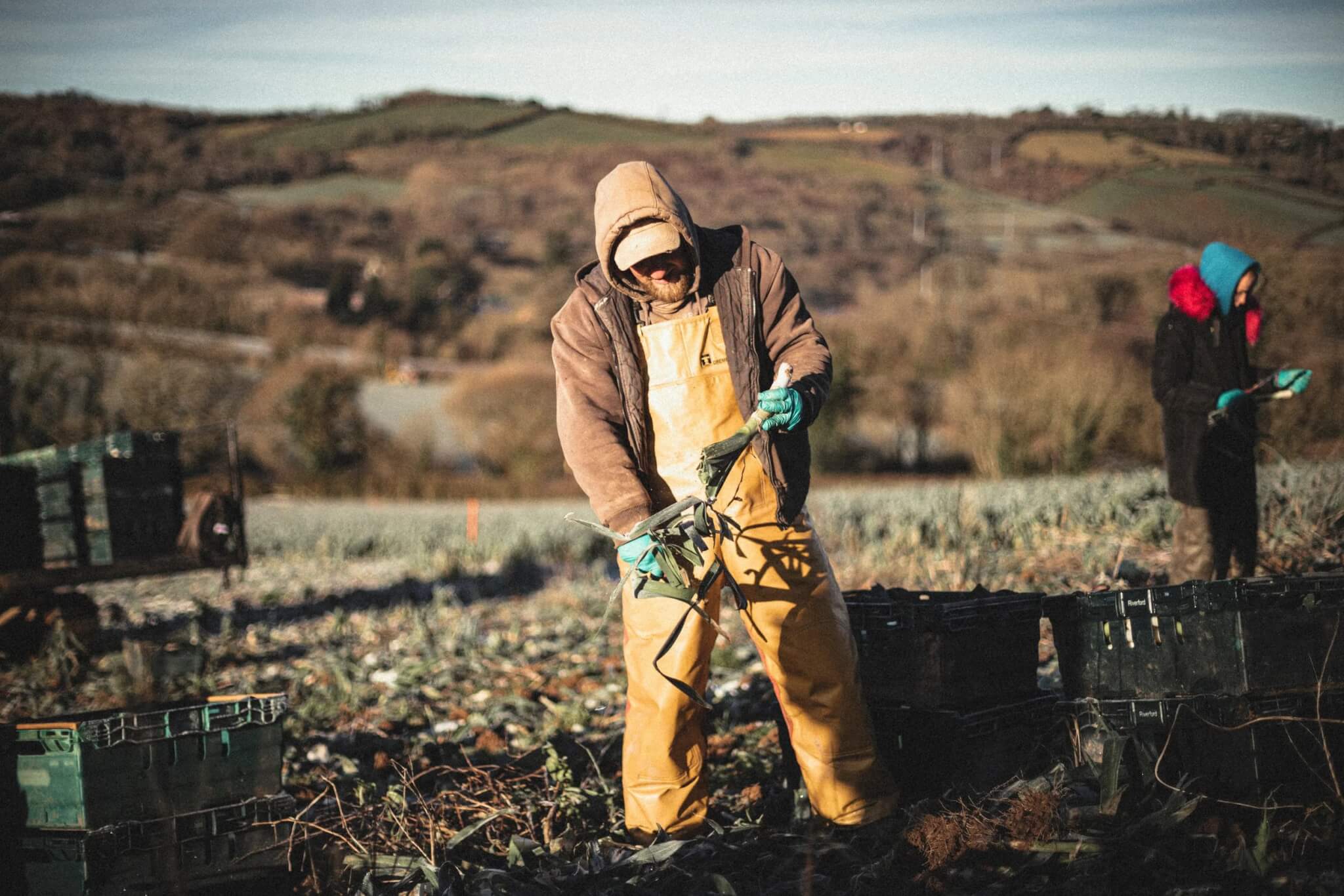
Over two thirds of farmers feel the relationship between growers and retailers has worsened in the last two years, according to a new survey commissioned by Riverford. A similar number said they had no choice but to accept the terms dictated by the supermarkets for fear of being delisted. While three quarters of farmers feel under financial pressure from the retailers’ buying practices.
Haydn Evans, a dairy farmer from Carmarthen in Wales, successfully pressured his milk buyer to ask for an extra penny per litre from a supermarket chain, only to find out that the buyer was then delisted just three months later.
“The supermarkets know how much they’re taking and how vulnerable farmers are. They exploit the power imbalance. They know that you are always negotiating with two hands tied behind your back. All the risk is passed back to my end. The contract is really unfair.”
Retail giant, Aldi only recently settled out of court in a dispute with its former brassica supplier. The supermarket chain was being sued for £3.7 million by a Yorkshire grower that went bust after a last-minute cancellation of its supply agreement for Brussels sprouts. The crop had already been sown and a substantial amount of money invested.
A court case would have opened up the nefarious practices of supermarkets to public scrutiny, yet the silence continues to this day. Why? Because nearly all suppliers, countrywide, are unwilling to speak up for fear of being exorcised from their main route to market. The only producers willing to talk are those who have stopped supplying.
Producers speak out
Their stories point to a litany of behaviours aimed at maximising shareholder profits and minimising responsibilities to the supply chain. This involves dictating low farmgate prices despite escalating costs, revolving buyers so they don’t build sympathetic relationships with producers, and delisting suppliers when contract terms aren’t met.
“There is little constructive negotiation or consultation resulting in nobody really knowing what we do anymore. A young buyer may find themselves at one moment in charge of battery buying and the next top fruit,” states Richard Stogdon, an apple grower from Sussex who has now stopped selling to supermarkets after 40 years.
It is no wonder that a recent survey, conducted anonymously with 200 current or recent suppliers to supermarkets from the horticulture sector, found that 99 percent have faced at least one ‘unfair’ practice; this includes cancelled orders, late payments, and unfavourable, unfair or unprofitable pricing. Farmers are crying out for change.
“For three years, our campaign, Get Fair About Farming has been calling for a regulator with real teeth, one that can stand up to supermarkets and help address the huge imbalance of power in our supply chains. Over 113,000 people have backed that call, and even the UK Parliament has debated it, yet farmers are still being failed by a system that’s meant to protect them,” states Guy Singh-Watson, founder of Riverford.
All rests on the powers of the GCA
As previously reported by Wicked Leeks, the issue lies with the Groceries Code Adjudicator (GCA) which regulates the relationship between supermarkets, the supply chain, and producers. It doesn’t help that it’s funded by the big retailers themselves. Many in the sector are now calling for an overhaul of the GCA, if farming is to feel less “like survival” according to one producer.
More than three quarters of those surveyed believe the supply chain regulatory system does not protect farmers from unfair supermarket practices and is unfit for purpose – a shocking indictment of how the system operates in the UK.
This mood, dictated by big retail’s dominance and the subsequent extraction of value from the food supply chain, is having huge consequences on the future of growers themselves. The average age of UK farmers is 59; 40 percent are over 60. A vast swathe of producers don’t have much time until retirement. Yet it takes five to ten years before any new investment really comes to fruition. Why would they invest now if their situations are so precarious? They won’t.
“The relationship with supermarkets is strained. It’s a model that is boom and bust continuously. And how are we going to attract people into the market? It’s self-defeatism,” points out Haydn Evans.
Throw in other impediments such as inheritance tax for family businesses and the uncertainty over government funding for the Sustainable Farming Incentive (SFI) and it is not surprising that farming is paralysed by a food system held to ransom by a poorly regulated retail oligarchy.
It’s why 68 per cent of respondents said that making a living through farming has never been harder. With an alarming, 82 per cent saying unfair supermarket practices are contributing to stress and poor mental health, despite the smiling, friendly-farmer imagery touted by the big retailers.
“Farming shouldn’t feel like survival. It should be a livelihood to be proud of – producing good food, caring for the land, and looking after the people who work it. How can farmers do the right thing for their soil, their animals and the planet if they’re squeezed for every penny and lack the funds and security to invest in farming well for the long term? And how can shoppers make good choices when they’re being misled by supermarket farmwashing?” states Guy Singh-Watson.
Change cannot come quickly enough
Calls for change are mounting. MPs have now signed an Early Day Motion in Westminster calling to merge the existing supply chain watchdogs, which are split across two government departments, into one stronger body.
While three quarters of respondents in the survey believe a single regulator overseeing the entire supply chain would ensure fairer treatment of farmers. At the same time, over 3,000 people have also written to their MPs in support of better regulation.
If nothing does change, expect more British farmers to stop selling to retailers. This could lead to more imports from overseas, in a race to the bottom on price, less domestic production, and loss of local food resilience.
Better outcomes will all depend on better regulation, a beefed up GCA, and the need to offer UK farmers more, especially with rising costs. As we head towards Christmas and price wars that reduce the supermarket price tags for veg to mere pennies – and the perception that produce is cheap – a rethink is sorely needed.
“What eventually caused me to stop growing for supermarkets and instead process all my fruit for local sales was the sharp rise in labour costs, energy, and inputs that were not being covered by a corresponding rise in prices paid by the supermarket,” states Jonathan Hoskyns a third generation apple grower who has stopped selling to the big retailers after nearly a century.
He adds: “They were well advised about the shortfalls but were willing to let farmers go to the wall. There has long been a government strategy of cheap food and having a few supermarkets controlling retail prices suits their policy. There needs to be a reset regarding costs of getting food from farm to supermarket shelf and making sure the savings are shared between the suppliers and customers, as well as the retailers themselves.”
There are other issues at stake as well. Supermarkets have been found to reject produce over unreasonable demands, such as specifications on colour, size, or shape. This leads to a lot of on-farm food waste or a lower price paid which does not even cover the original costs. These practices having a direct effect on the land itself too.
“It is deeply concerning that three quarters of farmers also say that retailers’ behaviour is driving farms towards more intensive, environmentally damaging practices,” states Georgina Edwards, Sustainable Farming Campaign Officer at Sustain.
She adds: “Without taking more ambitious action to improve supply chain fairness, the government will fail to address the issue of farm profitability and support farmers in the transition to nature-friendly farming methods.”
Want to help?
Three years ago, over 100,000 people signed Riverford’s petition to parliament in support of Riverford’s Get Fair About Farming campaign, calling for better protection from retailers for British farmers. Riverford has working hard behind the scenes with Sustain: the alliance for better food and farming, and there’s big news: MPs put forward an Early Day Motion on Farmers, Growers, and the Supermarket Supply Chain. The proposal would bring existing supply chain regulators together into one stronger, more effective body to help ensure fair treatment across the whole chain, from farmers and growers to the biggest retailers – BUT we need more signatures to make it happen.
Will you email your MP today and ask them to support this proposal? It takes just a minute, and it could help build a fairer system for the people who produce our food.






I am sorry that Riverford’s, and others’, efforts have not had more success.
I have emailed my MP
Susan Harris
It’s interesting when we continually hear about farmers ‘diversifying’ We may think how wonderful. But in reality the farmers are only trying to make a living. Supermarkets should be paying them a fair price covering the growing costs plus a reasonable profit and not demanding unreasonable, one sided conditions.
I will write to my MP, but given the sort of reply I get from either of the 2 parties that rule our country, very little action will be taken. I hope we eventually get leaders who will truly care for the people of this nation.
I’m pleased to report that my MP Sara Dyke (Lib Dem) has signed the Early Day Motion and made it clear in e mail exchanges her support for the campaign being from a Somerset farming family herself.
I’d encourage everyone to e mail their MP to help make the desperately needed change happen. Shame on the supermarkets !
I have just written to my MP.
It is very interesting to see that the vast majority of MPs who have signed are Lib Dem.
I hope changes are made without delay, to protect our farmers who work tirelessly and with dedication.
I never buy meat from a supermarket but use local butchers who buy from local farmers, and Riverford.