
Ignore fungi at your peril. Most of our crops – whether they’re plant, bush or tree – depend on them for vital minerals. Beneath the ground they create a symbiotic web of life that connects our soil with the very roots, tubers and vegetation that we consume. Our human health very much depends on mycological vitality. Yet our interest and knowledge of fungi is still in its infancy.
“The problems that a golf course, a premiership football club pitch, a farmer growing strawberries, or a landowner foresting land have are all the same – they just don’t realise it. It’s an issue with soil health and I would go further and say it’s an issue with fungi health,” says Daniel Iddon, the founder of Re-Genus.
The former Formula 1 engineer is on a crusade to repopulate British soils with fungi. Decades of fertiliser, insecticide and fungicide overuse have decimated the biodiversity in the earth that helps put food on our table. Crop yields have gone down, so has soil fertility; just like human gut health, a lack of good bugs in the microbiome is bad for us and bad for our soil.
“One of the things we’ve found in every single one of the analyses we’ve done over the last five years is that British soils are missing sufficient fungi, which is a fundamental problem. This is especially true with intensive agricultural fields. If you’ve got millions of fungi they hold onto nutrients and essential minerals in the ground; they hold onto water, as well. They also aerate the soil. If there aren’t enough fungi these elements just run off and fuel water pollution,” states Iddon.
The UK has a catalogue of ongoing ecological crises that can be linked to such phenomena, whether its Lough Neagh in Northern Ireland, the River Wye in Herefordshire or Windermere in the Lake District. Across these catchment areas, algal blooms have decimated wildlife, partly due to agricultural run-off from synthetic fertiliser use in farmers’ fields.
“Fungi do so many things we don’t even realise at this stage. They are the unsung heroes of soil health. We believe their decline is partly due to a lack carbon and insect litter in the soil. We also know that insect populations are in decline. When we use our fungi fertiliser, which contains insect frass – the faeces and exoskeletons from black soldier fly farming – soils come back to life. That’s because the cell walls of fungi are made from chitin, the very same natural polymer found in insects,” he explains.
Inoculating the land
Daniel Iddon and his team at Re-Genus have created a small pellet that contains fungi, bacteria and nutrients. It is made like a loaf of sourdough bread, where a natural fungi starter or “mother” is fed to boost the microbes in a soil culture. This forms the basis of the product that aims to deliver a microbiome of fungi closely mimicking healthy soil, whether that’s for woodland or cropland.
In turn this allows for natural, homegrown sources of nitrogen and other nutrients to be fed to crops via fungi. They’ve also created a pellet as a drop-in replacement for synthetic fertiliser. This is vital at a time of increasing food insecurity, driven by war in the Middle East and escalating fossil fuel prices.
“The soil can also help itself once it’s got the right ingredients. We only apply 60 kilos of our pellets onto a hectare of soil, yet within three months the soil can be in better shape and functioning again. Out of the 60 billion fungi spores we’re applying to that hectare, there will be some that make a real difference,” details Daniel.
Human knowledge of fungi is only in its infancy. There are an estimated 2.5 million species of fungi in the world and 90 per cent are still unknown, according to a report by the Royal Botanic Gardens, Kew. It’s why Re-Genus inoculate their pellets with over 380 fungi species.
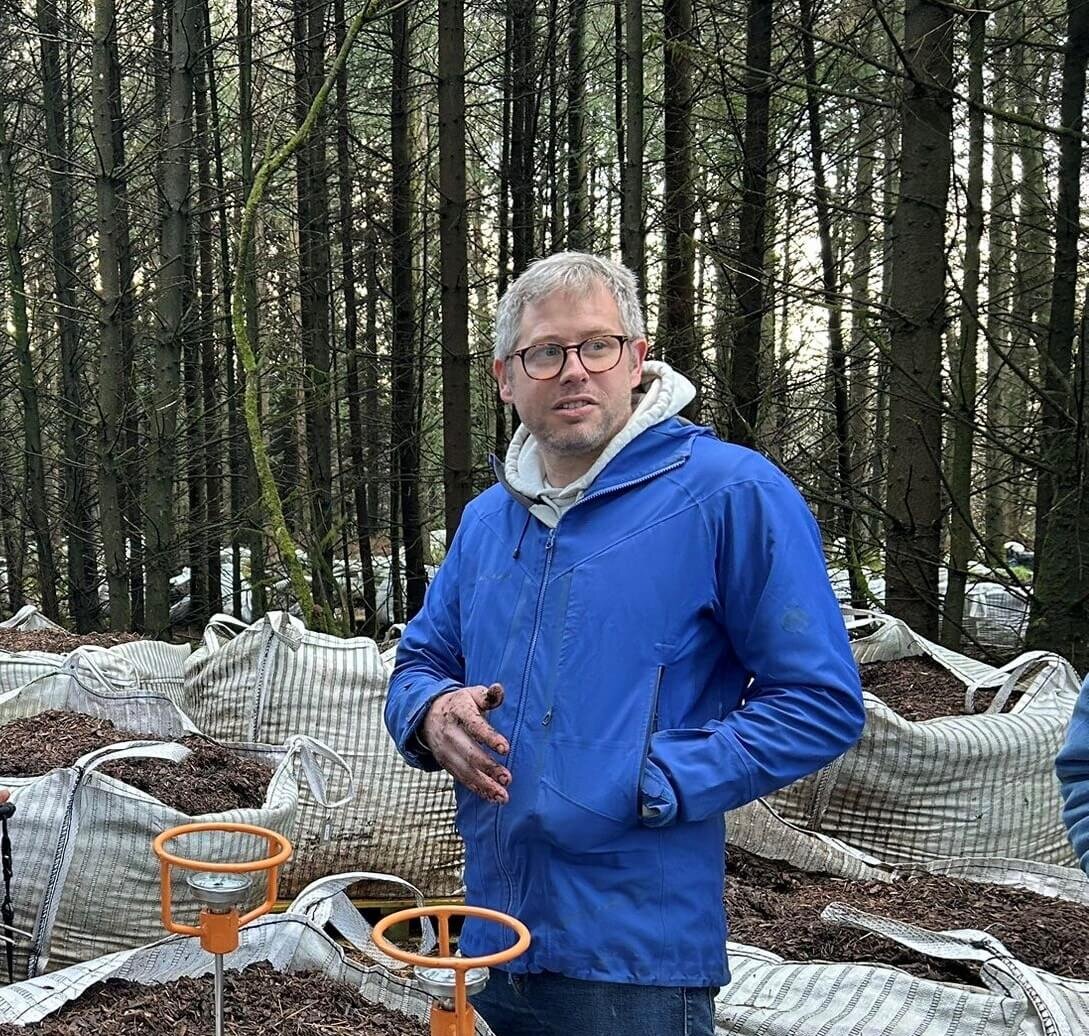
The idea came to Iddon when he purchased a woodland in West Wales over five years ago. The seedlings he first planted in his tree nursery nearly died when he used generic growing media and water. A forester pointed out that it was the local microbial population from the surrounding hills that was essential to growth – this was the lightbulb moment for Daniel.
“This is when I knew I had to do something. Over the years we’ve tried to work out how to bring the power of nature back to soils at commodity scale using natural, organic nutrition. The challenge is that people don’t even know they need fungi; many landowners don’t even acknowledge that their soils are dead and don’t contain enough fungi,” explains Iddon.
He continues: “I was a stress engineer working in Formula 1. It involved looking at steering, the exhaust pipes and cooling systems. When you’re working on the complexity of a racing car this involves ‘systems thinking.’ The same is true with soil health. I also got diagnosed with autism in my forties. This means I think in big handfuls when trying to solve challenges. I question things differently – this is what I’ve done with fungi and soils.”
Iddon doesn’t have a background in biology either, although his father is a second-generation horticulturalist. The single problem he wanted to solve in his woodland is how he could start growing seedlings straight away once planted, with no attrition. He has looked to the power of fungi ever since.
An innovation that’s a breath of fresh air
Re-Genus’s peat-free organic pellets are also made in the UK, using residues from the food, beverage and forestry industries. This is a low-carbon product, reliant on the local circular economy, which is in stark contrast to say fossil fuel-based fertilisers being imported from the Middle East.
In an age of high-tech farming solutions, precision breeding, vertical farming and robotics, this innovation feels like a breath of fresh air.
The start-up hopes to move us towards a more sustainable era of food and farming using cutting-edge science, a better understanding of organic systems and how we can compliment these. This is not an exploitative hack designed for the benefit of a handful of multinational corporations. We need more people working on these crucial ‘systems’ in this way.
Iddon and his team are now tailoring fungi pellets to different crops, since they need different fungi and organic profiles that release nutrients at different rates. They’ve also had enquiries from people around the world growing different crops from cacti in South Africa to cacao growers in Africa, agarwood harvesters in Malaysia, to golf course owners in Europe.
Daniel isn’t the only one who thinks this is the future. George Eustice, former MP and the Secretary of State for Environment, Food and Rural Affairs back in 2022 is now a special advisor for Re-Genus.
“George is similar in that he has always had a view that fungi are central to soil health. He also believes in what we are doing from a UK policy perspective,” concludes Iddon.
“The ultimate answer is that we’ve got to get rid of synthetic fertiliser. That is the single thing that I would like to achieve. If we could do that it would be a gamechanger. We can do this through mycology. Fungi are the future.”





It will be a shame in some ways to see the commoditisation of this understanding and have it placed in the hands ultimately I suppose of big corporations, but if it gets us off synthetic fertilisers that must be a good thing?
Christine Jones the eminent soil microbiologist from Australia has indicated that the most detrimental of all the pesticides are the fungicides. This because they destroy soil mycorrhizal networks that are responsible for suppling (transporting) to the plants the needed nutrients digested from the geology by bacteria at the tips of the fungal web; in exchange for carbohydrates and fatty acids from the plants photosynthesis and exuded by the roots to energize the fungal network. When highly concentrated and usually water soluble fertilizers ( particularly nitrogen) are used the soil biology becomes lazy and no longer functions effectively. It needs to be weaned off of these inputs , and not withdrawn in entirety immediately, as this can not support an addicted ecosystem. You have to earn the right to remove N inputs over a few years as the soil biology is rebuilt. Moving from nitrate sources to ammonium based sources helps to facilitate withdrawal, until the soil biology can turn the 28 tons of N2 gas above every acre into a plant available form, which is how all unfarmed plants covering the earth have been able to survive.
Also fungi are capable of remediating nearly all of the detrimental toxic assaults that humans have perpetrated on Gaia’s natural environment