
Over the years, the AGtivist has reported time and again on the often-tragic environmental impacts of industrial farming, with scandal after scandal implicating swathes of our global food machine. But news now emerging from the world’s largest rainforest, the Amazon, dwarfs much of this data, and threatens potentially catastrophic consequences.
The mighty Amazon is around 6.7 million square kilometres in size – approximately twice the size of India – and a key buffer against climate change, acting as a vital carbon sink, absorbing more carbon dioxide than it releases. But like so many other forests globally, the Amazon is under sustained assault from a barrage of threats, including agriculture. When rainforests are cleared – whether being burnt or chopped down – to make way for beef ranches or crop plantations or other developments, carbon sinks are effectively obliterated, and the farming that often replaces trees can result in even greater carbon emissions.
Disturbingly, the future of a landmark agreement designed to protect the Amazon forest from deforestation is currently hanging in the balance after a number of major commodity traders abandoned the Amazon soy moratorium.
The moratorium, which was until recently supported by all significant grain agribusinesses, was created as a voluntary agreement between soya traders, industry groups, and environmental campaigners to ban the purchase or finance of soyabeans grown on Amazon land deforested after 2008.
The initiative was set up following an international outcry over forest destruction linked to global chicken meat supply chains, with poultry found to be fed soya traced back to the forest. The agreement is widely credited with dramatically reducing forest loss linked to soya cultivation.
But earlier this year an influential trade group, the Brazilian Association of Vegetable Oil Industries (ABIOVE), which represents many of the largest companies involved in Brazil’s soya industry, announced plans to withdraw from the moratorium, at least partly in response to new laws in the state of Mato Grosso – a major agribusiness powerhouse – that strip tax benefits from companies participating in voluntary environmental pacts.
Some estimates have suggested that deforestation could increase by up to 30% over the next two decades if the agreement collapses and soya producers adopt weaker environmental standards, as is widely feared.
The ABIOVE withdrawal from the moratorium, along with its key members which include the commodity traders Cargill, Archer Daniels Midlands, Bunge, Louis Dreyfus, and Cofco, prompted worldwide alarm amongst both environmental campaigners and many food businesses.
In the UK, we import some 3 million tonnes of soya annually, mainly from Brazil, Argentina and Paraguay, with the vast majority of the protein-rich commodity being used to feed livestock, including poultry, pigs and cattle. In an outspoken response to ABIOVE’s move, a coalition of more than 50 UK food businesses this month called for “urgent action and immediate dialogue” to protect the Amazon.
The UK Soy Manifesto (UKSM) said bluntly that the withdrawal had “major implications for the future” and called for all actors within the wider soya supply chain – including governments, financial institutions, farmers groups, buyers of soya and civil society – to “commit to a new constructive dialogue to ensure that the achievements of the past 19 years are not lost and Brazil’s hard-won reputation for the production and export of deforestation-free soy is maintained.” UKSM members include supermarkets Tesco, Sainsburys, Morrisons, Aldi and Lidl as well as Arla, Cranswick and Hilton Foods, amongst others.
McDonald’s urged to intervene
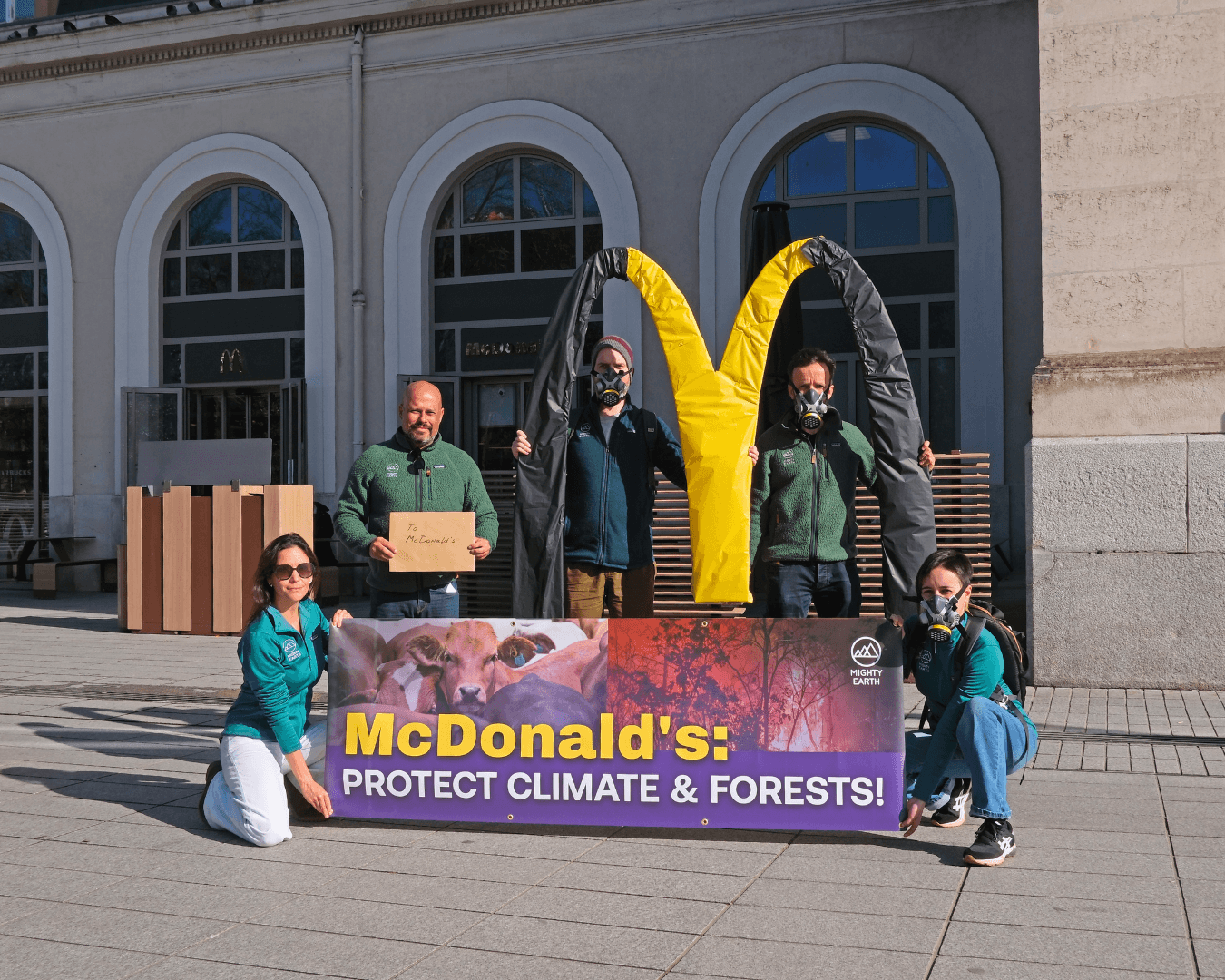
In a further attempt to spur action, campaigners from two big guns of the environmental world, Greenpeace and Mighty Earth, have also called on fast food giant McDonald’s to intervene. In a letter to the company’s CEO Chris Kempczinski, the groups urged McDonald’s to use its vast market influence to secure a “renewed pledge” from major soya traders to “remain committed to the criteria of the soya moratorium”. The campaigners also demanded that the restaurant chain makes it “unequivocally clear” that the company will cut ties with “suppliers that withdraw from or fail to uphold zero deforestation commitments.”
According to Greenpeace, McDonald’s played a pivotal role in establishing the soya moratorium 20 years ago after an investigation exposed how soya grown on deforested land was entering the company’s poultry supply chain. In response to the scandal, McDonald’s and a coalition of retailers demanded that grain traders halt the expansion of soya growing into newly deforested areas. (Greenpeace says that since being implemented, the moratorium has helped reduce the share of soya grown on newly deforested land in the Amazon from 30% to less than 4% in 2025.)
The letter also warns that major traders walking away from the moratorium will make it “functionally impossible” for McDonald’s to guarantee its soya supply chains are not linked to new deforestation of the Amazon.
Lis Cunha, from Greenpeace International, said: “The world’s largest soya traders pulling out of the moratorium is not merely a policy shift; it is a retreat from a mechanism that has been a primary bulwark against ecological collapse. As one of the world’s most recognisable brands and a founding member of the pact, McDonald’s has a moral responsibility to do all it can to prevent its partners from turning their backs on zero deforestation.”
Boris Patentreger, from Mighty Earth, added: “McDonalds can be a saboteur or a saviour of the moratorium zero deforestation goal. The fast-food giant must choose to fight for a mechanism that has spared huge swathes of the Amazon rainforest from being destroyed over the last twenty years. That means holding the big soya traders to their commitments and cutting ties with suppliers abandoning the moratorium. Or sourcing only from those who comply with the moratorium criteria […] without rolling back. There cannot be a soya free-for-all that will push the Amazon ever closer to collapse.”
McDonald’s, for its part, says it is committed to “eliminating deforestation” from its global supply chains, “prioritising the commodities and geographies where we can have the biggest impact.” According to the company, it has made significant progress, “supporting deforestation-free supply chains for several of our primary ingredients and materials – beef, chicken (soy in feed), palm oil, coffee and the fibre used in guest packaging.”
The firm has said previously that it recognises there is “more work to do”, particularly on soya, but noted that McDonald’s UK and Ireland were founding signatories of the UKSM, and were committed to sourcing soya used as an ingredient and in the animal feed across its supply chains from deforestation-free supply chains.
Whilst the spectre of meat and dairy products being tainted by Amazon destruction hangs over consumer’s dinner plates once more – something that should concern us all – it’s worth remembering, as Wicked Leeks has reported before, that many grain supply chains serving the UK’s demand for animal feed are already implicated in deforestation affecting other tropical forests.
For example, numerous investigations have previously found major UK supermarkets and fast food outlets selling products from livestock fed on soya that had been linked to deforestation in Brazil’s Cerrado region. Though the area is perhaps less well-known, the Cerrado is a vast natural biome in its own right, covering some 2 million sq km of land, and an important habitat for wildlife – some estimates suggest it is home to up to 5% of the world’s plant and animal species – and, similarly to the Amazon, a critical region for helping offset climate change.
Soya grown in the Cerrado has been linked to allegations of land-grabbing, violence as well as forest destruction, and tracked, via often-complex international trading chains, all the way to UK poultry and dairy farms, amongst other destinations.
Ensuring that the Amazon Soya Moratorium and similar initiatives remain in place is essential for helping preserve the world’s largest rainforest. It also sends a powerful signal that such global environmental protections are non-negotiable. Asking McDonald’s to use its significant power to influence the actions of soya traders is also smart. But equally important is surely to ask a wider, fundamental question: whether we want to continue relying on a food system that is largely dependent on livestock being fattened up with grains imported from halfway around the world?
Featured image: Mighty Earth issuing an open letter to McDonald’s CEO Chris Kempczinski
What can I do?
The following organisations are campaigning to protect the Amazon and urging McDonalds to defend the Amazon Soy Moratorium. Greenpeace has also shared a petition (link below).




0 Comments