
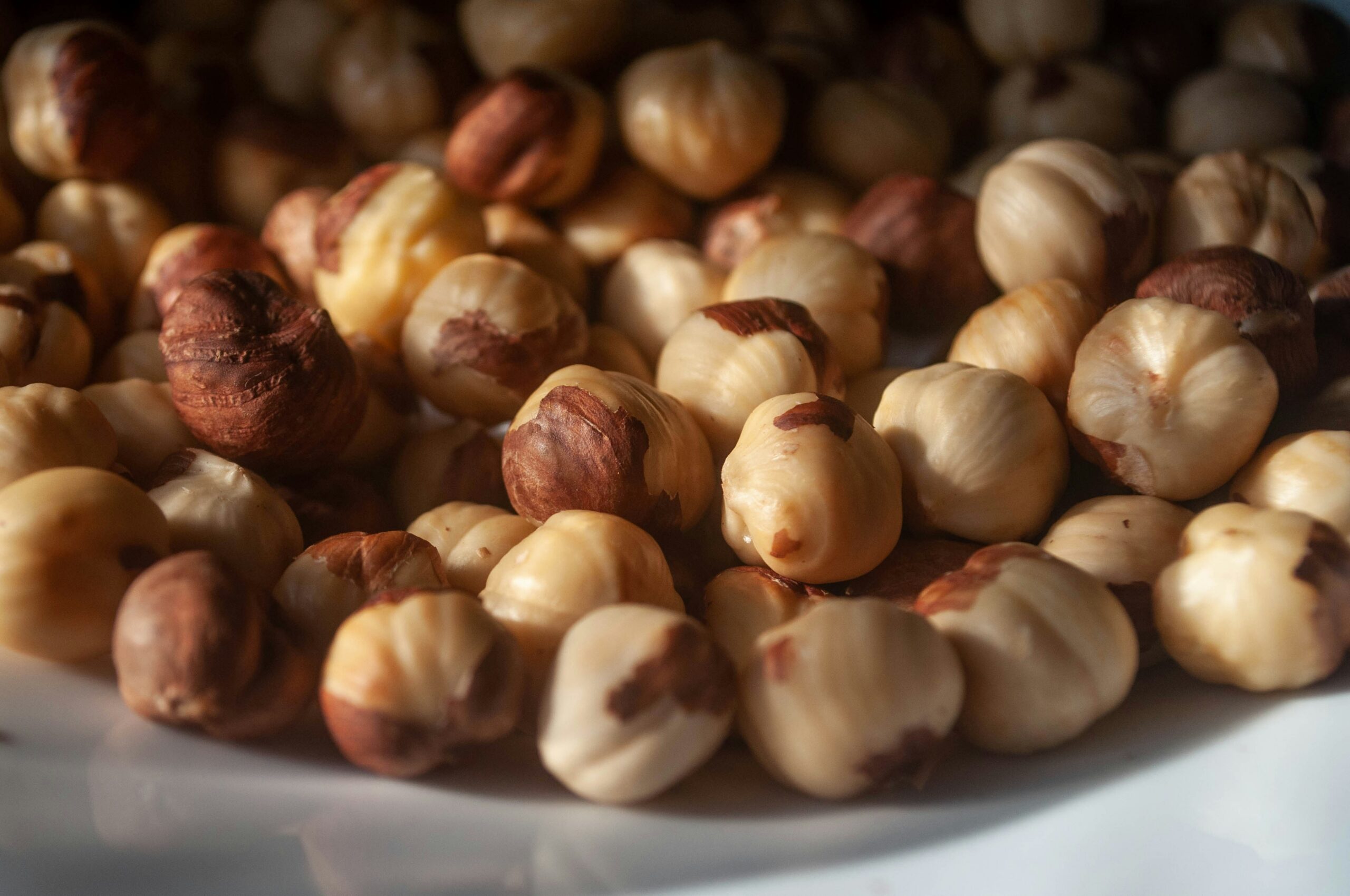
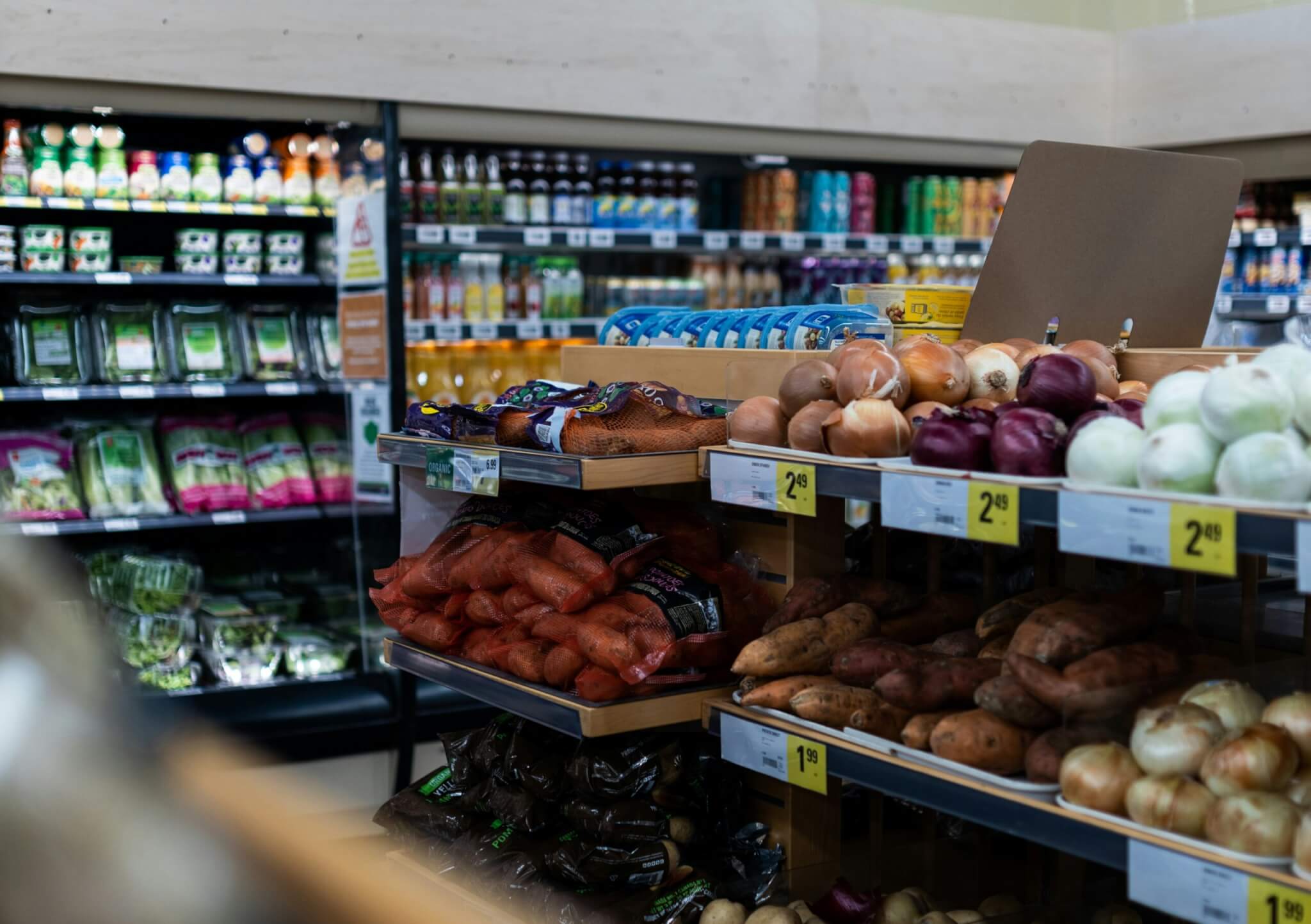
The UK crisps, snacks, and nuts market is worth a staggering £5.3 billion but almost every nut on the supermarket shelves across Britain is imported; a large proportion come from Turkey, the rest from Italy, Spain, and the U.S.
The UK once had a thriving and viable domestic market, mainly for hazelnuts and cobnuts (the latter is a type of cultivated British hazelnut). But many trees were grubbed out in the 1970s, catalysed by our accession to the European Economic Community, which promoted large scale, annual cereal cropping. With today’s falling grain prices, there’s renewed interest in these perennial proteins, which also include walnuts and sweet chestnuts.
“There is definitely growing interest from farmers. Attitudes are changing. The fact that dried nuts are nutritious, valuable and non-perishable are all helping people see the potential. Let’s not forget native hazelnuts are one of Britain’s oldest sources of plant-based protein,” explains Elsa Kent, who along with her brother and father run Glastonbury Nut Farm, one of the UK’s largest hazelnut orchards.
“I think there’s a real appetite for nuts. Lots of people love them even more so than beans in my view, so I’m excited about their potential. If we look at all the work done to boost pulses with the Bang in Some Beans campaign from the Food Foundation and Veg Power, and what the Bold Bean Co are doing, why can’t we do the same for British nuts?”
Agroforestry push helps nut orchards
It helps that the government is now supporting the upfront investment needed to plant nut orchards through grants aimed at new agroforestry schemes. Planted in alleys they can be integrated with livestock and arable cropping. The trees deliver a variety of benefits, including shelter, carbon capture, improved soil health, water management, as well as boosting biodiversity.
Nuts also have the potential to offer farms a good income stream. “Organic roasted hazelnuts can retail for around £30 per kilogram, and we hope that a mature tree might eventually yield up to six kilograms in a good season,” states Kent.
Suffolk farmer, Tom McVeigh, who’s recently started the British Hazelnut Association estimates gross margins of £10,000 her hectare per year for hazelnuts, which he says can be grown successfully at a commercial scale in the UK. However, they represent a long-term investment, upfront costs can be significant, hence why there’s been limited interest.
“There aren’t a massive amount of walnut or cobnut/hazelnut orchards in the UK… I would guess there’s probably around 500 or so. Yet we’re the only country in western Europe that doesn’t have a formally recognised, all-encompassing nut growers’ association,” points out Tom Tame, who runs Warwickshire Walnuts & Trees.
There is the Kentish Cobnuts Association which was founded in 1990, but this only accounts for hazelnuts and a handful of growers. So, what’s going to provide the much-needed shot in the arm for the whole British nut sector?
“We need uniformity and a consistent quality of nuts, as well as formal recognition for the UK industry. If everyone was selling good quality nuts at a good price at retail we could succeed. At present, most wholesalers and supermarkets are selling really old and poor quality nuts imported on the world market for pennies and selling them at a high price,” points out Tame.
The quantities available domestically in the UK are still small since many nut orchards are young. For instance, Tom Tame’s farm, which is one of the biggest walnut growers in the country, sells up to five tonnes a year, but the total import market for walnuts is around 1,000 tonnes, such is the demand.
Both Tame and White, among others, are certainly keen to push the provenance of this sustainable tree protein in the UK. “British-grown nuts taste completely different from many imported nuts. They are fresher, more aromatic, and much more flavoursome,” states Elsa Kent.
She continues: “A lot of imported nuts are grown in highly intensive systems, where vegetation beneath the trees is removed or sprayed off to make mechanical harvesting easier. We are trying to demonstrate another approach composed of a diverse food forest where nuts are grown alongside grasses, herbs, shrubs, livestock and wildlife.”
Several high-profile growers and farmers are now endorsing nuts within mixed farming systems – from Guy Singh-Watson and Riverford who have planted over 1,500 nut trees across four farms, to Roger Saul (founder of Mulberry and the organic spelt brand, Sharpham Park) who has planted hundreds of walnut trees in Somerset.
Challenges ahead
Another barrier is processing. Nuts sold in their shells are worth considerably less, so drying, cracking and roasting at scale is how British growers could add value, However, there is very limited infrastructure in the UK. “We’ve got no commercial scale equipment here,” expresses White, whose farm has received an Innovate UK grant to mechanise their harvesting operations. They also hope to eventually develop the processing equipment on the farm.
“We would also love to make this equipment available to other nut growers where a cooperative model would allow growers to share machinery and processing facilities. This could be an important part of making British nut production viable,” she says.
The weather is another issue. A warmer climate may create opportunities for some nut varieties. But unpredictability has its own challenges. Even though hardy nut trees, once established, are more climate resilient than annual crops with their deep roots and shade-giving branches, the unprecedented heatwaves and drought this summer are making nut growing more difficult, especially for younger trees.
“We are currently installing irrigation to help ours establish properly, while aiming to create a system that will ultimately be resilient, low-input, and able to cope with a changing climate,” expresses Elsa Kent, who is also looking to raise funding through partners and enthusiasts for the ‘Big British Nut Project.’
Anything that raises the profile of a sustainable, British grown crop that is climate resilient has got to be a good thing.

0 Comments