
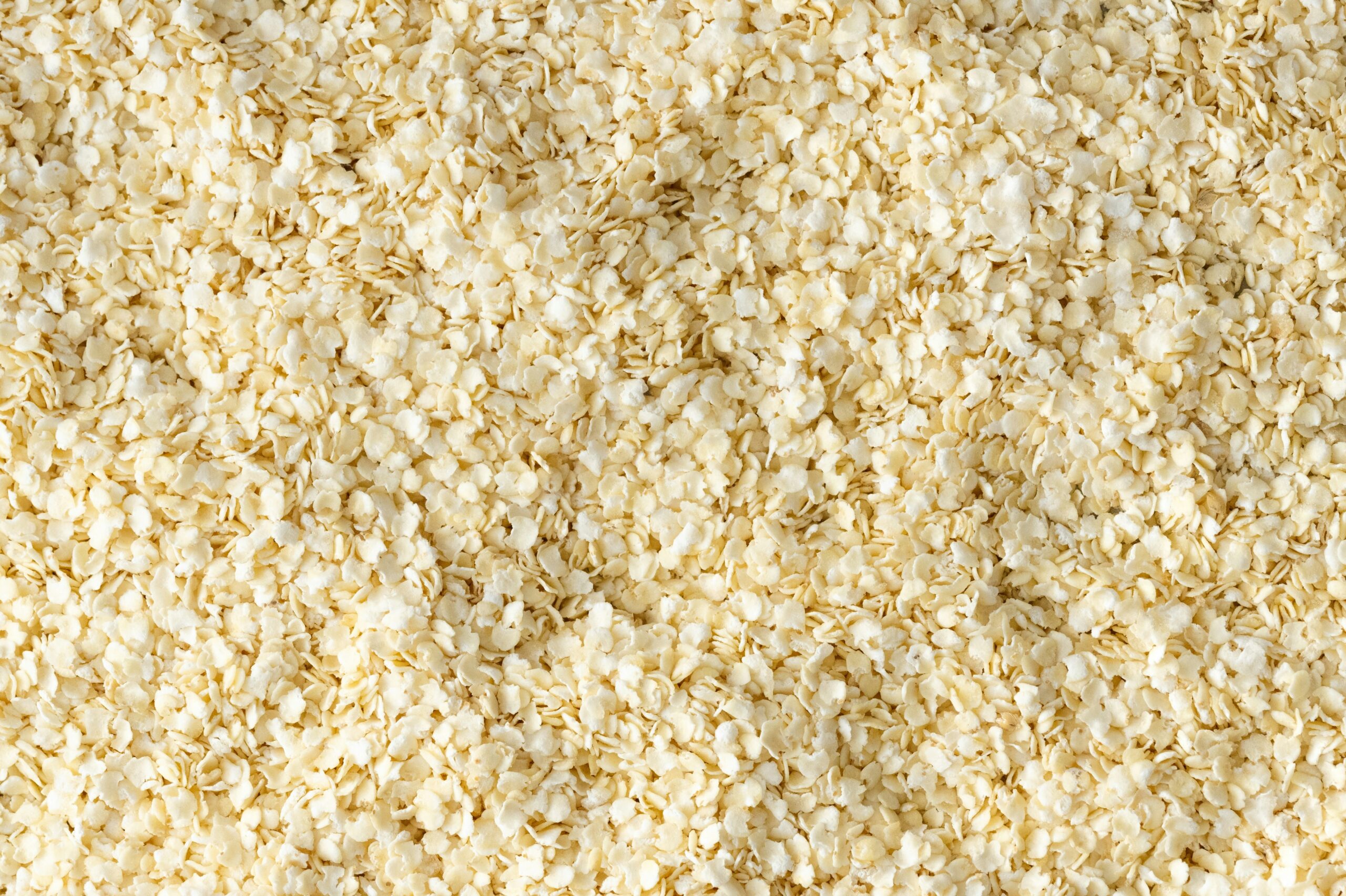
‘“Oh,” they say, “I thought it was bird food.”’ At Dev Biswal’s Canterbury restaurant The Cook’s Tale, the introduction of a certain ingredient has had diners either confused or pleasantly surprised.
Typically grown in tropical climates and poor quality soils, millet is a small-seed grass not unlike couscous in appearance by the time it reaches your plate. Biswal is slowly, tentatively bringing it onto his menus and, while his guests aren’t wrong (millet is currently almost exclusively grown in the UK as bird seed), the grain is more flavoursome, and arguably just as versatile, than the rice Biswal is hoping it’ll eventually replace.
“I come from Odisha in the eastern part of India,” he says, referencing where millet was the grain du jour long before wheat or rice. “There, rice fields are being switched for millet fields because of the health benefits people are seeing.” Millet being much lower on the glycemic index than rice and harbouring higher levels of protein and fibre is one thing, but interventions from the Government of India (such as rebranding millet as a ‘wealth grain’) might say more about why millet is taking off.
Back in Canterbury, and with help from Innovate UK and Defra, Biswal and local regenerative farmer, Emma Loder-Symonds, are part of the two-year ‘Millit Project’, which is trialing millet as a sustainable carbohydrate to rival rice – the high-emission and notoriously thirsty (5,000 litres of water per one kilo of rice) crop that it is. “We’ve always grown millet here,” says Loder-Symonds, who co-owns Nonington Farms. “but we’ve never harvested it before.” That’s because millet’s principally employed in a farmer’s rotation as a nature-friendly break crop, allowing the land to recover nutrients and suppress weeds before another crop (usually wheat) is due for sowing. “That’s actually where some farmers I’ve spoken to are excited about millet, because break crops generally tend to lose money,” Emma says. “And you haven’t got much other choice, beyond rape – which is a pain to grow.”
Where rapeseed – the most common break crop in the UK – tends to be fed back into the system as animal fodder, millet has a lot more potential. “If we can create a demand for it from the gluten-free and culinary side of things,” Loder-Symonds says, “then hopefully the price will go higher than the cost of production. It should be a win-win.”
So far, Biswal’s experimented with millet flour in things like cookies (“they were really, really nice”), with a view to substitute for rice across all dishes in which it’s traditionally used, including biryani, pilaf, and dosa. Anecdotally – having never cooked or eaten millet before – I bought a packet of Ukrainian-grown millet from my local organic shop, and noticed how quick and easy it was to cook and fluff up, yielding a creamy and slightly nutty flavour.
Of the varieties sown at Emma’s farm this May, ‘Mammoth’ is the most likely to acquiesce to the UK climate before it’s harvested in September. Part of the project’s aim, however, is proving it’s possible to get respectable yields of the crop without the use of glyphosate. In lieu of herbicides, the farm will carry out the pre-industrial technique of swathing, where the plant is cut and left to dry – trapping weeds from maturing in the process – before harvesting with a combine.
The real question here is whether millet has the best chance of being the UK’s equivalent to rice, or whether other already established culinary crops in the UK could do a better job?
There is also, for example, quinoa: traditionally a South American crop, whose varieties have been adapted to the UK climate by the likes of The British Quinoa Company. Quinoa is a good source of fibre and protein, however it can be unreliable to cultivate, and unlikely to feature alongside a curry or in a stir fry.
Then there’s couscous – like millet, another relatively versatile, small, round grain. Derived from durum wheat, it doesn’t tick the ‘gluten-free’ box, and is a relatively needy high-value crop rather than a byproduct of a farm rotation. Even so, “We get occasional enquiries about UK-grown durum,” says Matthews Cotswold Flour Managing Director, Bertie Matthews. “The key drivers there are provenance, supply chain resilience, and a desire to support British agriculture.”
Since durum wheat favours a Mediterranean climate, couscous originating from UK fields is rare but not out of the question. “Recent UK seasons have shown that those conditions can occur here,” says Matthews. But with extreme or capricious weather patterns brought on by a changing climate, Matthews isn’t exactly in high hopes. “The future of UK durum will depend as much on plant breeding and agronomic innovation as it will on climate,” he says. “Grain quality can deteriorate quickly if weather conditions become unfavourable.”
Other grains that might throw their hat into the ring include spelt or barley – referred to as farro or pearled barley respectively when processed into their culinary form. Both are grown widely in the UK and, as wholegrains, are nutrient rich, kinder on blood sugar levels and easier to digest. In theory, anyway – as Adam Simon at Tamarisk Farm says, the custom of polishing pearl barley before it’s packaged and sold yields little more than “small white blobs of starch with less food value, minimal fibre, and almost no protein.” Instead, Simon processes his grain into pot barley, wherein only the minimum irritating and inedible outer husk is removed. Where grains like this are usually a reliable choice for risottos, salads, and stews, “Some people certainly do choose it because it is a rice alternative,” says Simon.
It was the Green Revolution in the 1960s that played the largest part in defining the carbohydrates that we – wherever we are in the world – eat today. Farmers such as those in India were encouraged to grow higher-yielding but chemically-dependent and nutritionally-poor crops, which helped steer the global population away from famine, but instigated an environmental and dietary crisis in the process.
Now, more than half of all the calories we eat derive from either rice, maize, or wheat – not ideal when considering nutrient density and perhaps one of the reasons why large parts of the world are overfed but undernourished.
Meanwhile, local grain alternatives are proving they have something to contribute not just in terms of self-sufficiency, but in what they can do for climate and health, too. Some, though, have more to offer than others… but will growers and diners respond?


Have previously bought red millet from Hodmedod:
https://hodmedods.co.uk/products/red-millet-flour-wholemeal?srsltid=AfmBOoratwyvbniWrva97N3331HV6ztTmaU9bGoVTY6I4lMNYXfcef1d
Why did you not mention rye: We grow it here in Romania. It is grown completely organically and without any added fertilizer. We have had a crop every year through very wet years and this year, which has been so dry all the rivers have stopped flowing. Rye has no husk which is a massive advantage and as well as making delicious healthy bread from the flour we also just boil up the grains and have them as a breakfast cereal. We have often employed them as a substitute for rice.
I have replaced rice with barley, whole and kibbled from Hodmedods for a couple of years. Lovely nutty taste. I live on the Essex coast. The farmer at the back of our property has grown quinoa for the last two years. It did well last year and this year looks good again. Still standing with big plump seed heads and apart from watering soon after going in has survived well in the extreme heat.
I didn’t understand the point on glyphosate, is there high residue left on millet or no? Can you please clarify, thank you.