
Mustapha Bockarie is one of the estimated 30,000 people that lost a limb during Sierra Leone’s brutal decade-long civil war.
His arm was amputated after being struck by a stray bullet and a “heartbroken” Bockarie said he found himself stigmatised and ostracised by those in his village. “My friends said I was a burden to them.”
Now though, having been one of the first to enrol at Farming on Crutches, a charitable agricultural training program for amputees, his life has been transformed.
From his own community farm, Bockarie now raises goats, keeps bees, and grows enough sustainable produce to eat and sell. He even teaches others in his community how to do the same.
He’s one of more than 100 of Sierra Leone’s amputees to have benefited from the program, set up in 2018 at a three-acre parcel of land just outside the country’s capital of Freetown by founder Mambud Samai.
“We’re turning amputees into changemakers in their various localities,” Samai tells Wicked Leeks. “People are now coming to them to gain knowledge, people who had believed that those with disabilities weren’t important.”
From football to farming
Samai’s mission to provide community, training and support for the West African country’s vast number of amputees, began after his own traumatic experiences during the conflict, with the pastor forced to flee, leaving friends, family and his job to take refuge in neighbouring Guinea. “I spent two years in a refugee camp there and decided that when it was safe to return home, I needed to do something to help the victims.”
Samai’s first thought was football. The sport is a shared passion point for many in Sierra Leone, often credited as a unifying force across its different regions, tribes and political affiliations, and in setting up the Single Leg Amputee Sports Association (SLASA) in 2001 Samai sought to forge a new sense of community among amputees, setting up local matches played on crutches.
“I’d heard about the game of amputee football becoming more popular, especially in the US, and could immediately imagine how impactful it could be in Sierra Leone,” he says. “Football is an amazing way of providing rehabilitation, education, and community-building to support amputees in rebuilding their lives with dignity and purpose.” As proof, the SLASA-run football leagues now run in five of Sierra Leone’s provinces.
But Samai believed there was more he could do.
Empowering amputees through agriculture
Agriculture is the backbone of Sierra Leone’s economy. It provides income for an estimated 65% of the total labour force, with the overwhelming majority operating as smallholders on plots of land little bigger than two hectares. Crucially though, this hefty reliance also leaves the country disproportionately exposed to the mounting impact of climate change. It’s consistently ranked among the 10% of countries most vulnerable to the impacts of climate change.
Against that backdrop, Samai identified how, by training amputees in more sustainable and regenerative farming techniques, they could return to their homes equipped with the practical means to regain their independence and make a steady income, while also educating the wider community on the economic and environmental benefits of switching away from synthetic fertilisers and toward sustainable alternatives.
Having had no prior background in farming himself, Samai spent nine months at the Asian Rural Institute in Japan, completing a course in community development and organic farming practices. He took what he’d learned and returned home to Sierra Leone to set up Farming on Crutches.
“I returned to Sierra Leone confident that I could share what I had learned in sustainable farming with the amputee community – helping them to go beyond social reintegration through football and empowering them to be true change-makers in their communities.”
His proposition convinced the likes of John Meadley, the co-founder of UK non-profit Pasture for Life, who has spent several years working within Sierra Leone’s rural economy and met Samai serendipitously while SLASA members were playing football on the beach. Meadley worked with Samai to mobilise funds, helping to secure £25,000 from the Lush Foundation to set up the farm on the three-acre site originally donated by former UN Secretary General Ban Ki Moon some years before, but which had lain idle due to a lack of funds.
There, Samai developed Farming on Crutches’ week-long intensive programme, during which trainees get hands-on experience in skills like seed saving, water efficient irrigation, crop rotation, and even Bokashi, a Japanese composting technique. More recently, it added training courses in beekeeping too, working with charities Rory’s Well and Bees Abroad to show the group how to manage bees and cultivate both honey and beeswax, using the latter to make creams and even insect repellent. Recently, the charity secured funding to introduce multi-layered farming to the site too, a method that helps protect both the soil and roots from Sierra Leone’s heavy rainfall and protracted dry season.
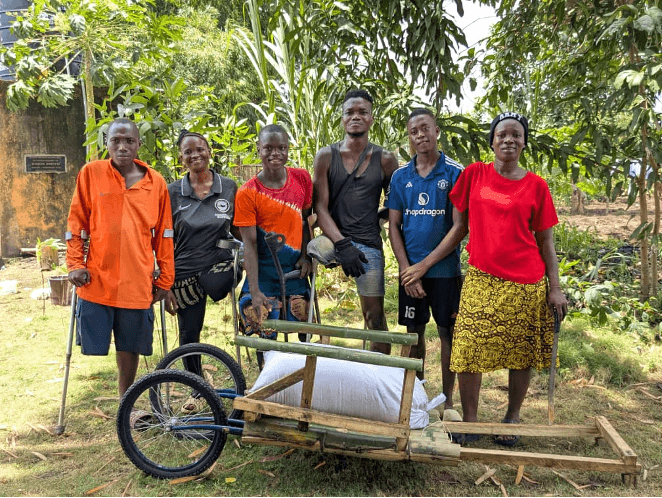
The program adapts everything to the physical challenges that amputees face, and continues to innovate. For example, during one of last year’s courses, a group of amputees set about designing an adaptive wheelbarrow made from local materials. They used bamboo grown on the farm, timber and two bicycle wheels to design a device that can be used by everyone on the farm. “The bamboo wheelbarrow is very important for us who are physically challenged,” says trainee Zainab Makieu. “Because I wouldn’t say we are disabled: we all know disability is not inability.”
At the end of the course, each trainee leaves with seeds, tools, and a small amount of cash to invest in their own farm once they return home and many, like Bockarie go on to both bring in their own steady income and coach others on the benefits of sustainable agriculture.
‘I chose agriculture’
Currently, people travel from across the country to take part in the program, says Samai, but the ambition is to establish demonstration farms throughout Sierra Leone in the coming years. “Indeed, I dream of eventually expanding this nature-friendly approach to farming, free from chemicals and as far a possible free from debt, beyond our country and into wider West Africa.”
To achieve that will require further funding and support. To grow the scale of the project will require, for example, more on-site accommodation. Samai also wants to get the word out and highlight to more people the value that Farming on Crutches is delivering for both trainees, but also wider smallholder networks in Sierra Leone. “We need more opportunities, we need more partners to come on board and help us with promotions, but also donors.”
For people like Bockarie, the program delivers invaluable change. “I’m no longer a beggar – now I’m a worker,” he says. “I’m really proud of myself. After the training I went back to my village. I wasn’t lazy and didn’t look at my condition of being an amputee. I chose agriculture instead.”
Photograph c/o Farming on Crutches, which shows the adapted wheelbarrow created by the FoC team.
You can support Farming on Crutches here. You can help with seeds (£20) or fund one day of the training course (£55), sponsor an amputee through the training course (£400). More details of these funding opportunities can be found here.

0 Comments