
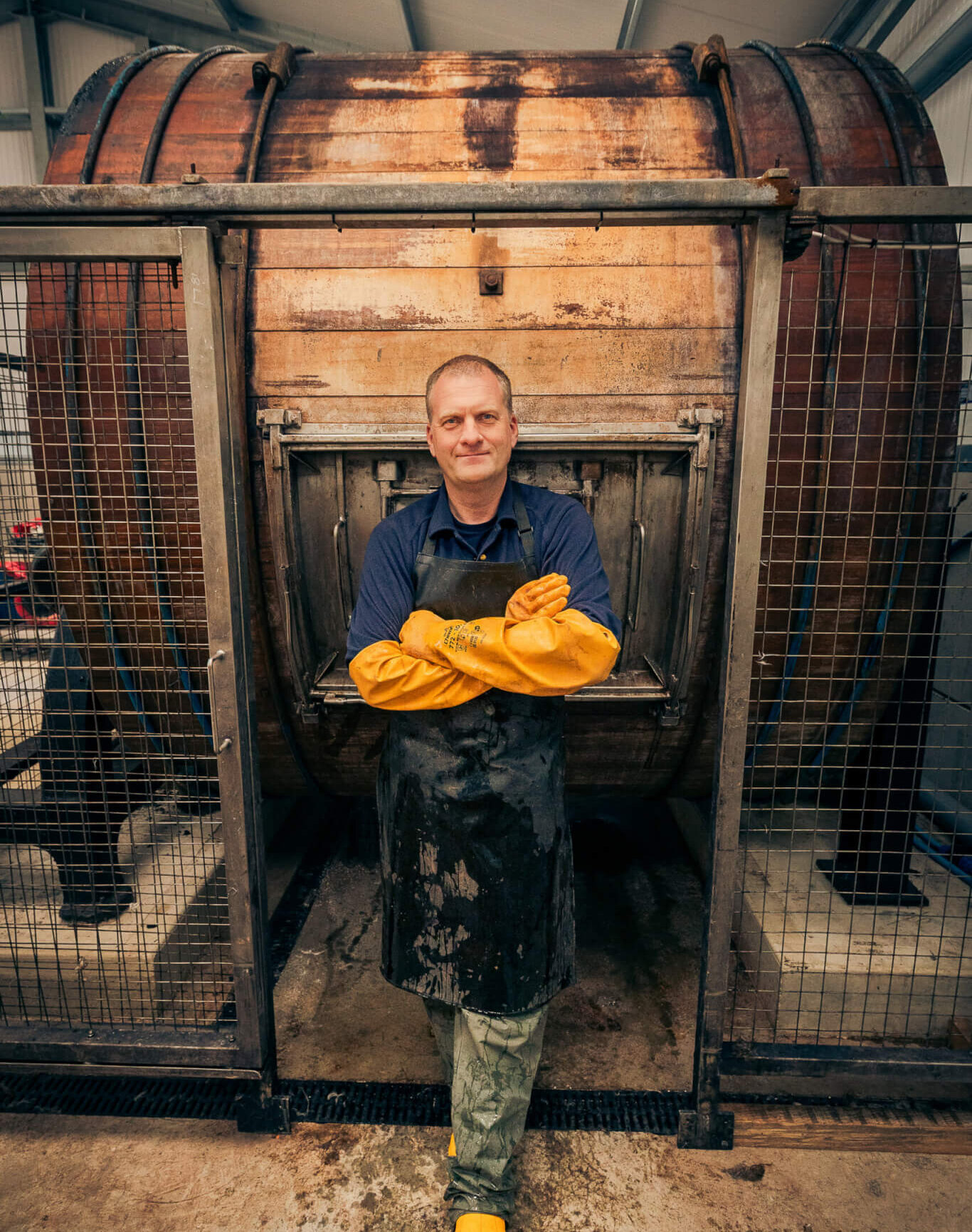
It’s difficult to imagine now, but Great Britain was once a global leader in leather. Making shoes and belts, bags and saddles, every town had a tannery, while a thriving industry existed across the country. Today this profession has all but disappeared; most businesses have closed and oak bark tanning is classified as critically endangered on the Heritage Crafts Red List.
Traditionally, tanning was always done using tannins extracted from bark and other plant material. It was only in the industrial era that businesses adopted chrome tanning to speed up the process and produce leather with more flexible properties.
This traditional craft is now being revived at Great Cotmarsh, an organic farm in Wiltshire near Swindon, where James Allen has built a micro-tannery.
“In the last few years we’ve seen at least four or so tanneries shut down. If we don’t revive this now, vegetable tanning in the UK is going to be lost. It helps that there is a growing movement now around local and artisan production. People want to know where their food and fibre comes from and this is what we’re focused on,” the farmer explains.
Allen aims to develop the commercial viability of small-scale vegetable tanning, with the goal of addressing the appalling levels of cattle hide waste. This is a by-product of the British meat and livestock industry. There are also significant carbon emissions associated with carcass disposal.
“If leather isn’t being used for clothing, footwear, belts and furniture then other fossil-fuel based fibres are likely to be deployed – doubling down on the negative environmental effects,” states Allen.
Every year, over two million cattle are slaughtered for food in the UK, yet only half of the hides are currently used for leather. The rest end up in landfill or are incinerated, which does further environmental damage. Abattoirs used to receive £45 per hide, now they pay for disposal. A revival in local, British tanning would ensure that this resource is turned into a valuable product promoting the circular economy.
A dying industry
It doesn’t help that there are now only two commercial operators in vegetable tanning in the country including J. & F.J. Baker in Colyton, East Devon and Thomas Ware & Sons in Bristol. The University of Northamptonshire closed its famous tannery and leather institute last year. Pittards in Yeovil, another well-known leather firm, recently shut up shop.
“The bigger tanneries struggled with costs. There’s also been a race to the bottom on commodity leather prices. Hopefully, smaller, artisan leather production won’t be hit as much. It’s important to me and others that we try and maintain high-quality tanning in this country, beyond the few remaining firms that now exist,” he states.
Allen continues: “It’s also important to connect people with the leather they use in their daily lives. We are seeing a greater connection between farm and fork, so let’s not forget about the fibre as well!”
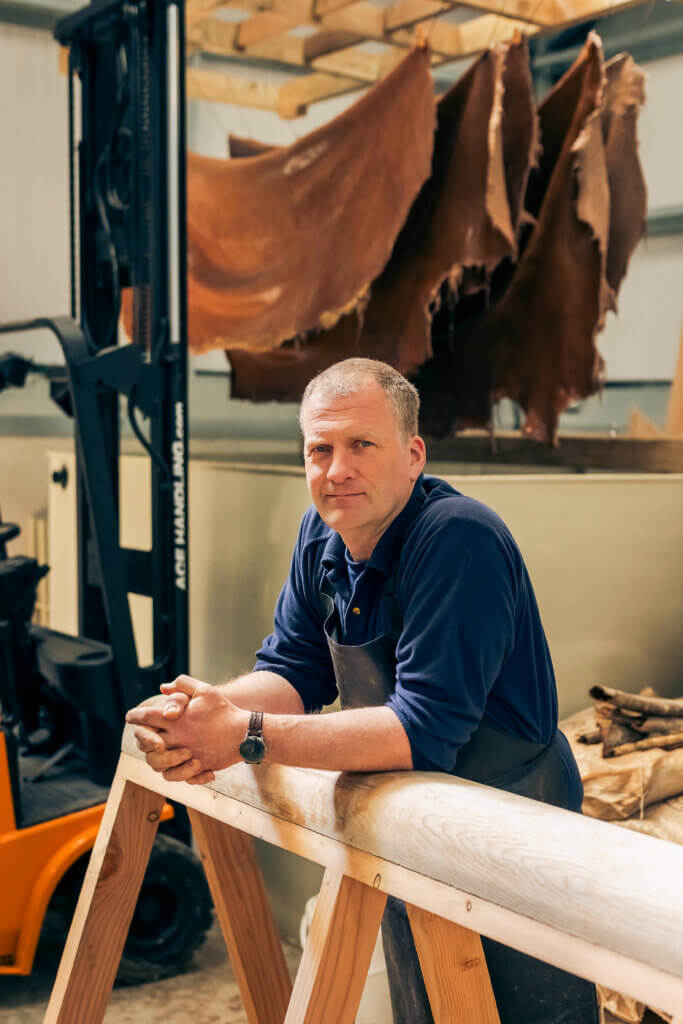
James Allen did his homework first. He interned with Matt Richards a famous tanner in Oregon. U.S. and received a Churchill Fellowship to investigate how tanneries in Switzerland, Germany and Italy operate, including time in Santa Croce sull’Arno, the global epicentre for vegetable-tanned leather in Tuscany.
He then applied for various grants to build the not-for-profit, micro-tannery at Great Cotmarsh, with a large ‘Farming in Protected Landscape’ grant from the North Wessex Downs National Landscape and many donations including those from leather sellers, farmers, organisations, and individuals keen to see this project get off the ground.
The goal is to produce high-quality leather commercially, which can be traceable down to the individual cow. “We also want to support the education of students who visit us to understand what the ‘farm to fibre’ story is all about. The aim is to try and boost the micro-tannery industry by creating a national hub for the sector, building and disseminating know-how, as well as sharing expensive equipment,” states Allen.
He continues: “Our main market is the ‘tan and return’ for farmers, that’s because many now want to do something with their livestock by-product and generate a new income stream. We’ve also had interest from craft companies and furniture makers who increasingly want to source British leather that has provenance, rather than import.”
Barriers to entry
One of the reason why tanneries are difficult to set up, is that the upfront costs are huge. For instance, a fleshing machine, which removes the connective tissue and fat from a cattle hide, making the tanning process easier and faster, can cost up to £100,000 to buy second-hand and install.
“If I can fund a fleshing machine I might use it for just half a day a month. So why don’t I share these expensive bits of kits with others who want to set up a tannery? It makes total sense. This will then lower the bar to entry for others who want to become tanners. Instead of spending hundreds of thousands, you could get started with £20,000,” states Allen.
He is now in the process of producing his first batches of leather, which will be ready for sale in the coming months. Allen already has a waiting list and a backlog of those farmers who want their cattle hides tanned, as well as makers who want to buy leather.
“I’ve also built a system for tracing everything through the tannery. You’ll be able to scan a QR code on a belt you buy, and it will show you which farm it came from, when it arrived at the tannery, the processes it went through and the time taken. So you get a real understanding of the effort and hours that have been put into the product,” he explains.
“We’ve already had interest from artisan shoe, furniture, and belt makers who all want to purchase British-made, vegetable-tanned cattle leather that’s fully traceable. What I want to do is build momentum for this type of product.”
Allen is inspired by the work of Jack Millington who founded the first new UK goat leather tannery in over half a century, a decade ago. Another inspiration is his wife, Katie who produces high-end knitwear from British wool and has had products stocked by Liberty London.
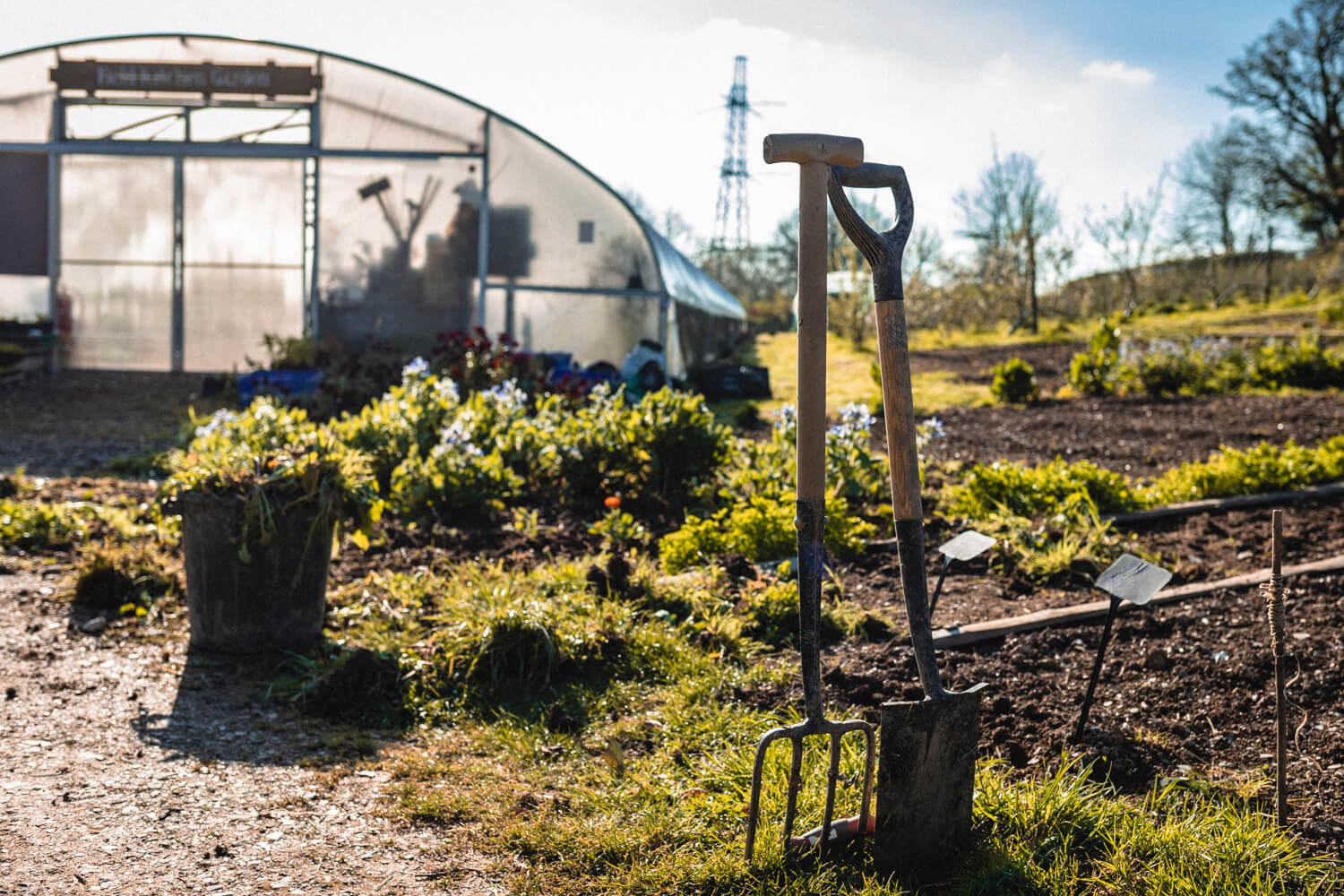
On their ‘Pasture for Life’ certified organic farm they also have a 800-plant botanical dye garden, which is used for clothing.
Great Cotmarsh Farm already has a strong focus on education through Katie’s wool work, hosting fashion and textile students who are doing GCSEs all the way up to degree level with the aim of promoting sustainable, organic wool production and fibre use. They also visit the tannery to see how leather is produced.
“What I would like to see is the 350 students who come visit us each year, including apprentices from Mulberry and Dr Martens, to be inspired when they start working. If they understand where leather comes from and the effort it takes to make it, they will then value it in the products they create,” explains Allen.
He concludes: “When they are top decision makers in leather-dependent businesses in say ten years time, my dream would be for them to be able to source British hides made from a network of small-scale vegetable tanners that we helped along the way – that would be great.”
Photography by Paul Read, with thanks The Leathersellers

0 Comments