
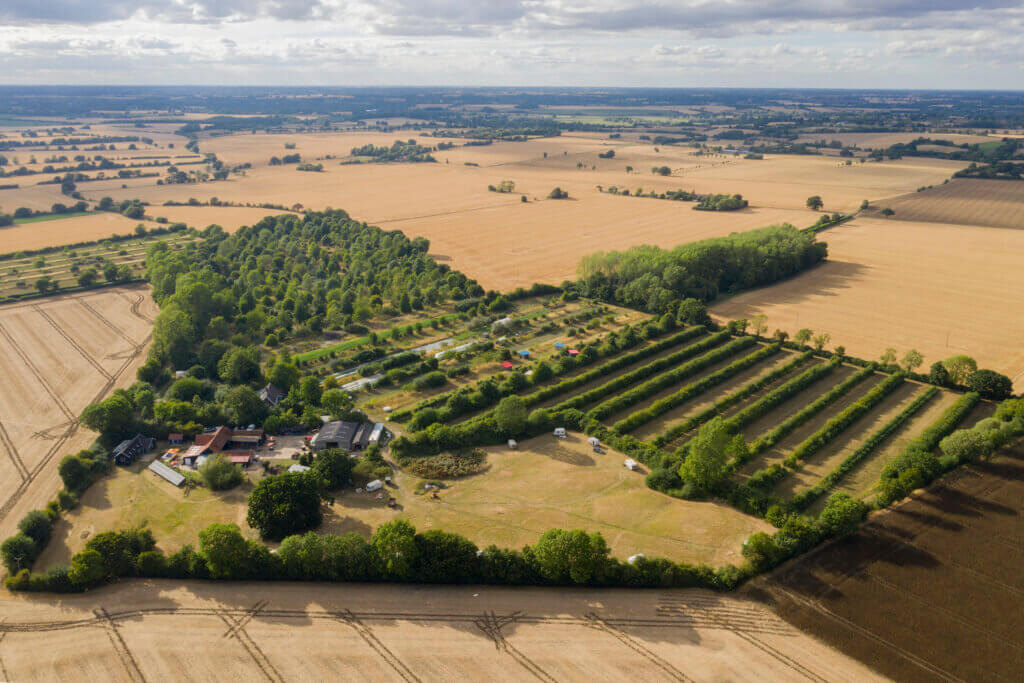
If you want to see what sustainable and resilient organic agroforestry looks like, head to Wakelyns in Suffolk where 56 acres of trees, orchards, and crops are grown in balance. At just over 30 years old, this is now one of the oldest and most diverse agroforestry systems in existence and one of Europe’s first.
This is an antidote to the industrial agriculture that blankets the east of England. Here lies an oasis of diversity, demonstrating that farming can do a lot better… even as, frustratingly, Wakelyns is now under threat. From a bird’s eye view on a hot summer’s day, Wakelyns appears like a green jewel among the toasted brown, commodity-crop filled prairies carpeting the horizon – its diverse plantings an antidote to the chemical-fuelled arable monocultures that have depleted soil, polluted water, and decimated nature for decades.
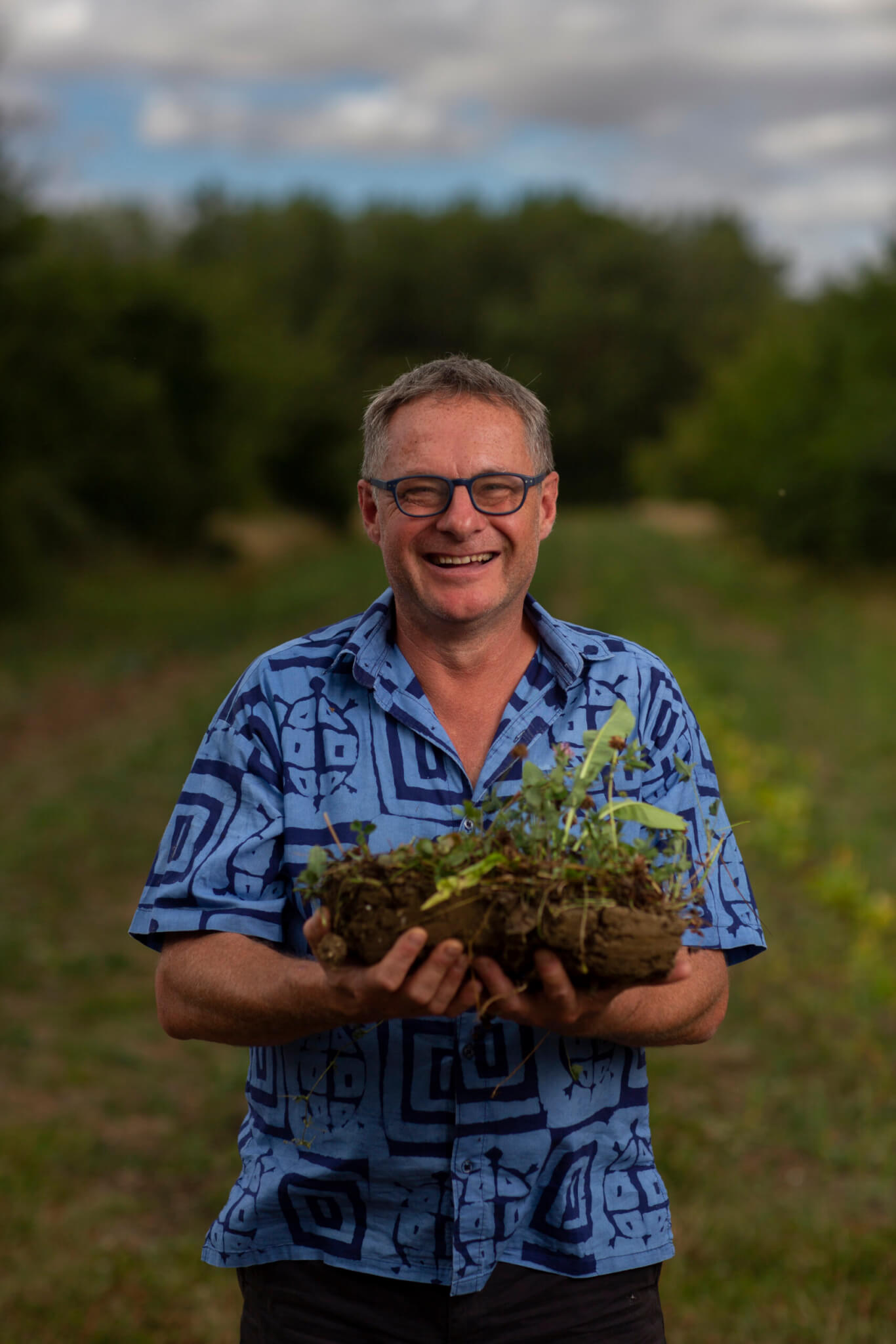
“I thought it was normal to hear turtle doves; there are three breeding pairs here. Then someone told me how rare they are. It’s then you realise how special Wakelyns is,” explains David Wolfe, an environmental lawyer, who calls himself the custodian of this unique site.
His life is woven into the very fabric of the place. This farm was like any other until David’s parents, Martin and Ann, purchased the 23 hectare plot in 1992 and decided to turn it into a test bed for new farming techniques. At the time, agroforestry – planting trees alongside crops – was experimental. Today it has been embedded into government policy – Martin Wolfe, an agricultural scientist interested in farming with low-inputs, was way ahead of his time.
“Today we have coachloads of Dutch farmers who visit us and are inspired. We had a farmer from Cork who flew over. He spent only 40 minutes looking around and it was enough to convince him to return to Ireland and invest in agroforestry. In that short space of time, he was inspired and could visualise what his farm would like in a few decades’ time,” explains David.
He adds: “Wakelyns is probably the best, if not the only example of a multi-faceted agroforestry planting of this age in Western Europe. It is the maturity and diversity of Wakelyns which is truly unique.”
A demonstration today of farming tomorrow
This smallholding in Fressingfield, is a flourishing farm first and a refuge for nature second. Its aim was to demonstrate and experiment with different styles of agroforestry.
It has one area for hazel coppicing in a seven-year rotation that provides hedge-laying stakes, good lengths of hazel, and the residue is chipped for biomass. There are 38 apple varieties, pears, plums, quinces, cherries and medlars, as well as trees for timber including ash, oak, hornbeam, sycamore, wild cherry, and alder, all planted in rows.
There are organic rotations of wheat, lentils, and hemp including rows of mixed vegetables and vines. Within this rotation are glamping pods for visitors – yes the pods themselves are in rotation, above the leys used to provide green manure.
“Resilience through diversity” is Wakelyns’ tagline. This year’s hot summer will see some varieties of fruit or field crops thrive; others won’t do as well. This is what more climate resilient cropping could look like across the UK in the years to come. The agroforestry and subsequent biodiversity on this site also encourage the natural control of plant diseases without external inputs.
Operational challenges, commercial opportunities
David and his wife Amanda Illing, took on Wakelyns after the death of his parents in 2020. Despite the commercial activity here they have found things operationally challenging, just like many smaller farmers dealing with pitiful farm-gate prices across the UK – growing grain or produce on a small scale doesn’t pay.
“We tried to sell our most delicious, organic Suffolk cherries and we still lost money. What consumers are prepared to pay is less than the cost we pay people to pick it. The same is true of apples – making our own juice with our own kit is better. This is why we’ve been trying to add value through short food supply chains and enterprise stacking or encouraging micro-enterprises on-site,” details Wolfe.
By processing food, whether its jams, apple juice or bread, Wakelyns is trying to capture more value. They have the Silva kitchen and bakery on-site, which does events and catering. They also have a hemp fibre grower and processer here, as well as an apple and fruit press, including bee hives and a honey producer. There is also a willow basket weaver at Wakelyns.
Wakelyns, in conjunction with Hodmedods, also pioneered commercial lentil growing in the UK – it even hosts an annual dal festival. The site also has a unique planting of wheat with a genetically diverse population. Over the years they’ve had a significant collaboration with the Organic Research Centre, nearby.
People first
“For us Wakelyns is very much a political project. It is centred on people. I don’t think land should be privately owned. We are therefore interested in how productive we can make these 23 hectares for a community. How many people can work at Wakelyns? How many turtle doves and how much biodiversity exists here? What about the carbon sequestered?” questions Wolfe.
He adds: “I also want to know how much wellbeing can be generated, how many people visit and how much learning we can conduct at Wakelyns – as well as the amount of science and research that takes place. We’re interested in involving lots of people doing many different things, all linked to making the land more productive.”
Wolfe paints this picture as an alternative to the industrial machinery that harvest the oilseed rape and wheat from the fields that surround this site in Suffolk. This denuded landscape in contrast supports very few livelihoods and is stripping the soil and the environment of both health and carbon.
“Our strength at Wakelyns is centred on the collaborations between people. The vegetables grown on the farm are used in the bakery, which feeds the people who come on a course where they’re learning to weave willow. We only need one stall at a farmer’s market where they share the selling of produce, honey, bread, jam and willow baskets. It’s about people working together – that’s exciting,” explains Wolfe.
He continues: “There’s a growing realisation that our food system is broken. It’s why people are much more interested in where their food comes from and places like this can help educate people and connect them with the land.”
A look to the future and funding
The issue now is that Wakelyns is part-owned by David’s brother, who wants to sell. This has spurred David and Amanda to try and raise £1.2 million, to pay his brother for his half of the farm and then invest more money in the future of this unique place.
They want to turn Wakelyns into a Charitable Community Benefit Society (CCBC), a legal structure that will operate for the benefit of the wider community.
“We want it to survive and thrive beyond us both as we become older and frailer, so we want to transfer the ownership of Wakelyns into a charitable entity. I’m happy to gift my half of this place so that in five years’ time it won’t be dependent on us and hopefully it will be a self-sustaining, community-run project,” explains Wolfe.
“We hope that the sort of creativity and energy that comes from a wider ownership model will bring in lots of additional ideas and entrepreneurs into this space. This is about the community having better access to use Wakelyns and the land more productively.”
David Wolfe cites the likes of the Baddaford Farm Collective, started by Riverford’s Guy Singh-Watson and ethical restaurateur & entrepreneur, Geetie Singh-Watson, FarmEd and Maple Farm (also in Suffolk), in a similar vein: place-based communities focused on inspiring growers and producers to do better and think more creatively, ethically, and sustainably about farming and food.
“We’ve seen a lot of interest already in saving Wakelyns for the future. We’ve raised £200,000 but there’s still a long way to go. This is a social investment for people. Buy a share and you are investing in the future. People across the world and the UK can now become stakeholders and part of the Wakelyns community.”
“We want a wide range of people, especially young ones to get involved. This will give it resilience and stability for the long run. We hope to have a couple of thousand members who will then want to visit, to learn, and get involved. We want this special place to be for everyone and that includes experiencing our turtle doves.”
If you are inspired and would like to buy charitable community shares in Wakelyns, click here.
Photographs by David Bebber.

I’m the CEO of a CBS- run agroforestry farm in Nottinghamshire called FarmEco. We are doing similar things on our 40 acres. We planted our trees around 2016-18 so are a bit younger, but they are starting to bear more fruit. We are also hoping to convert to a charitable CBS and are growing our community of people who volunteer on the farm and become members and co-owners of the organisation. We don’t own the land; we lease parts and have a licence to access the rest.