
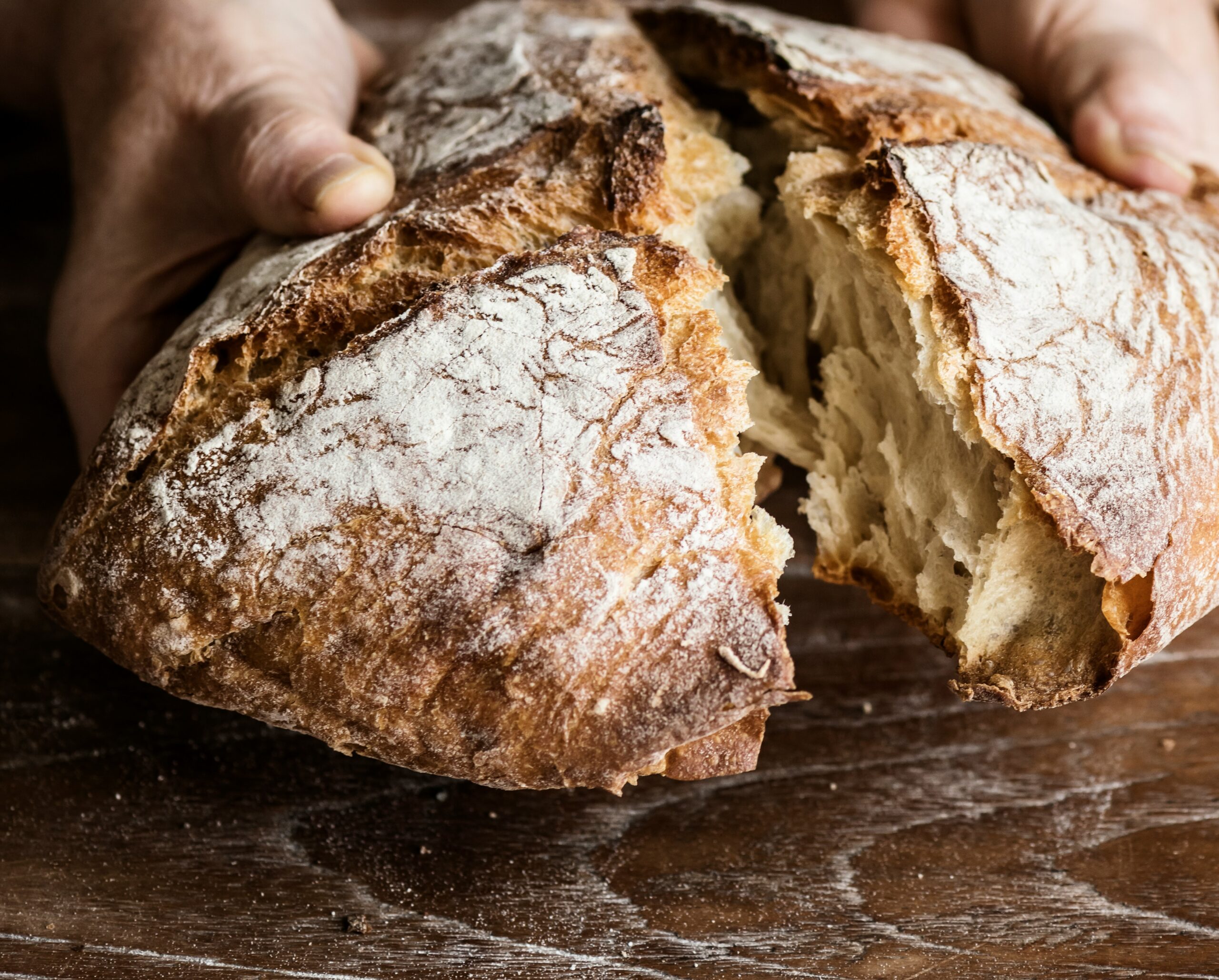
Wheat is perhaps the ultimate commodity: cheap, reliable, uniform, ubiquitous. It is grown and milled on industrial scales to particular specifications, in order to make standardised products, like the Chorleywood loaf. It represents almost a third of Britain’s energy intake. Mostly, the person using it will have no clue where it’s from. It is, quite literally, cheap white powder.
Britain grows a lot of it. In swathes of the country you will pass acres of golden wheat fields. Yet much is deemed unfit for our industrialised baking processes – only half goes for human consumption, the rest primarily for animal feed and bioethanol. According to UK Flour Millers, around 15% of the wheat used by British millers is imported, although last year the AHDB reported that imports were at a 30-year high.
But a growing number of bakers, millers and farmers are opting for another route, bypassing the commodity market and leading a revolution in British wheat. Britain has undergone a bakery boom; now bakers are teaming up with farmers to go the extra mile. “There’s been huge growth, bakeries are popping up everywhere,” says the Real Bread Campaign’s Chris Young. “Some are now tying into regional, non-commodity grain networks to make truly local loaves.”
In east London, E5 Bakehouse, with links to Fellows Farm in Suffolk, was an early advocate, milling wheat at the bakery. More recently, Landrace has opened in Bath, using heritage grains grown and milled at Westcombe Dairy, near Bruton. Landrace also has connections with Quince, a bakery in north London. Oxford’s Hamblin Bread uses grain from within a 50-mile radius, while Field Bakery is based at Gothelney Farm in Somerset, where it sources wheat. Next year a new mill will open in East Lothian, developed by Musselburgh-based Company Bakery and sourcing wheat from southeast Scotland.
Often, the wheat is ancient, heritage or “population”, a genetically diverse crop. These require fewer chemical inputs and, proponents argue, have greater depth of flavour than modern varieties and are more nutritious. Long vilified, farmers, bakers and millers are resuscitating wheat’s reputation.
Pinch opened in 2021 on Maple Farm in Suffolk. It uses organic wheat, including ancient and heritage varieties, grown on the farm. During the pandemic, founder Alice Norman returned to Suffolk from London, where she had worked in several top restaurants. Some used “nice organic flour,” she explains; many didn’t. “I always had this urge to be nearer to the produce and where it was growing,” says Norman. She eventually opened her cafe, and Pinch became renowned for ice cream (with cones made from the farm’s spelt), crullers, a deep-fried pastry, and Roman-style pizza.
The wheat comes directly from the farm, varieties including Red Lammas, Maris Wigeon, both heritage grains, and YQ and Miller’s Choice, both modern populations. While providing a consistent source of grain, it also poses challenges. Each year Norman has to work with what the harvest offers and plan for the year. In 2024 it was just 40% of the previous year’s take. “I had to think carefully about not making too much X, Y or Z, to limit how many pastries had flour in, to predict how many pizzas we were going to sell that year,” says Norman.
Not all bakeries benefit from such short distances, yet even in major cities many are building direct links with growers. In 2023, Florin Grama founded Tarn in north London, after years working as a baker and pastry chef. At the now-closed Flor, in London Bridge, he learned about the importance of using the “finest ingredients”. Flor bought flour from John Letts in Oxfordshire and eventually Bruern Farms in the Cotswolds, which was beginning to shift from conventional to heritage grains.
Tarn sources flour directly from Bruern Farms and Gilchester’s. From Bruern, which is smaller, “we’re still getting whatever he has,” says Grama, explaining that the varieties change throughout the year – evidently not the easiest way to run a bakery. A more generic wheat, even if organic, would provide consistent results. “I like making my life harder, it’s a challenge,” says Grama. “Every batch is different. If you buy conventional wheat it doesn’t have any taste. You don’t have to think about it, you get the same results day in, day out. This gives you different results. You have to touch the bread, feel it, check the fermentation throughout the process. It’s much harder to scale, to teach people.”
Though “not into labels like regenerative, organic or sustainable,” Grama prefers working with farmers “who are conscious about the environment and care about their soil.” Cutting out the middle man also gives the farmers a better deal (although isn’t necessarily cheaper for the baker).
While Britain’s new-wave bakeries are cutting imported wheat, one product requires foreign wheat: the croissant. Grama uses some in Tarn’s, as the lower protein content of British flour isn’t conducive to the flaky pastry. His experiments have led to “decent results”, if a little bready. “Eventually, someone will crack it, maybe us,” he says.
Over the past decade, a number of regional collectives have emerged, comprising farmers, millers, scientists, teachers, academics, bakers and more. Often labelled grain networks or alliances, their goal is to grow diverse wheat in environmentally friendly ways, says Catherine Howell, a member of the Yorkshire Grain Alliance and RISE, a project bringing the regional networks together.
There are, Howell explains, “about seven types of wheat that form the majority of wheat grown in this country. There’s very little diversity in those populations to cope with changing conditions.” This summer’s heatwaves and drought, which led to the earliest harvest in decades, is the type of situation these networks are preparing for.
Howell says there are thousands of types of wheat available, from ancient and heritage to those currently being developed, from around the world. The alliances are increasingly turning to these and sharing the knowledge. “More and more, certainly this year, there’s a recognition of the impact of climate change. People are asking more questions about the food they eat, where it comes from, and who has control over their systems.”
“I think there’s a distinction here between ‘regenerative’ and ‘agroecological’, adds Howell. “Neither are defined in law or assessed as part of any certification scheme, but agroecological would not favour the use of glyphosate. As a movement, we would fall into the agroecological camp, although I don’t think any of the regional networks have any policies or practices that specifically acknowledge this.
“Specifically in the Yorkshire Grain Alliance, members would not source their resources (grain, seed or flour) from a glyphosate dependent system, mainly because of the conflict between providing products for human nourishment that might contain a human carcinogen. The focus is instead on nurturing soil health via cover cropping and direct drilling methods, rather than herbicide application. To the best of my knowledge, this approach would be mirrored in any of the other grain networks.
Personally, I do not advocate for the use of glyphosate at any stage of the growing process for the above reasons and also because our grain network farmers have proved that with their approach – there is no need to do so!” states Howell.
Bakers – the link between farmers and consumers – are a crucial part of the chain. “When you start comparing this to the commodity grain market, you realise how important those relationships are,” says Howell. “They are very transparent, traceable and personable. The bakers know the millers, the millers know the farmers, the bakers know the farmers, where grain has come from and who’s milled it. Only when you step away from this kind of system do you realise that, in the commodity grain system, that doesn’t exist in any shape or form.”
For bakers, that role isn’t easy. Stoneground, non-commodity grains are very different to what most consumers are accustomed to: richer, nuttier, earthier, sometimes chewier. Norman says the plain flour she uses is similar to wholegrain wheat in texture and colour. It’s almost always pricier, too. “At the beginning of Pinch, it was common to hear ‘oh that’s expensive, how can you charge that much?’ Now we get it like once a year.”
Ultimately, wheat is being treated as an ingredient in its own right. Norman cites Wildfarmed, which pioneered a method of regenerative wheat farming and has grown exponentially since the pandemic, as “the first brand to make wheat a thing.”
About time, she reckons. At London restaurants in the 2010s, restaurants were starting to take sourcing seriously. “If I had to create a timeline, meat was first, then vegetables,” says Norman. “People are more sensitive to eating the right type of meat, because it’s a living thing. Vegetables were more relatable, something we all cook and use every day. Wheat was not something ever spoken about.”
For most customers, bakers and chefs, wheat was merely a white powder. Increasingly, due to a growing network of bakers, millers and farmers – and rising public interest – it is being heralded in its own right.
Want “real” bread? Enter your postcode to locate a local bakery that makes additive-free bread

0 Comments