

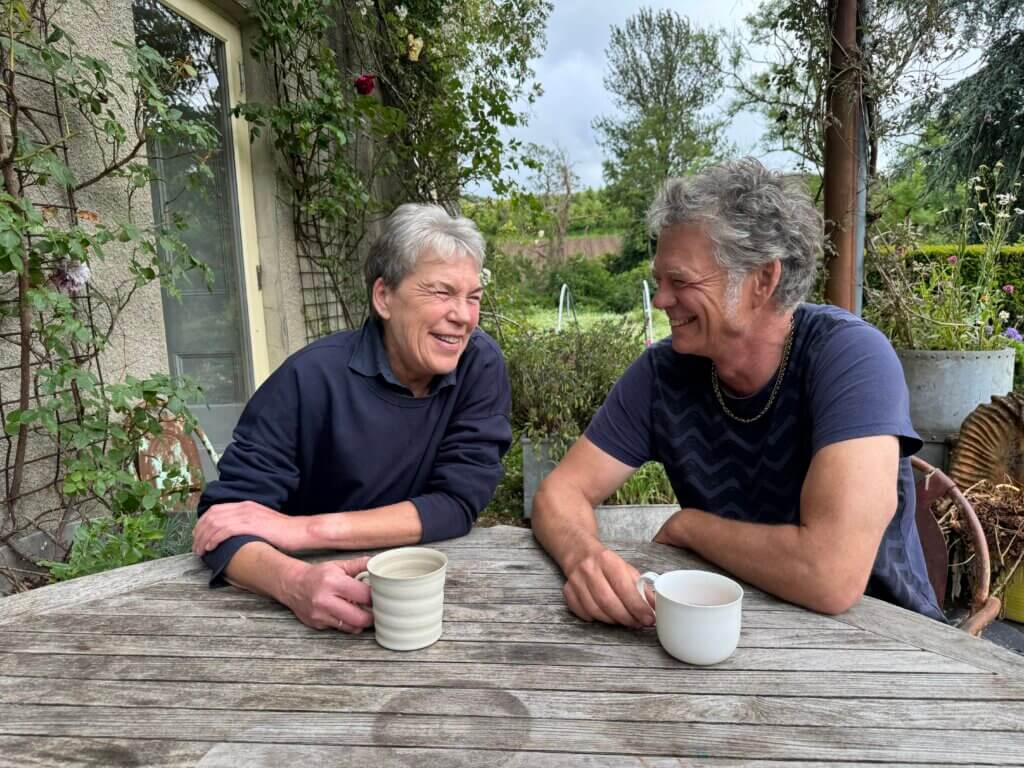
Forty years ago, Guy Singh-Watson and Helen Browning set out to farm differently. From a wheelbarrow of leeks, Guy built Riverford into one of Britain’s best-known ethical food businesses that champions soil health, radical honesty, and employee ownership. At the same time, Helen was transforming her family’s Wiltshire farm into a model of organic mixed farming while becoming one of the UK’s most influential voices on animal welfare and sustainable agriculture as Chief Executive of the Soil Association, which also celebrates 80 years this year. Lizzie Rivera sits down with them at Baddaford, Guy’s farm in South Devon.
On best laid plans and turning 40…
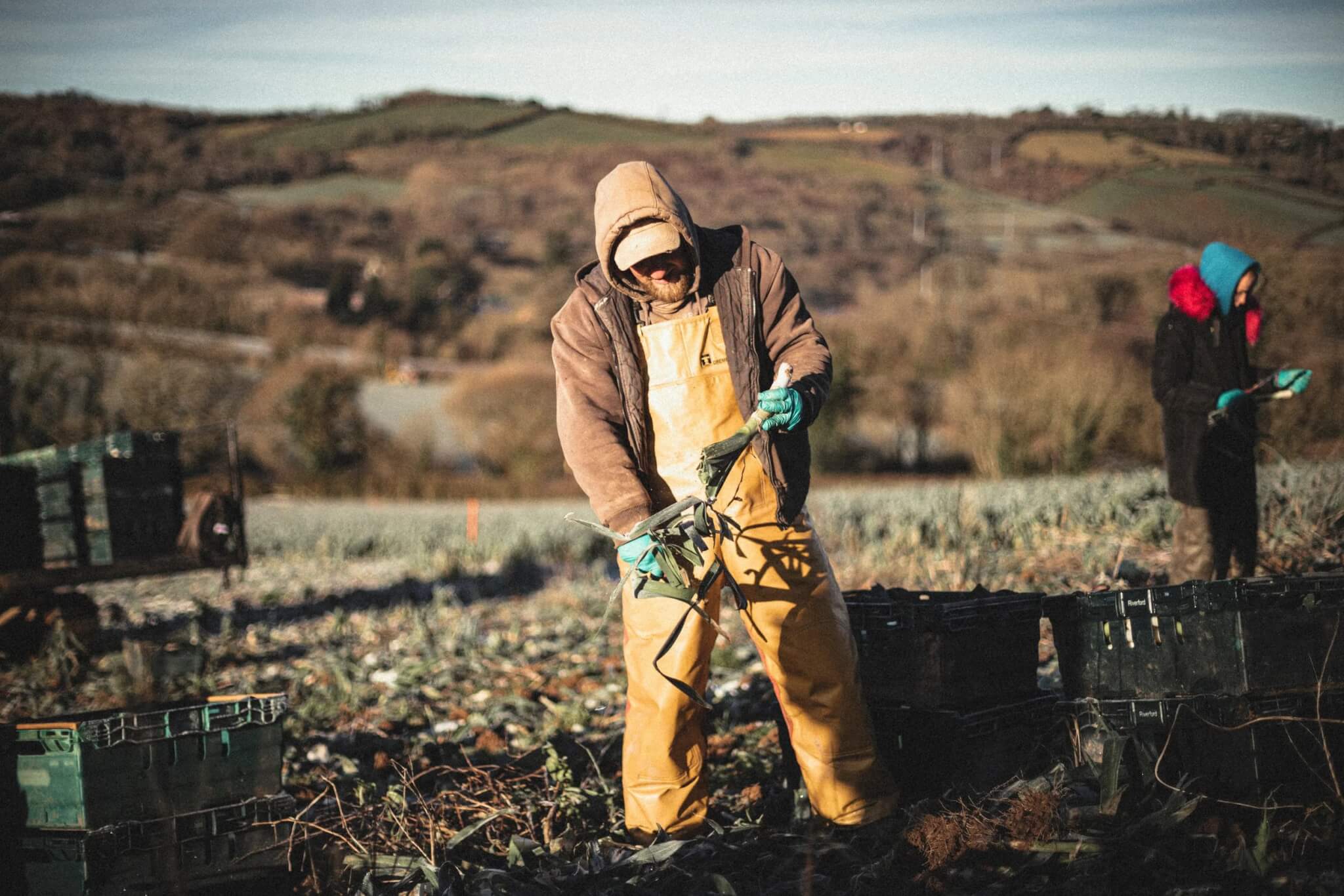
Guy: I put my head down to plant leeks 40 years ago, and when I looked up Riverford was packing a veg box every two seconds. I truly don’t know how that happened. The only time I wrote and followed a business plan was when we extricated ourselves from the supermarkets.
Helen: I’ve always felt slightly sheepish that I didn’t have some great master plan, either. When people are enjoying our farm, the pub’s thriving, the pigs are happy and the cows are getting milked, I think it’s a miracle.
On success…
Helen: People cite us as a success, but when I hear that I think: ‘You don’t know the half of it!’. It feels more like survival. There have been some moments of particular horror, when we’ve put everything on the line and have been staring into the abyss financially…
Guy: I think our biggest success at Riverford is building that genuine trust with our customers, being able to share our story with authenticity – not oversimplifying, not overclaiming, and being able to put our hands up when we’ve got it wrong. They’ve supported us through some pretty difficult times. That’s taken years to build.
Helen: Success to me is doing work I believe is important and finding a way of making it stack up financially. I wouldn’t run a business just because it was a way to make money.
Guy: I completely second that. I was out on the land this morning and I’ll be out there again this evening, that’s what keeps me honest. Rhubarb’s been a disaster again, we’ve been trying to work out how to get the weeds under control. I don’t think anyone’s cracked it, but I’m not going to give up. Really, it’s just a red rag to a bull…
Helen: It’s that persistence that’s important, too. It’s very easy to have a good idea and start something, but actually trying to see it through and being dogged about it, is something we’ve both done.
On values and motivations…
Helen: I think my main role, both at the Soil Association and the farm, is to set the values and the ethos of the business and make space for people to take action.
Guy: My values have emerged over the years. I was always incredibly driven, but the thing that initially drove me was the absence of my father’s approval. Just before he died, about six years ago, he did finally say: ‘Son, you’ve done well’. I just about refrained from replying: ‘For God’s sake, Pa. You could have said that sooner.’
Helen: Rebelling against my mother’s very vocal belief that ‘farming is not for women’ was a definite motivation. But the main one, for me, was learning about the horrors of industrial livestock farming. I was studying Agricultural Technology at Harper Adams and they took us around intensive pig and poultry units that were supposedly state of the art. I just thought they were horrific.
Guy: So, despite the fact you seem incredibly rational, a lot of your decisions are also emotionally-driven. I mean that as a compliment. I think the best decisions are when we combine emotion and intellect.
Helen: Absolutely.
On organic vs chemical growing…
Guy: I think of things I did growing up on a conventional farm and I really hope they don’t catch up with me. I remember blowing out sprayer nozzles with my lips and ending up with a crippling headache, and then doing it again. I just cannot believe I did that. There was such a blasé attitude to chemicals.
Helen: Absolutely. We always had queues of reps coming down the garden path to sell us various sprays, many of which are now illegal. I became determined to see what I could achieve without them.
Guy: The environmental awareness has slowly crept up on me over the years. When I see a field sprayed off with Roundup, and the grass is slowly yellowing and dying, it’s a very visceral feeling – I just know I don’t want to bloody do that.
I think we’re one of the last few producers who still grow strawberries in soil rather than in tunnels on tabletops. I think they taste better, but that’s subjective. I would be amazed if the evidence doesn’t emerge that they are also nutritionally superior. But, it’s so hard to design an experiment to correlate the health of the soil with the nutritional density of the crop.
Helen: Flavour is actually a very good indicator of nutritional quality. But, it is incredibly difficult to prove. The founding premise of the Soil Association is that soil health ultimately results in human health. It feels like more people are instinctively starting to understand that now.
You know, I even remember visiting the home of a barley baron, and in his own garden, everything, was grown organically because: ‘You wouldn’t want to eat those chemicals yourself!’.
Guy: It’s amazing how common that is. Not long ago, I was walking across some lettuce fields and went to pick some to eat, as I do all the time here, and the farmer said: ‘Oh, I wouldn’t do that if I were you’.
On the challenges with organics…
Guy: Two decades ago the UK organic market was on a strong growth trajectory. But, then we started falling behind. Today, only 3% of farmland in the UK is organic, compared with 11% in the EU. Even in the US, organic food sales are around three times the market share. Where did we go wrong?
I think one reason is the price we paid for being a leading voice opposing the introduction of GM crops into British agriculture. The then-Chairman of the UK Food Standards Agency, John Krebs, didn’t want anything to get in the way of GM, and he played a blinder by dismissing organic food as a ‘lifestyle choice’. That was so damning. It’s 20 years later and we’re still recovering from that.
Helen: Then shortly after, during the 2008 financial crisis, Tesco pretty much pulled out of organic because they proactively decided that people wouldn’t buy organic food. It crashed the organic market. Our farm had just spent a fortune launching into Tesco’s with a whole range of products and they delisted all of them within a month. It nearly brought us to our knees. The other supermarkets who stayed with organic didn’t see anything like the decline they anticipated. It was just so depressing because it set the whole thing back.
Guy: It was a real turning point and a lot of farmers lost confidence in organic. The legacy is that we’ve still got this huge import gap in the UK. The organic sector is now worth £3.9 billion but a lot of that is being imported because we don’t have enough production in the UK.
Helen: It ties back into the UK’s particular focus on cheap food and organic being painted into an expensive, elitist corner. The US also has a cheap food culture, but their feedlots and intensive systems are famously inhumane and there’s a backlash against them. Whereas people here have always been told that British farming is superior as a starting point. We have made some improvements in our overall farming in the UK, but we have to really fight to stop more intensive farms from being built if we want that to remain true.
That said, people are beginning to understand and public perception is changing. I have felt more optimistic about organic over the last five years than I felt for the last 40, in some ways.
Guy: Perception is changing among the farming community, too. When I used to go to the East of England as an after dinner speaker, it felt like I’d been invited for sport; they were so in denial about soils. Now most farmers want to self-identify as regenerative at least. Whether we can demonstrate that we are reducing chemicals and improving biodiversity is increasingly becoming part of our status as farmers.
On the Soil Association…
Helen: It’s very easy for a lot of organisations to end up in a bit of an ivory tower, and I’ve never wanted that for the Soil Association. Being practically involved in farming helps me to know what’s really going on at the coal-face.
Guy: I think we’re really lucky to have you there. I’ve pushed back a bit – quite a lot – at times. I remember once standing up during a meeting and accusing someone of disappearing up their own backside. I wouldn’t do that now… after much coaching. Actually, the person I said it to is our Managing Director now, so he’s technically my boss!
Helen: We’ve always been a controversial organisation. We never get it right for everybody. The Soil Association is trying to plot a way through some very polarised debates and that’s a hard place to be.
Guy: I can see that. It’s important we engage with the process and don’t just moan about policies we disagree with.
On whether organic can feed the world…
Guy: In interviews, whatever you’re there to talk about, the first question is always ‘Can people afford organic?’ and the second is ‘Can organic feed the world?’ I find it really frustrating.
Helen: I got into such trouble when I first took the Soil Association role and I did an article for The Telegraph saying I wasn’t interested in celebrity culture and that’s not where I wanted to go with organic.
Guy: I never wanted to sell food to posh people. I suppose if I have one regret in my career, it’s that we have become relatively more expensive. Although, I think that’s inevitably the result of trying to do things well – caring for staff, looking after the land, buying green electricity etc. It’s hard to do that and be the cheapest. That said, if you buy your organic veg from Riverford, the difference in your weekly budget will be gone if not on your first pint, certainly by your second.
Lizzie [interviewer]: But, can you feed the world?
Both: Yes!
Helen: There’s lots of research, all across the globe, showing that if you develop organic techniques and improve the soil then you grow a lot more food. More organic farms in the UK would really help prices come down, too. It’s not just the obvious economies of scale, there’s a lot of research and development required and most funding goes to wealth-creating products or blue sky research rather than advancing the practical knowledge of farmers.
Guy: I think it’s a shame that so much knowledge is owned by private companies. Bigger, non-organic companies seem quite happy to come to our farm and expect us to share our learnings, but then protect their own intellectual property. That’s one of the lovely things about the organic sector, everyone shares pretty much everything. They want to help you to be successful.
Helen: Yes. I came into this with a fire in my belly to try to make change, but I actually found a second family in the organic world. Plus, I was delighted to find a lot more women involved than I had experienced on conventional farms.
Guy: If you go to the Oxford Real Farming Conference, it’s very diverse. It’s a beautiful thing.
Helen: Most of us are driven by something more than just trying to make money. That drives the collaborative culture that persists today.
On the future of Riverford and Helen Browning Organics:
Guy: For me, Riverford is about demonstrating that there is an alternative to rapacious shareholder capitalism, which I think has taken us to hell and is destroying the planet along the way. Riverford is 100% employee-owned and I’ve largely handed that over to them now. They’d probably say organic is their main focus.
I mostly work on my own farm, Baddaford. I want to make that as complicated and messy as possible. All those things I used to hate. One of our neighbours used to say: ‘mixed farming, muddled thinking.’ Now, I’m clear I want to mix it all up.
Helen: Our main, tenanted farm is in great hands with my daughter, Sophie, and her husband, Dai. They’re still doing it organically, but they’ve got a completely different business philosophy. They’re doing things their way, and it wasn’t a straight line to getting here, but I think it’s brilliant to have that coming through.
When I started out, I cared so much about animal welfare, so we went down the livestock route. Animals have their place, but we also need to be growing and eating more plants. So, about 10 years ago we also started moving into agroforestry on the land I own, and we are now trying to commercially develop products from trees. All of that feels really exciting, a bit like when I first went organic 40 years ago.
Guy: I think you’re even more bonkers than me. It’s an insane jump into the unknown, isn’t it? I’ll be amazed if you see any return on that in your lifetime. And similarly with my experiments in agroforestry. But, it’s driven by what feels like the right thing to do.
Helen: That’s one of the lovely things about agroforestry – I feel like I’m setting up a landscape for a time beyond us. I feel it puts me in the right place in the world.
Images by Lizzie Rivera: Live Frankly

You have my support and I don’t mind if I have to spend a bit more on good food. I’ll just have to cut back on other things. I guess I’m lucky to have that choice but caring for God’s earth and all the other things that emanate from this method of farming are important to me. Many thanks
Helen and Guy are a great inspiration, we have been Riverford customers for as long as I can remember. The weekly “news from the farm” has really helped out outlook on life change for the better!
We also have an allotment and this makes me realize how hard it is to grow anything organically and in a cost effective way. The amount of disasters we have, we just put down to another learning 😂.
What are posh people Guy? We have always had a simple lifestyle cycle to work, don’t earn a huge amount, but because we care about where things come from -particularly food, people do think we’re posh 😱; because the Riverford van comes to our house regularly. Pehaps are only posh cos you care?
Thank you so much to Guy and Helen for what they’ve achieved over the last 40 years.
It was interesting to read about the producers using chemicals who wouldn’t eat the crops that they sell for public consumption! About 25 years ago I was living close to a PYO fruit farm in Somerset, and at the beginning of the strawberry season for a couple of years running I developed excruciating gut pain after picking and eating the new berries. A local commented that the owners didn’t eat those crops because of the chemicals used, and grew their own separate supply for use in the house. I didn’t repeat the mistake and have never picked at a fruit farm again.