

At the end of the next olive harvest, Haj Bashir, as he is affectionately known, is looking forward to eating Musakhan – a meal so rich in olive oil it will be dripping down his elbows. A dish his family can only afford to splurge on when the olives have just ripened and the oil is plentiful, around mid-October.
Olive oil is having something of a renaissance in the UK. We’re beginning to attune our palates to its diverse flavours and fully appreciate its health benefits. For Bashir Habaibeh, 70, in Palestine, olive oil provides a vital connection to the world outside the walls that feel like they are closing in on him.
Farming in the West Bank
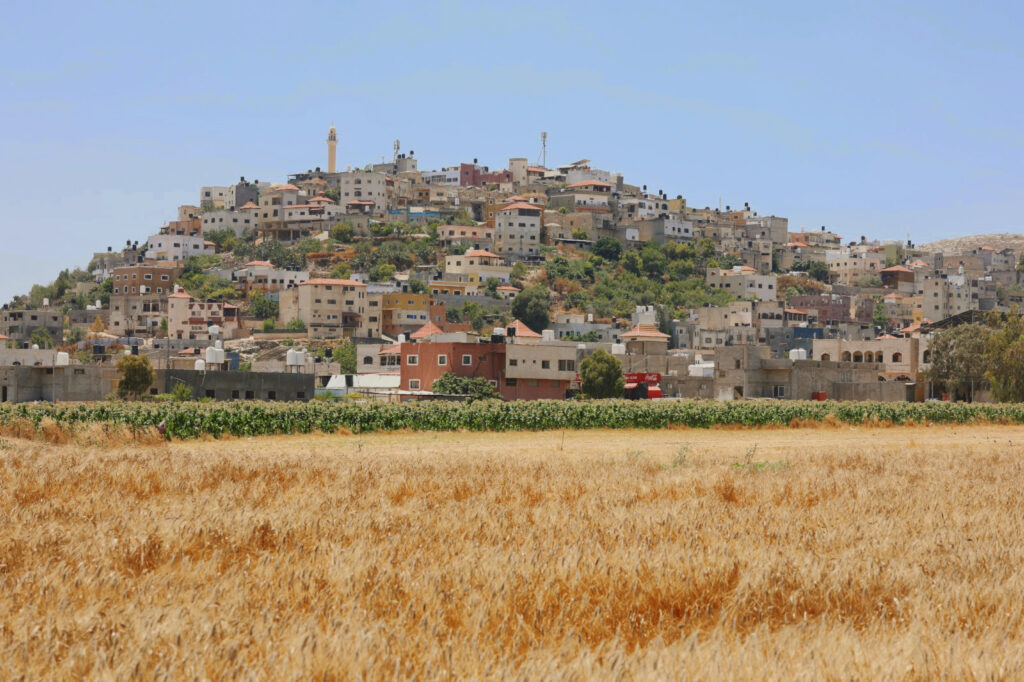
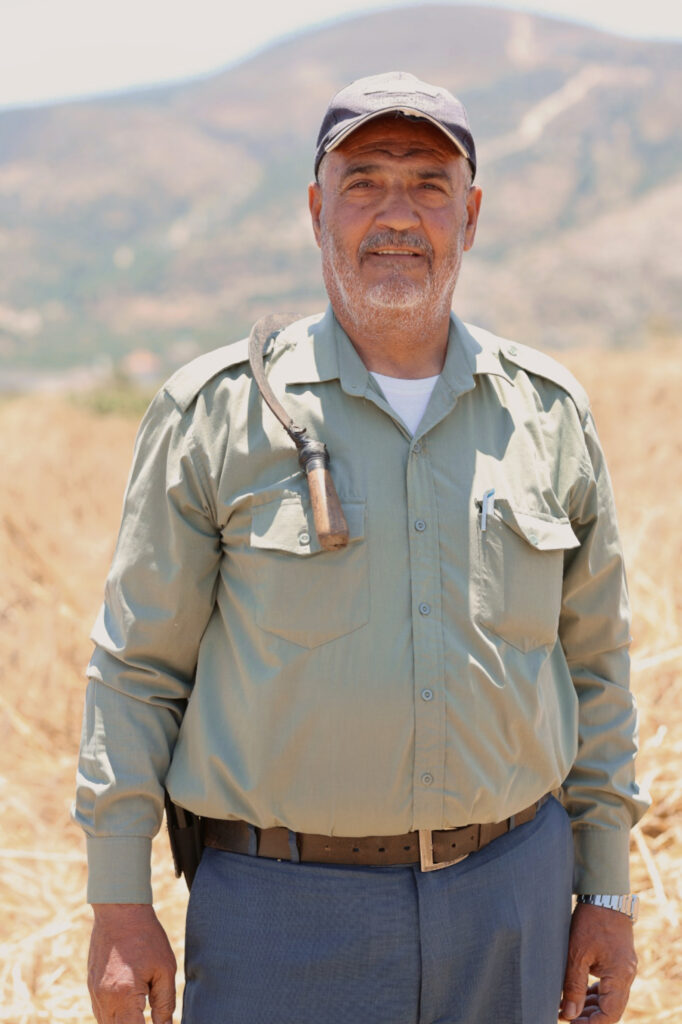
Haj Bashir is chair of the The Palestine Fair Trade Association (PFTA); he is also a farmer in the West Bank. He grows wheat, anise, sesame and lentils as well as, of course, looking after the olive trees growing on the 65 dunums (about 6.5 hectares) of land that have been farmed by his family for more than 200 years.
With Israeli settlements moving closer to this agricultural spot, he knows that land is at risk of being taken. That’s not his most immediate problem, though. The week we speak, roadblocks have prevented him from accessing the food market in Jenin, around 20 kilometres away. It means the tomatoes and pumpkins Haj Bashir’s family just harvested won’t be sold. Instead, they will likely end up as animal feed, at a financial loss, since the cost of growing the fruit and vegetables is higher than its value as feed.
Even on days he can make it to the market, Haj Bashir has to compete with imported products. He produced 700 kilos of anise this year and couldn’t sell it to any of the merchants for its usual price – they had already bought it cheaper from Syria, Egypt and Turkey. With no access to export markets, Haj Bashir eventually had to sell his anise to a merchant for no profit, but this time he was able to at least cover the costs of growing it.
From the West Bank to the UK
This is one reason why Zaytoun was created – to give Palestinian farmers access to a UK market. Zaytoun, the Arabic word for olive, imports Palestinian organic extra virgin olive oil and Medjoul dates as well as giant couscous (matfoul) and green wheat freekah. It guarantees farmers a pre-determined price for their produce and commits to the quantities it will buy, sustaining thousands of Palestinian families.
A grassroots organisation and social enterprise, Zaytoun was founded by four people who volunteered as human rights activists in the occupied West Bank during the October harvest of 2003. Upon their return, they promised to sell bottles of olive oil to friends and family. An impressive 22 years later, Zaytoun has become an established route to market with products certified Fairtrade and organic.
But the situation in the West Bank is highly volatile. Over the last three years, reports of assaults by settlers and incursions by the army have become more frequent, and the organic certifiers stopped coming due to security concerns. In 2024, Zaytoun had to remove the organic label from its olive oil bottles, risking its organic customer base.
It was their most challenging year in terms of supply chain disruption and increased transportation costs, as it was for most businesses operating from the West Bank. However, it was also their most successful because UK customers doubled down on their support. Every quarter returned a profit for the first time and Zaytoun was able to purchase more than £2 million worth of goods from producers, representing a 46% increase on 2023.
“It was just beyond anything we could ever have imagined,” says Zaytoun managing director, Manal Ramadan White. “There was a real huge surge in sales and social media following and just an outpouring of love and solidarity.”
Organic farming in the West Bank
Despite the lack of certification, the farmers continued to farm the wheat and the olives in line with organic principles. Organic to Haj Bashir means farming in the “traditional” way he was taught by his father, who was taught by his father before him – fertilising the soil with animal manure rather than imported chemicals. Haj Bashir insists that you can taste the difference with the intensity of the olives and the richness of the dairy.
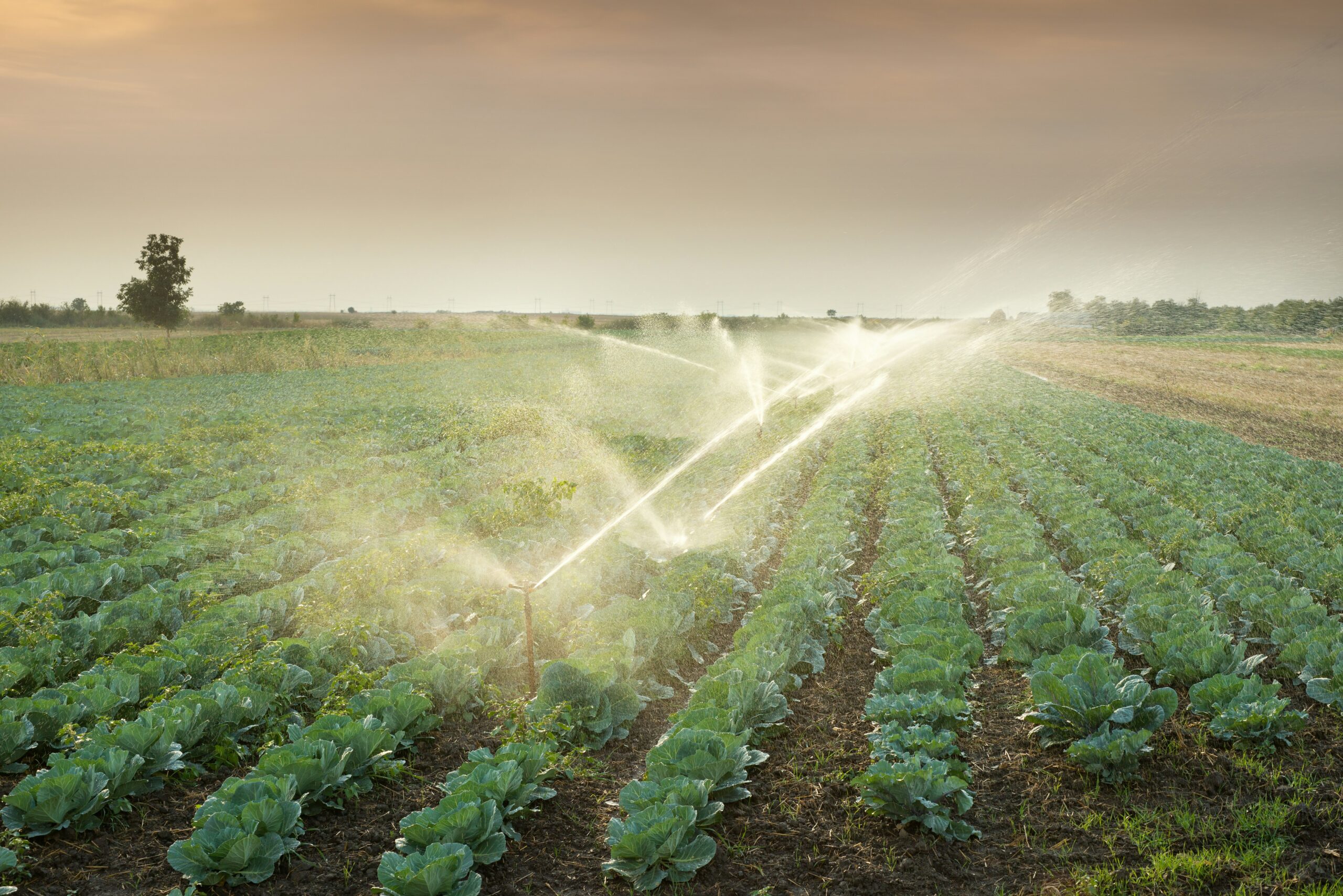
Farming more in tune with nature also helps farmers cope with Israel’s discriminatory water policy, which heavily restricts Palestinian access to water. Normally the West Bank would not be a water-poor region, the main challenge is that the water supply is controlled by the Israeli government. Rivers, springs, and aquifers are diverted to settlements. To drill a well, permits are required. Haj Bashir says that to be granted such a licence is “a miracle”. He explains that people sometimes drill wells without permission. “They find out and they destroy them. They physically come to destroy them,” he says.
To counter the chronic water shortage around 90% of Palestinians in the West Bank have water tanks on their rooftops to harvest rainwater. Farmers also choose varieties of almond and olive trees that are rain-fed, while mixed-crop farming helps to retain water and nutrients in the ground. In the Jordan Valley where water used to be plentiful and they were renowned for their banana and citrus fruits, now only dates grow. The olive trees are incredibly resilient and can survive droughts but they are not immune to settler aggression. Latest figures from the United Nations Office for the Coordination of Humanitarian Affairs (OCHA) report that 77,000 trees have been damaged between January 2023 and April 2026.
Joy and fear at harvest time
OCHA data also shows that settler violence has trended upwards since 2023, and spikes annually at harvest time. The latest annual report from Zaytoun, covering 2024, documents that farmers were shot while bringing in their olives, and whole harvests were confiscated. It reports armed settlers setting trees alight, raiding homes, and diverting water.
“This year already the violence seems so much more extreme than previous ones, we can only hope that the harvest isn’t going to be as bad as we fear,” Ramadan White says. “Traditionally the harvest is a huge celebratory event in the calendar, with families and extended families coming together to help bring the harvest home. There is incredible hospitality and joy. However, these past few years communities are harvesting together in the hope of providing each other with some form of protection.”
If they are able to reach their farms, that is. Already travel – whether to work, to the market or to see friends and family – for Palestinians living in the West Bank is risky. Journeys that usually take two hours can now take six. Petrol may or may not be available at petrol stations. Ramadan White speaks regularly with suppliers; a quality control specialist for the Medjoul dates has to stay near her place of work and away from her young children for up to three days at a time to reduce the risks the journey now represents. It’s a story Ramadan White hears again and again. Because of this, she describes the produce that makes it to homes in the UK as “symbols of hope, despite all the odds”.
The last hope
Haj Bashir and I speak via a translator and he welcomes me warmly. To my ear his tone seems even and his voice matter of fact as he describes the hardships and challenges the Palestinian farmers are facing on a daily basis. It’s only when I ask how it feels to live under such conditions that he shares more.
“The burdens on the shoulders of the Palestinian farmer would be unbearable to most farmers around the world. In every village and community it’s the same, we’re farming in a prison.”
For the farmers in the West Bank, Zaytoun is one way to get through such walls.
“It serves both as lenses that see through walls, and oxygen to keep us breathing within them. It allows us to penetrate these walls and reach the outside world,” Haj Bashir explains.
He says: “We’re living from nothing. That’s the challenge and we accept it. All of these pressures are designed to force us to leave. But we remain grounded in the knowledge that our cause is just… Being on the land, continuing to cultivate it, and witnessing its productivity provides spiritual and emotional satisfaction. The connection between land, justice and identity is what keeps us going.
“The last hope is the land we are living on.”

Buying Zaytoun seems like such a small act of support, so it is good to read how collectively, those who do buy it really do support farmers in desperate need. What we can’t do as consumers is stop the settlements and the eviction of Palestinians from their land.
I also think it is scandal that organic certification was removed because the certifiers couldn’t safely access the territory. The farmers should not be penalised because others are making access impossible. They have been farming organically for years and they should be trusted to keep doing so until the certifiers can return. It is another example of the limitations of certification.
Your readers may be interested to know that Zaytoun products are available in the UK from the Ethical Shop https://ethicalshop.org/catalogsearch/result/?q=Zaytoun – support more than one good cause at the same time!
an Israeli Government minister on Radio 4 today said this was the land of Abraham its ours!
I have every sympathy for Israel and the threats against it but the Israeli Palestinians need protecting and our support, what is happening to them is appalling in plain sight
Having just read Peter Oborne’s ‘Complicit’, Omar Bartov’s ‘Israel: What went wrong?’ and Ilan Pappe’s ‘The ethnic cleansing of Palestine’, my respect for the state of Israel as it now exists is pretty much zero. My respect for certain brave Jewish people in Israel, on the other hand, has gone up enormously. The treatment of Palestinians by the state of Israel was and continues to be appalling. Those books were real eye-openers. I recommend them highly. I will soon be starting Avi Schlaim’s ‘The iron wall’.
Buying Zaytoun is a good way if helping. I’d not heard of it before this article. Haj Bashir shows his respect and love for the planet and the food that God has provided in the way that he farms. I’m sure the Israeli “god ” would not be offended by him and that they’ve misinterpreted the ancient texts.
We are lucky in Totnes (Devon) in that we have a plethora of places to obtain Zaytoun goods. One of the people who set up Zaytoun also comes from Totnes. I wouldn’t consider buying from anyone else, Zaytoun are a wonderful organisation to follow. I remember them showing a film where a farmer in the north of Palestine had boars released on his land which dug up the roots of his crop. Sadly this, as well as restricting water, are common place, what we can do is support the Palestinians in whatever way we can. And Zaytoun is the obvious way…..