
You don’t have to travel very far back in time to find a generation of farmers who saw tree management as part of their everyday.
Coppicing, managing the hedgerows that divided and boundaried fields, and the trees that would provide useful timber and firewood – it all fell under a farmer’s remit.
Livestock would forage in woodland and geese were kept in orchards. These days, farming and forestry are separate entities; up until a few short years ago a farmer could be penalised financially for having a tree in a food-producing field, and it’s still common for tenant farmers to have strict covenants forbidding the planting of trees on the land they steward, or requiring them to remove them when their tenancy expires. But in more recent years, there’s been a shift back towards support for farmers who want to plant trees within their agricultural systems.
“Agroforestry can help improve resilience to climate challenges, enhance biodiversity and support long-term farm productivity,” reads a recent blog on Defra’s website, encouraging farmers to access funding for both planning and implementation of agroforestry projects.
So how did we become so tree-depleted on our farms?
“During World War I and World War II, we cut down a load of trees in general,” explains Harriet Bell, Regenerative Farming Lead at Riverford.
“Devon lost most of its ancient woodland for pit props – to create the structures for battlefield trenches. We were starving as a nation, and we needed to become much more productive than we were.
“We all learn in history about how our food supply chain into this country was targeted during WW2, that’s when you see the real intensification of agriculture; the expansion of fields and the taking out of hedgerows. Farmers were paid by the government to remove hedgerows, remove trees, and to expand fields, in order for us to be a more intensively food producing, competitively industrialised agricultural nation.”
Forestry and farming were divided to fall under two different government departments, with different skills, training and responsibilities attached to each.
“Agroforestry is very simply bringing these things back together, but really specifically, it’s about bringing trees back into agricultural land,” says Harriet.
What does that look like in practise? Approaches vary. In some ways, it’s a return to an old way of farming, but in terms of the contemporary farming mainstream, it’s a relatively new concept, and experimentation is part of the process. Some of its roots lie in permaculture, it’s a cornerstone of regenerative approaches, and it’s had its pioneers and champions in more modern times – like Martin Crawford, Director of the Agroforestry Research Trust, and founder of the Forest Garden Project at Dartington in South Devon.
There’s silvopasture – where trees are planted in fields where livestock graze – and silvoarable, where trees are planted within large arable operations, and there are more nuanced variations. But as for tree variety, and exactly what it looks like, that depends on the farmer, and what they think might work best in their unique system.
There are those who favour timber, as an alternative income stream, and those who might prefer growing fruit or nut trees, as crops. Some prefer to start small, while others are keen to go all in, and have their trees form a key part of their crop plan.
The Nut Farmer of Glastonbury, a film by Elsa Kent, tells the story of Elsa’s dad, Andrew Kent, and his journey from 40 years of conventional farming, and its lonely reality of low margins and isolation, to a more collaborative farming approach, interplanting nut trees with grain and vegetable crops. Their farm, The Glastonbury Nut Farm, launches The Big British Nut Project this month, a new coalition of British farmers coming together to grow a homegrown industry from the ground up, championing UK-grown hazelnuts and walnuts as a climate-smart, regenerative alternative to imported varieties.
In other words, there’s no ‘right’ way to do agroforestry. The key, according to Harriet, is in sharing experiences and results so that others can benefit from their learnings and evolve their own practices.
“After I planted my first agroforestry field, I spent three years going round all the farming conferences talking about all the things I did wrong,” she recalls.
“But I think that was genuinely useful for people. Now you’ve got various WhatsApp and farming groups… the more people are learning, the more they’re chatting about it and the more they can share, the more it becomes a community of practice.”
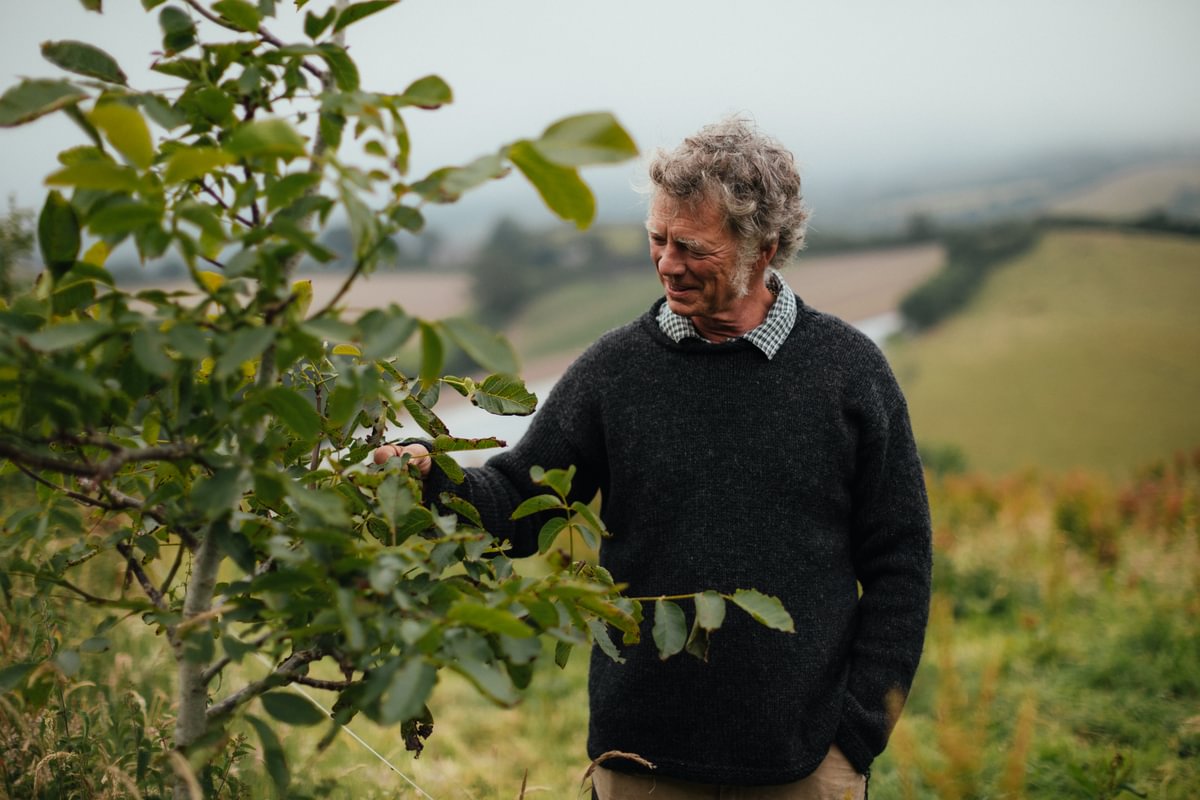
Riverford founder, Guy Singh-Watson has planted some experimental agroforestry projects on his farm at Baddaford in Devon, including beech, ash and oak among his strawberries, and nut trees – walnut and hazelnut – in rows across a field in which his neighbour’s beef cattle graze. He showed me some of them over the summer, explaining me how he was inspired by visits to smallholder farmers in East Africa, where he saw how sophisticated the planting was, and how deep the knowledge ran around interplanting trees and crops.
“As farmers we make lots of compromises to grow food,” he explains.
“When you cultivate the soil you are damaging all the fungal mycelium going through the earth. It feels quite an aggressive and destructive act, and I suppose over my 45 years of growing vegetables, I’ve become increasingly uncomfortable with that. I’ve asked myself whether there are ways that we can produce our food that is less disruptive of nature, and perhaps more complementary, where we are learning more from nature.
“When I was in East Africa, the best farmers I met really understood how crops worked together, how different trees had different characteristics; some things you could grow things underneath, sometimes you couldn’t. An oak tree is very different to an ash or a sycamore, which I would say are quite greedy trees, nothing grows under them. They just rob all the nutrients. Whereas an oak, it’s amazing, crops will grow right underneath an oak.”
In evidence, Guy examined the strawberry plants growing directly beneath one of the young oak trees – their leaves were dark green, and they were vigorous with health.
“There are no aphids on these strawberries,” he said. “I have never grown such healthy strawberries. That’s a result of really looking after the soil, the diversity in the soil, and having it all mixed up so that we have lots of predators to control the insects. We’ve very little fungal disease, almost no insect disease, and it’s looking really, really good.”
What’s happening beneath the roots to cause such a dramatic health uplift for the crop?
“These trees will all have roots that are going out underneath these strawberries, and through photosynthesis, trees convert sunlight and carbon dioxide into sugars (carbohydrates). Rather than keeping all of this energy for their own growth, trees actively pump a portion of these sugars out through their roots as root exudates. These sugars then directly feed the surrounding soil microbes, particularly mycorrhizal fungi.
“That’s building and sequestering soil carbon and helping with climate resilience. It’s fostering biodiversity and it’s just fantastic for soil health as well. I find it really exciting; I feel that I’m working with nature, this doesn’t feel like a destructive act.”
As if to prove his point, a pair of geese perform a loud, honking fly-by, their calls momentarily drowning out the constant background buzz of birdsong, and Guy tells me that they have 15 goslings on the reservoir. It’s a similar story of rich, and immediately evident biodiversity in his second agroforestry project, a field of silvopasture, where rows of walnut and hazelnut trees dot their way across, at 2.6 metre intervals. The ground beneath our feet is thrumming with life, and we watch beetles clamber over a diverse array of meadow plants.
“This is what would be described as ‘species-rich grass,’” says Guy.
“To manage it is quite difficult, because we’ve lost a lot of the skills. Wind it back two or three generations, and you would have had people in the countryside who knew how to do this stuff… there aren’t now really so we’ve got a lot to learn.”
Guy admits there are major challenges in making his projects economically viable – not least the fact that trees make it harder for large farm machinery to access fields, and harvesting the nuts in our damp UK climate, where they cannot simply drop to the floor without rotting, is going to require some ingenuity. But for him perhaps the biggest win when it comes to selling the concept of agroforestry is a cultural one, and a shift in understanding of the role that trees can play in farming.
He says: “We’ve all grown up seeing a successful farmer as one with a perfect field of wheat, stretching off into the distance, not an insect, not a weed to be seen, and a giant combine sucking it up, with the grain pouring into the trailer at the end of the row. That’s what successful farming looks like to most of my generation, that’s what we were taught. This is much more subtle, and some farmers do get their heads round it… a minority really love the challenge. For the majority, I think we’ve got a long way to go.”
What are the benefits of agroforestry? There are certainly plenty. Trees help to foster biodiversity by providing habitats, and breaking up the distances small mammals, insects and birds need to travel across a large field. This tends to have particular benefit within an organic or regenerative system, creating what’s known as ‘integrated pest management’, with predators better able to thrive, and help keep crops healthy.
Trees have a significant impact on soil health; they sequester carbon, they help with water filtration, and they can provide resilience against extreme weather events, like flooding. And as Guy mentioned, the roots push out rich nutrients that the trees have photosynthesised into the soil biome.
There is the potential for increased food production per acre – Guy says that a conservative estimate means he’s looking at harvesting around 500 kilograms of edible nuts, on top of the 60-100 kilograms of beef per acre per year. And the additional income for farmers could lie in timber, as well as crops.
There’s also the matter of animal welfare. “That’s a really big one,” says Harriet. “And it can take multiple forms. There’s the nutrition aspect that lies in diverse forage. Things like hazelnut leaves are really high in calcium, willow provides natural pain relief, and it also has a lot of the B vitamins which can really help with deficiencies in lambs and sheep.
“If you observe animals in the field, they browse from hedgerow trees, a lot of that is about them using their innate instincts to try and address dietary needs, or to manage pain, or manage illness.
“Another element of animal welfare is coat maintenance – the ability to rub on a tree, if you’ve got ticks in your coat, or you’ve got dead fur or dead skin. There’s a lot of research that shows animals are less stressed in tree environments. Prey animals like to know where the cover is.”
And climate change, and the hot summer weather, means that this is more important than ever.
“I would hope that this summer, any farmers resistant to the idea figured out the relief that trees could provide for their stock,” says Harriet.
There are major challenges that lie in the fact that while our agricultural systems are often at scale, so is the machinery, and breaking up large areas creates issues with access. But as robotics and AI get smarter, there may be solutions in smaller, subtler pieces of tech. Good design also plays an important role in being able to properly access fields around trees.
But for those who pursue it, it can be a satisfying art, knowing that you are farming so innovatively, hand in hand with nature.
“To be an ecological farmer requires so much knowledge,” says Guy.
“And really I feel at 66 I’ve still got so much to learn. I think if we’re going to farm in this way, we’ve got a bit of a mountain to climb. But it’s a very exciting mountain, and the views from the top, or even halfway up, are pretty fantastic. I think we should be putting much more effort into learning and farming in this way, in harmony with nature.”
Image by Emma Stoner for Veg&Table magazine


0 Comments