

What’s served up to kids on the school dinner plate varies hugely across the country, constrained by budget, resources, knowledge and people. In some local authorities, the beige food of scant nutrition is still served, in others there are pockets of nutritional excellence. And then there is Bury, a market town in Greater Manchester, which has truly revolutionised school food.
Food standards are now firmly in the spotlight. From next year, schools in England will be expected to serve food under a new set of improved guidelines – this is the first refresh in over a decade. And Bury is demonstrating what’s possible.
The local authority serves 10,000 plated meals a day at 56 schools, and up to 25 percent of the produce used here is organic. Freshly prepared, seasonal food is sourced from local suppliers boosting regional supply chains. They’ve also reduced food waste and made a one-off saving of £50,000.
It’s also earned them ‘Food for Life Served Here’ Gold certification from the Soil Association. This verifies that meals are healthy and ethical, as well as better for the climate and environment
Such a feat isn’t down to just one person, but at the heart of this transformation is Andrew Cowan, Senior Operations Manager for Bury Council’s school catering service. He worked as a private chef and switched to the public sector during the Covid pandemic. If the UK is to move towards a more sustainable food and farming system, there is a lot that can be learned here.
“When I first started out on our journey of change I asked the question: why are we doing this with our school food? The answer was always: “because we’ve always done it”. I knew then that it was about going back to basics and starting from scratch. We didn’t achieve change overnight. It will be my sixth year in 2027. But the focus has always been on presenting quality food on a plate and we’re passionate about it,” explains Cowan.
“It’s also about education, he adds. “We produce displays of fruit and vegetables in schools so pupils, staff and teachers can see what’s actually going into their meals. We’re not just swapping things out and not letting people know. I always bang on about the true value of food. It’s not just what’s on the plate – it’s about everything else that goes with it.”
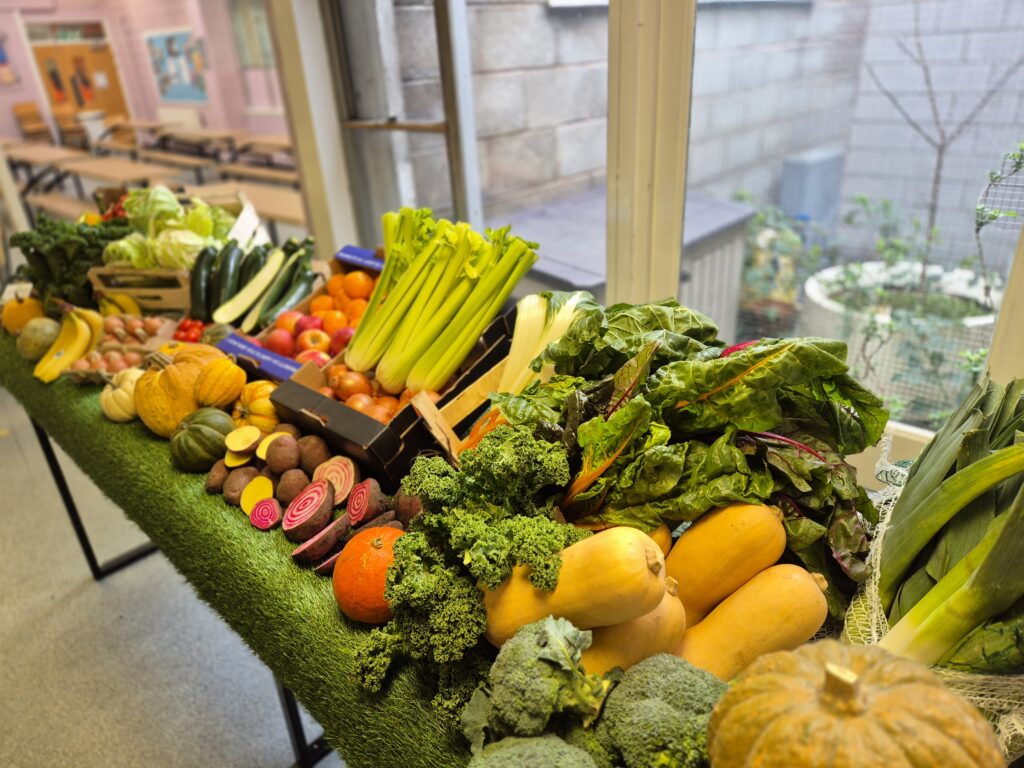
More than just food on a plate
Getting recognition and awards has given Andrew and his team a platform to show the social value they’ve created through the meals they’re delivering. Bury has even been used as a case study in the UK government’s recently published Organic Action Plan, which aims to boost production in the sector. One key to success has been local sourcing.
Roughly 35 percent of food stocks are now sourced within 20 miles of Bury, the local authority uses suppliers such as Organic North Wholesalers and Dunsters Farm, a family-run food service firm. Both have benefited from longer-term demand and steady contracts.
“We’ve focused on shortening supply chains and in the process we’re reducing costs. Yes, those local organic carrots may cost £1.10 a bag versus 80p for non-organic ones from Europe. But the local ones were dug out of the ground just a day ago, they’re more nutritious and they’re fresher for longer, which means less food waste,” states Cowan, who is also a Soil Association Ambassador.
He continues: “We need to go further though and link school meals to health and childhood obesity, as well as the NHS’s ten-year plan. If we invest in healthy and nutritious plated food across the local authority, we can certainly save money down the line because obesity related illnesses cost the taxpayer billions of pounds every year.”
Bury is the only local authority in the UK to have a gold certification for ‘Food for Life Served Here’ across all of its schools. It’s also the first borough in Greater Manchester to achieve Sustainable Food Places Silver, and the town has received a Green Kitchen Standard certification. They’ve also done training with Chefs in Schools.
What’s Bury’s secret sauce?
So what is Cowan’s ‘secret sauce’ and that of Bury Council’s school catering service? They must be doing something right as the government’s Department of Education, as well as farming and food, Defra, wants to learn from their experience.
“The main thing is just to get hands on and start small, with incremental gains. If it takes 10 or 20 years, that’s OK. It’s also about having new conversations. I spoke at Groundswell, the regenerative agriculture festival, this year. And I met so many people crying out to sell their produce into local authorities and schools. So why are we not tapping into this? It seems baffling to me,” details Cowan.
He also believes that local authorities, councils and school academies need to ask the hard questions to their food suppliers and make new demands on procurement, as well as reject the status quo. After all, the public sector has huge purchasing power.
“Procurement managers need to say to suppliers: if I’m not happy with the product that you’re going to provide, I can go elsewhere, or I’m able to go to third party providers, or you can help me access new third party providers, but you can only add a maximum of 20 percent on-costs onto that contract. This is where we’ve unlocked a lot of things,” points out Senior Operations Manager, Cowan.
This has allowed Cowan to source local organic potatoes from a farmer who doesn’t have logistical support to shift his crop. This allows Bury to access high-quality produce through a food service company and for it to be delivered to 54 schools for their meals. It allows the local authority to have more local, seasonal menus.
“We still have fish fingers on a Friday. But it’s about that flexibility – we’re putting more pulses and beans in our bolognese and lasagna, so we can save money on the amount of beef we use and boost the nutritional and health value of our meals. With the new school food standards coming in over the next two years, we’ll hopefully see broader changes,” he states.
What Cowan has seen is a complete change in the school environment when local, fresh, seasonal, as well as organic produce is delivered to kitchens. The muddy carrot is prized more than neat battened, tasteless veg in blue bags. There’s better staff retention. There’s also a buzz about meals in school newsletters and the local media. Bury has even gone international with its story, connecting up with Eurocities, which networks the continent’s urban centres.
Listening to Andrew Cowan, what you realise is that he’s still hungry for change and won’t settle on the status quo for Bury. Improvements are in his sights. He’s already looking at how he can scale things up. Maybe he’s the government’s new school food tzar in waiting?
He concludes: “I’m thinking about Greater Manchester as a whole, then the northwest. I’d love it if it was UK government policy for every local authority to have a ‘Food for Life’ silver standard. We’re also looking at the wider community here including leisure facilities and care homes, as well as a centralised, production kitchen to deliver nutritious food in bulk. I am also keen to get kids into the kitchen with more food education. We’re busy in Bury!” he laughs.


0 Comments