
Britain’s rivers and waterways, many already severely polluted, could be at risk of further contamination after the government signalled it would end multi-million-pound subsidies to power stations which process vast quantities of chicken-farm waste in order to generate energy.
The withdrawal of the payouts, which was confirmed by the government earlier this month, has prompted warnings that large volumes of poultry litter – a toxic mix of faeces, urine and bedding materials – could instead be diverted for use as fertiliser, where “run off” from farmland could result in fresh pollution incidents and a wider “waste management crisis.”
As the AGtivist has reported before, waste from industrial-scale chicken farming has been blamed for blighting the iconic River Wye in Herefordshire and surrounding areas, as well as being implicated in the poisoning of Lough Neagh in Northern Ireland, the UK’s largest inland water source.
Environmental scandals such as these, as well as stubbornly high levels of pollution linked to farming overall – one investigation last year uncovered more than 50 pollution incidents a month associated with livestock production – have refocused attention on the scale of the UK’s chicken industry, and prompted fresh questions around its ultimate sustainability.
Around 1 billion chickens are now grown and slaughtered in the UK each year, and hundreds of factory farms – some confining more than a million birds – now populate swathes of the British countryside. These birds produce an immense volume of waste: the poultry industry generates as much as 2.4 million tonnes of chicken litter annually, according to some estimates. Disposing of such a huge amount of excrement has become a wicked problem for both the poultry industry and government.
Unknown to many, one solution devised in recent years has been to send consignments of used litter from chicken farms to be burned or processed at a network of power plants that subsequently use the waste to generate energy. But, behind the scenes, the practice has relied on taxpayers’ money, with some companies involved having received more than £600 million in government subsidies. This makes it highly vulnerable to wider cutbacks and spending caps.
Indeed, earlier this month, the energy minister, Michael Shanks, wrote to the operators of the power plants involved and announced that the government does not intend to renew the subsidy support scheme for “small-scale biomass generators” – covering a variety of plants that convert organic waste into energy – which is due to expire early next year.
One of the companies to be affected by the move is Melton Renewable Energy, which runs three plants that between them process some 600,000 tonnes of poultry litter a year. More than half of Melton’s income for this processing comes from taxpayer support. Without it, they could be forced to close.
The minister’s letter rejected a proposal for “transitional support” for the next few years, and while it flagged finding an “alternative route for safe and sustainable disposal” of chicken waste, what this means in practice remains unclear. It seems highly likely, however, that most of it will be diverted for use as fertiliser and spread on arable farmland – a practice that comes with its own perils, as illustrated by the dire situation surrounding the River Wye.
Though there are legal limits on the amount of farm waste you can spread in so-called “nitrogen vulnerable zones”, which make up a big share of English farmland, according to environmentalists, enforcement around this is weak and prosecution is rare.
The wider trade in poultry farm litter is notoriously under-regulated, say critics, with environment officials often reliant on farms themselves to maintain accurate and up-to-date records of waste movements off-site, as well as volumes and destinations, and disclose this information when requested. Breaches of such rules, along with other environmental mitigation practices, are a regular occurrence, analysis of enforcement data has previously shown.
The poultry litter burned by Melton represents somewhere between 25-40% of what’s produced by the UK poultry meat sector, so the implications for the looming closures are huge. Additionally, multiple applications for new chicken farms that are currently winding their way through the planning system have stated that they intend to dispose of their waste via Melton’s power stations, raising further unanswered questions.
Jonathan Scurlock, founder of the consultancy Renewable Energy in Agriculture and an expert in land-based renewables, recently said that if Melton’s plant in Thetford, Norfolk, closes, “it’s hard to believe that quantity of poultry litter can suddenly be handled sustainably. The concern is that much of it will end up spread on land – adding to an already significant nitrogen pollution problem.”
The British Poultry Council (BPC), which represents the UK’s major poultry producers, highlighted its own concerns about the withdrawal of subsidies in a letter to the DEFRA Minister Emma Reynolds earlier in September.
Citing Melton’s operations specifically, the BPC said that the company “not only contributes to the UK’s renewable energy capacity,” but also “mitigates the risks associated with avian influenza and prevents potential environmental harm arising from the routine land-spreading of large volumes of litter.”
The body said that without an alternative form of support, “Melton will be forced to close its operations, and the poultry sector will need to find an alternative safe disposal route for large quantities of poultry litter. The most likely fallback will be increased land-spreading which is seasonal and requires storage and appropriate ground conditions.”
The BPC concluded by warning that without providing Melton and other similar entities with “certainty” about the situation, a “waste management crisis” was possible in the near future.
The revelations have also alarmed campaigners who say that the current chicken-waste situation across the UK is unsustainable – and raised concerns that government plans to further expand the poultry industry could fuel the problem further. Some have also highlighted the broader question of whether public money should be spent cleaning up the chicken industry’s waste problem in the first place.
“Chicken producers are part of an intensive poultry industry implicated in the ecological collapse of some of our most iconic rivers and lakes,” according to Amy Fairman, Head of Campaigns at River Action. “They profit from cheap chicken sold through major supermarkets and fast-food chains, yet taxpayers have provided more than £640m to subsidise the burning of the vast quantities of manure this model generates.
“Taxpayers should not be underwriting its waste disposal while our rivers, soils and air bear the environmental cost. The government needs a credible plan for managing this waste sustainably before supporting further expansion.”
Richard Griffiths, chief executive at the BPC, said its members “are exploring alternative capacity to ensure [chicken waste] continues to support renewable energy production and the UK’s domestic energy supply”. “Where appropriate,” he added, “poultry meat litter can also be applied to land in line with nutrient management plans, helping reduce reliance on manufactured fertilisers, which are energy-intensive to produce and heavily dependent on imports.”
In a statement, DEFRA said that it is currently working to draw up a simplified and “robust” piece of legislation around the spreading of poultry litter on farmland. But for now, it is controlled by existing water regulations.
Whilst many in the waste and poultry industry will no doubt be hoping that the government U-turns on its decision to end subsidies for power plants utilising chicken litter, this doesn’t at present look likely, with staff at Melton’s plants understood to have been told that consultation on closures and redundancies is expected to begin later this year.
For others, the whole situation is further proof of what they have been warning for years: that the adoption of industrial-scale chicken production in recent decades is ultimately flawed and destined to create a multitude of problems, some of which are only just beginning to emerge.
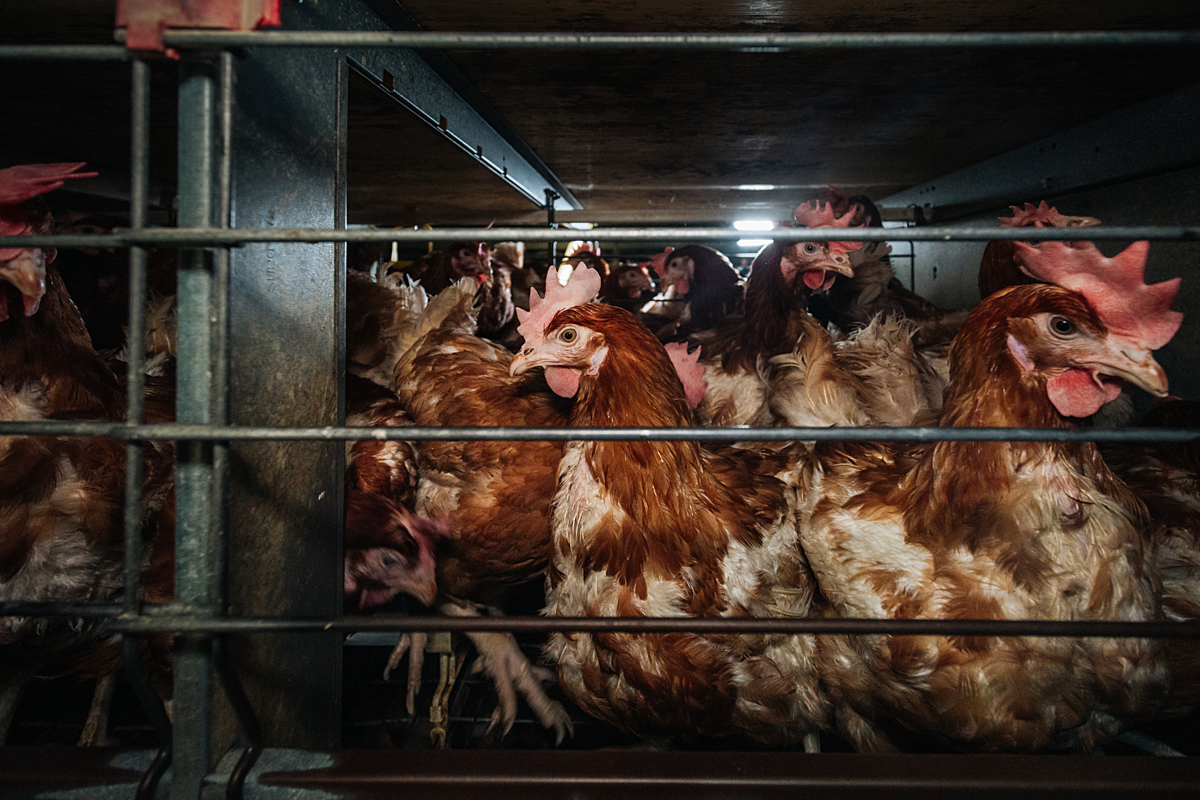
Image of confined hens looking out through the bars of a cramped “enriched colony” cage in a large-scale industrial egg farm. England, UK, 2023. Image c/o Tom Woollard / We Animals
The AGtivist is an investigative journalist specialising in food and agriculture issues who’s been covering this beat for 20+ years. The AGtivist column at Wicked Leeks shines a light on the key issues around intensive farming, Big Ag, Big Food, food safety, and the environmental impacts of intensive agribusiness.





I just wrote on another story about this: in the US these chicken processors sell the contents “of the “floor”—chicken poo, hay, dead carcasses, everything on the floor—to the beef industry to be processed for feed for beef. It is the cheapest form of feed for cattle; disgusting, isn’t it?
This is ridiculous. An industrial problem needs an industrial solution.
A govt funded agency that collects farm waste to first turn into biogas, and then into safe organic/ non fossil fertiliser.
This is a resource – not a waste product !!!
In one fell swoop we could help with energy AND produce home made fertiliser – both – if anyone’s been paying attention, being stymied by Trumps war on Iran !!!
A fact finding trip to china would be my first port of call.
You can bet they’ve got this covered…
Why is the government subsiding the removal of the waste products from animal agriculture? Surely the ones profiting from the industry- chicken farmers & processors supermarkets & food retailers should be paying from their large profits- or even more radical we should reduce consumer demand for cheap chicken.Make people pay the real price for food & they will find alternative foodstuffs that don’t wreck lives & the environment – while people are being feed poor quality heavily subsidised cheap food they’ll keep demanding it
Solution – don’t eat chicken.
Whenever a problem like this comes up, the discussion always assumes that waste must be centrally processed. Would it not be simpler if all industrial sized poultry sites were encouraged to deal with waste in situ by developing their own biomass power generators? If their sites could become self-powering that would benefit them financially in the long run and dispense with transport costs. Sometimes surely thinking small and local is best.