
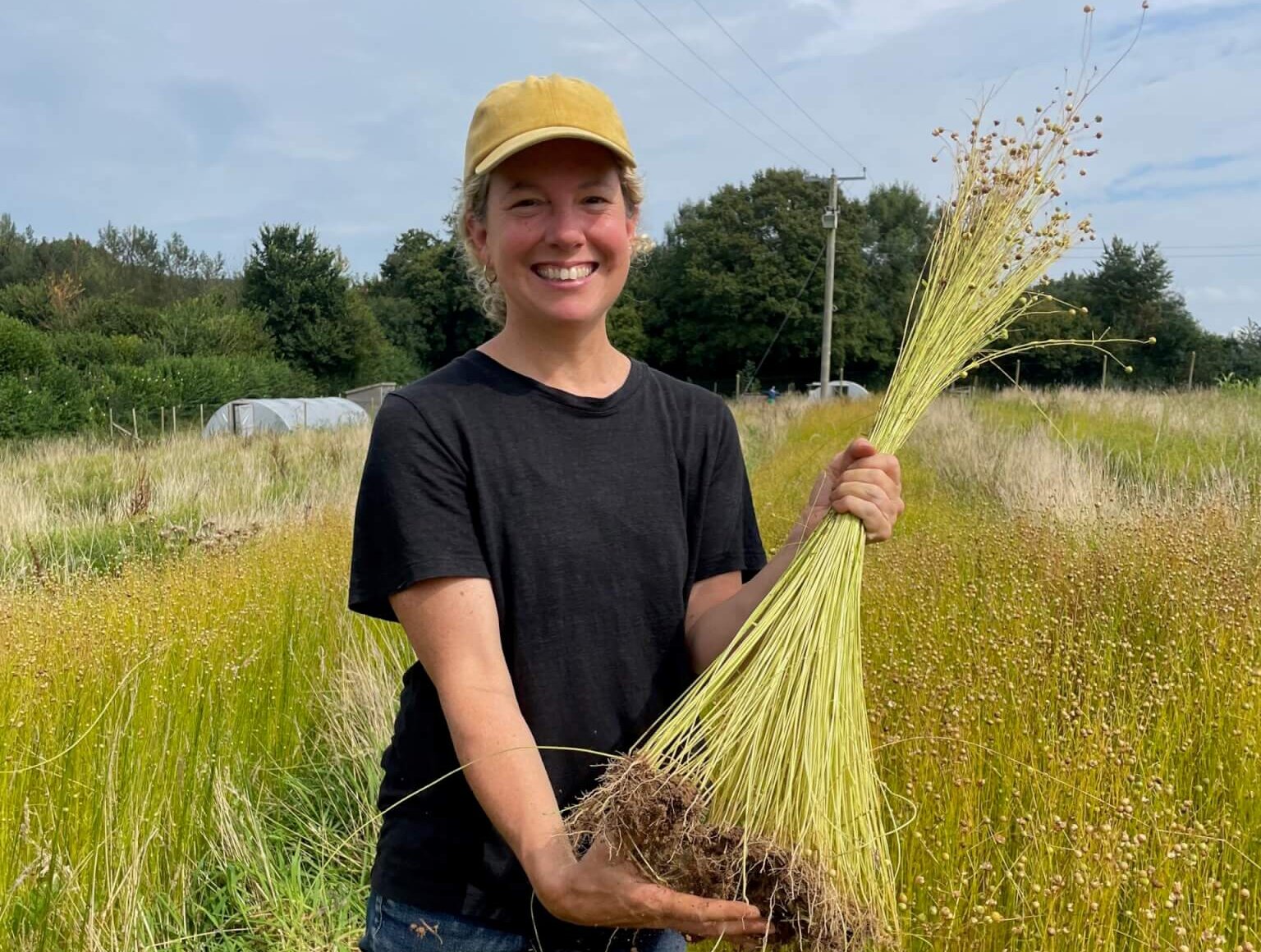
Provenance matters – whether with local produce, grain or wine, from farm to fork or glass. Growing what we imbibe using agroecological principles, while preserving the natural environment, is increasingly in the spotlight. So why should we not take this approach with the very fibres that make up the clothes on our backs?
This is the question that Zoe Gilbertson is asking – not just a backlash to the unsustainable practices of the fast fashion industry, which tries to deliver clothing at any cost to workers, farmland and the environment, but a realisation that local ‘seed to closet’ initiatives based here in the UK could lead to more responsible production and consumption.
“A lot of it comes down to future resilience for future generations. It’s clear that we need to start growing more of our own food. Many people now realise we must create robust, local supply chains. But it’s easier to grasp this for food than it is for textiles, clothing, or fashion,” explains Zoe Gilbertson.
“We need to start thinking about what it would look like if we grew and made our own materials locally. Why should we be outsourcing this responsibility to India or China? We want to demonstrate a responsible alternative that builds on local resilience in fibre production.”
Like food, the global fashion industry is at the centre of a debate around capitalism and climate change, driven by industrialisation, colonisation, and slavery. Again like the global trade in food, there are issues around waste, too much low quality production, and the proliferation of chemical pollution in the environment, and the ill effects to our bodies.
It is why Gilbertson founded Liflad, a design lab, which means “livelihood” in old English. This not-for-profit is now piloting and developing projects that focus on local fibre, fashion and textiles.
“Rather than aligning ourselves with the existing fashion industry. We’re developing agroecological textiles that are more akin to the local food movement instead. We know we can design beautiful garments, however the big question is, can we work out how to grow fibres and produce textiles in a sustainable and localised way?”
Reinventing what was once so vibrant
Historically, the UK was once the undisputed global leader in textiles, driving the Industrial Revolution. Before that, bast fibres, including flax and hemp, were grown in almost every town and village. Northern Ireland was a particularly important area for flax and linen. The industry was the biggest employer in the 19th Century; it was widely grown in Scotland too.
Today, domestic production has all but disappeared, giving way to cheap, imported cotton and even cheaper man-made fibres, derived from fossil fuels, while the vast majority of the world’s flax crop is grown in the Netherlands, Belgium, and France. There’s now renewed interest in reestablishing a UK textile sector, with demand for natural, sustainable fibres.
“We’re starting from scratch because we don’t have any knowledge left in the UK. It died a very long time ago because we industrialised so early. That is why we’re now developing the know-how so we can make our own textiles, from seed to cloth and retain this in our living memory,” states Gilbertson.

Through this revival, Zoe and collaborators are being necessarily critical, questioning every step of the production process. The aim is to create a UK textiles sector that works for local people, the land, and the environment. This goes against economies of scale and highly-mechanised, mass production of clothing. It also considers the whole production cycle from seed to closet.
“Right now, we consume too much fast fashion. Clothing is way too cheap and accessible. There’s also far too much of it. A lot of it ends up in landfill and is too difficult to recycle. One of the ways to reduce supply is to make it harder to access. We’re talking about reducing consumption by creating fewer but really, meaningful and durable pieces of clothing, as well as linen,” states Gilbertson.
She continues: “It is possible, if you think about English wine, it can be twice or three times the price of French wine. But people already accept this – realise the value of it and celebrate it.”
Realising the true value of growing cloth
Liflad, which is based in South Devon, is still at the Proof of Concept stage. What is exciting is that by starting from the ground up they are making new discoveries, which start to build provenance into the cloth producing process. This also involves another of Zoe’s collaborations, Common Cloth Works, alongside Fantasy Fibre Mill, who develop small-scale machinery for processing fibres.
“We’re starting to grow Indigo, used for dying clothes blue, alongside flax because we think their soil nutrient needs are complementary. We’re also looking at agroforestry, because we can also create dyes from tree bark and coppicing,” details Gilbertson.
She points out: “The provenance of flax is also fascinating. We realise that flax grown in different years on different farms and varying soil types, has a multitude of qualities. It’s a bit like a fine wine. Our aim is to create a cloth, like a fine wine, which has the terroir woven through it. This is something you can visibly see, because flax grown under varying conditions takes on different colours.”
She has also helped instigate Totnes Grows Flax, part of Devon Grows Flax and Flax in Schools, where participants grow one square metre of the crop in their own gardens and playing fields. This is then harvested; more than 50 people were involved in the project last year within the Devon town.
“There’s quite a lot of steps to producing linen. But it if we take people through these processes they’re amazed by the transformation from plant to cloth. They also understand how long it takes and what’s involved. Hopefully they will then appreciate the effort that’s needed to produce cloth. It’s all part of a journey to bring our textile culture back to life,” expresses Gilbertson.
She is not alone either. Zoe was inspired by Joline Jolink, a fashion designer in the Netherlands, who has bought her own farm to develop a Dutch seed-to-closet initiative. In France, there is the Organic Flax and Hemp Association, which Gilbertson studied through a Churchill Scholarship, which supports and networks French growers and producers. In the UK there is Flaxland based in Stroud, Mallon Linen in Northern Ireland, the Flax Project in Plymouth or Pigment Organic Dyes in South Devon to name a few.
“What I have learned on my journey is that it is important to build a network of likeminded people if we are to revive a vibrant, sustainable UK textile sector, one that shares knowledge and supports each other. Within five years, we will have demonstrated the possibilities. I certainly hope more people will be involved with the local growing and production of textiles. It is time for change,” concludes Gilbertson.

Great to see this initiative. Getting away from our dependence on cotton and developing fibres like flax, hemp and wool that grow well in our climate all help. Organic fibres and processing to produce organic textiles with certification to the Global Organic Textile Standard (GOTS) stops greenwashing and ensures strong social and environmental criteria are met. Organic for food and for textiles – live life within planetary boundaries. 😊❤️