
Beans are a hot topic. Everyone from the World Health Organization to Jamie Oliver and Lidl is urging us to eat more. Posh jars have become status symbols.
In a world as divided as ever, one thing (almost) everyone agrees on is that we must eat more beans. Health-related diseases are rising in Britain, as are food prices. Beans, which are affordable, packed with fibre, protein and a host of other nutrients, are a solution to both. Their nitrogen-fixing qualities can promote healthy soil, and they require far less water than beef. Most importantly, perhaps, they are delicious.
According to The Food Foundation, the average Briton eats just one portion of beans a week, a number that would have to increase by seven to meet the Planetary Health Diet. Secondary school children consume two-thirds of a portion per week, and half of children’s intake comes from baked beans. Around 95% of beans we buy are eaten at home – the foundation argues there is huge potential for restaurants to add more pulses to their menus. And the vast majority of beans we do consume are imported. According to the Food Foundation, Britain grows 800,000 tonnes of beans per year, which are mostly exported or used as animal feed; around 500,000 tonnes travel the other way.
But an increasing number of restaurants are turning to British-grown beans. At Higher Ground in Manchester, a heritage bean salad with Cornish beans and leeks uses kidney and flageolet beans from Norfolk. At London’s Evelyn’s Table, Seamus Sam makes miso from carlin peas, which he adds to wild garlic butter and brushes on lamb to barbecue. At Dockley Road, also in London, Emily Chia swaps traditional chickpea flour for British-grown fava and pea flours for a panisse, served with a pea mayo made with discarded pods.
Spearheading the surge is Hodmedod’s, founded in 2012 to promote British-grown beans and pulses. Its carlin peas, a round, nutty pea traditionally eaten in the north of England, have been a hit. For co-founder Josiah Meldrum, a key reason British beans have been relatively rare in recent decades is that Phaseolus varieties, including kidney, flageolet and black turtle, are hard to grow at scale in our climate. By contrast, fava beans grow well, but when Hodmedod’s started there was “little or no interest in them. There’s still very little interest, but more than there was.” Hodmedod’s work with around 35 British farmers, growing a similar amount of varieties, mostly in the UK, including trials on tough-to-grow varieties like chickpeas.
Increasingly, restaurants are also turning closer to either their own farms or farming partners. Higher Ground, which sources beans from Hodmedod’s, also grows broad, fava and borlotti beans at its market garden, Cinderwood, in Cheshire. In London, two-Michelin-starred The Clove Club set up a smallholding in an East London school last year, in collaboration with OrganicLea, a workers’ cooperative. Alongside vegetables, Hugo Silva, who runs the project, grows a wide range of rare beans, including varieties from Mexico and the Essex pea bean. According to Silva, the latter is a “beautiful maroon and cream bean. The seed has been grown and saved in the nearby village of Broxted since before WWII.”
Silva is also trialling chickpeas. “We are still learning how to grow this crop in the UK in order to obtain a good yield,” they explain. “It’s definitely a chef’s kiss of a crop when we will be able to harvest it green in the pod and taste the freshness of a locally grown chickpea.” Silva also grows the likes of borlotti lingua di fuoco, Kennedy wonder wax and cosse violette, all of which have ended up on the menu at The Clove Club. The Yucatan beans are being collected as seed for next year’s crop. “Seed saving is a way to strengthen our organic way to care for the planet and for food sovereignty.”
In Scotland, another pulse-based partnership is blossoming. Aside from sourcing from Hodmedod’s, Bart Stratfold, the executive chef at Timberyard, Montrose and Haze, has worked closely with Lauriston Farm, a 100-acre farm on the outskirts of Edinburgh, for the past year. It allows him to experiment with a number of rare and unique beans. At Timberyard, fresh beans are on from summer to early autumn, before moving into demi-sec, a style not often seen in the UK, the beans harvested when fully developed but not yet dried on the plant. Throughout winter, dried beans are always on hand. From Lauriston Farm, he has used the likes of Uncle Bill’s blue beans, which are a vibrant blue before cooking, and black apache. From Hodmedod’s, he has used fava, carlin peas and haricot.
“A chef I worked for said it’s always nice to have a fluffy pillow, and beans are like a fluffy pillow,” says Stratfold. “They do have flavour and are delicious, but they are a neutral vessel that carry flavours really well.” Stratfold likes to make pasta e fagioli, a classic Italian bean dish, and in summer cooks them with lobster stock.
“Everything Lauriston Farm grows is a) responsibly grown, b) delicious, and c) really cool. It’s all intriguing varieties,” says Stratfold. “Uncle Bill’s blue beans was Jossie’s [Ellis, a grower at Lauriston Farm] uncle beans which he grew in his garden. I trust in them so much that if they say they have something, I take it and then write my menu.”
While beans are more popular than ever in restaurants, Stratfold admits some guests grumble. “You get some people a bit stuck in an old mindset, like we’ve come out, why have you given us this. Particularly at Timberyard, we have our Michelin star, we’re perceived as fine dining, that perceived idea of pomp and fancy. Some come looking for that, and wouldn’t expect beans.” But the vast majority love them.
Britons eat far fewer beans and pulses than southern Europeans, not to mention large swathes of Asia, Africa, and the Americas. Aside from baked beans and mushy peas most, outside certain immigrant communities, rarely eat them. Yet Stratfold argues beans, peas and legumes have a strong heritage, particularly in the north. “Pease pudding, carlin peas, pigeon peas, all these things are sustenance, their origin is about filling the belly. If you went back to medieval times, pottage, the peasant food, was a mixed, continuous pot of vegetables, and always dried peas if they had them.”
Meldrum agrees. “Historically the UK has a strong pulse heritage. Peas, beans and very likely lentils were a central part of our diet really from the moment the first agriculturalists arrived.” Peas and fava beans, he adds, appeared in the first English-language recipe book, The Forme of Cury, published in the 14th century. “Pulses are often called ‘alternative proteins’, but for most of the history of the UK, and much of the world today, they were far from alternative.” Meldrum says colonialism and early industrialisation, which made the country rich, led to the greater availability of meat and the stigmatisation of ingredients associated with the poor. “Beans are not really honoured in the way they should be.”
Yet things are changing, and Stratfold argues that being able to use British beans is a boon for chefs. “There’s been a real resurgence in celebrating what used to be seen as lesser ingredients. Facing crippling taxes from the government, you can’t just write a menu that’s turbot, truffle and foie gras. Restaurants, a while ago, started celebrating these more interesting ingredients. Beans aren’t a stodgy bowl, you can make them elegant and light. It’s just common sense to use them.”
Read WL Meets Josiah Meldrum, here.
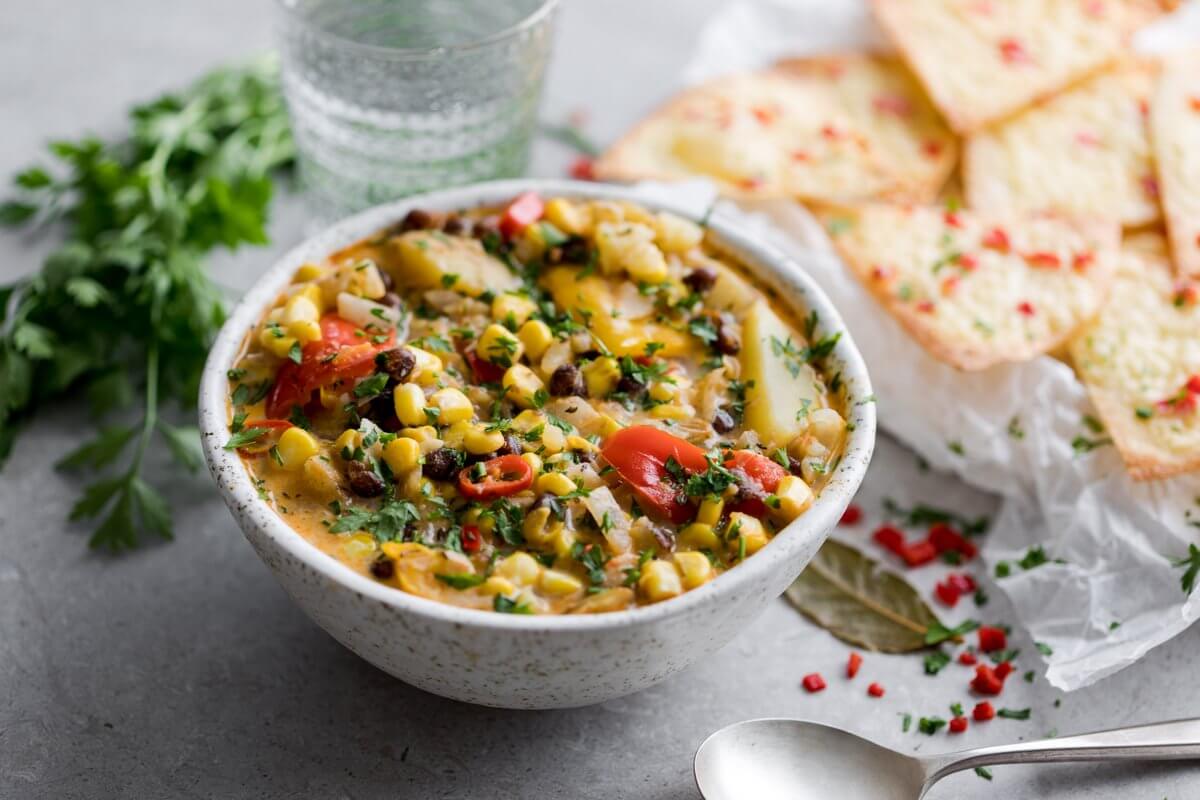
Image of Riverford’s Carlin Pea Chowder. Discover more of Riverford’s veg & bean recipes here.

0 Comments