

Back in 2015, a UK government press release issued an unusually stark warning. It said that the use of antibiotics in livestock farming represented a “critical threat” to public health owing to its role in fuelling the spread of drug-resistant “superbugs”.
The economist Jim O’Neill – who had been commissioned by the-then prime minister David Cameron to head up a major review into the growing peril of antibiotic resistance – used the release to call for “a phased global reduction in antibiotic use in livestock production.”
Although use and overuse of antibiotics in human medicine was, and remains, the biggest driver of the problem globally, and was the key focus of the O’Neill review, there had been growing concerns for years about the usage of the drugs on farms to treat and prevent disease, or promote faster growth (as previously reported by Wicked Leeks).
Research had shown how use of antibiotics in animals was leading to resistant variants of foodborne diseases such as salmonella, e.coli, and campylobacter, as well as livestock strains of MRSA.
The O’Neill review soberly set out the risks: “Firstly, drug-resistant strains [of disease] can be passed on to the human population through direct contact between humans and animals,” it stated.
“Secondly, these drug resistant strains have the potential to be passed on through the food chain, for instance from eating undercooked meat. Finally, there is a further indirect threat to human health as a result of animals excreting bacteria and antibiotics together into the environment.”
In the decade since, the issue has gained prominence internationally and seen many countries drive down antibiotic use on farms, particularly in Europe. The UK has achieved a 59 per cent reduction in sales of antibiotics for use in food producing animals, something widely touted as a success story.
Despite this, evidence this month emerged that highlights the very persistent and worrying nature of the problem. Government data has revealed the presence of “superbugs” in multiple UK meat supply chains, including those of leading supermarkets and food companies.
Testing found that sausages and other pork meat products had been contaminated with drug-resistant strains of salmonella, a common cause of food poisoning. The records were published on the website of the Agri-Food and Biosciences Institute (AFBI) in Northern Ireland following a freedom of information request and detail tests carried out between 2021 and 2024.
Pork products produced for Asda, Aldi, M&S and Booker (part of the Tesco group) were amongst those found to contain antibiotic resistant strains of salmonella, the AFBI records show. Meat or pork carcasses processed by the manufacturers Karro Foods, Finnebrogue and Cranswick also tested positive. A number of pig farms in Northern Ireland were additionally found to be contaminated.
Many of the salmonella samples in the government records showed resistance to multiple types of drugs.
Salmonella is commonly found in the guts of livestock and poultry, and once it becomes established on farms, can spread through the entire supply chain – including during animal transport, and at the slaughtering and processing phases in abattoirs – and go on to contaminate meat that’s then sold to consumers.
Although salmonella can cause serious illnesses in people – and in rare cases prove fatal – most victims will recover without the need for medical attention or treatment with antibiotics. Government and industry bodies also say that good hygiene practices – including proper storage, preparation, and cooking – are effective in protecting human health.
Nevertheless, risks remain. Many of the salmonella samples contained in the data are listed as being monophasic salmonella typhimurium (mST), which, according to the government, has increased in pigs and people in Europe since 2007. They report that whilst many commercial-scale pig farms have salmonella, some types of the disease, like mST, “are more hazardous than others”.
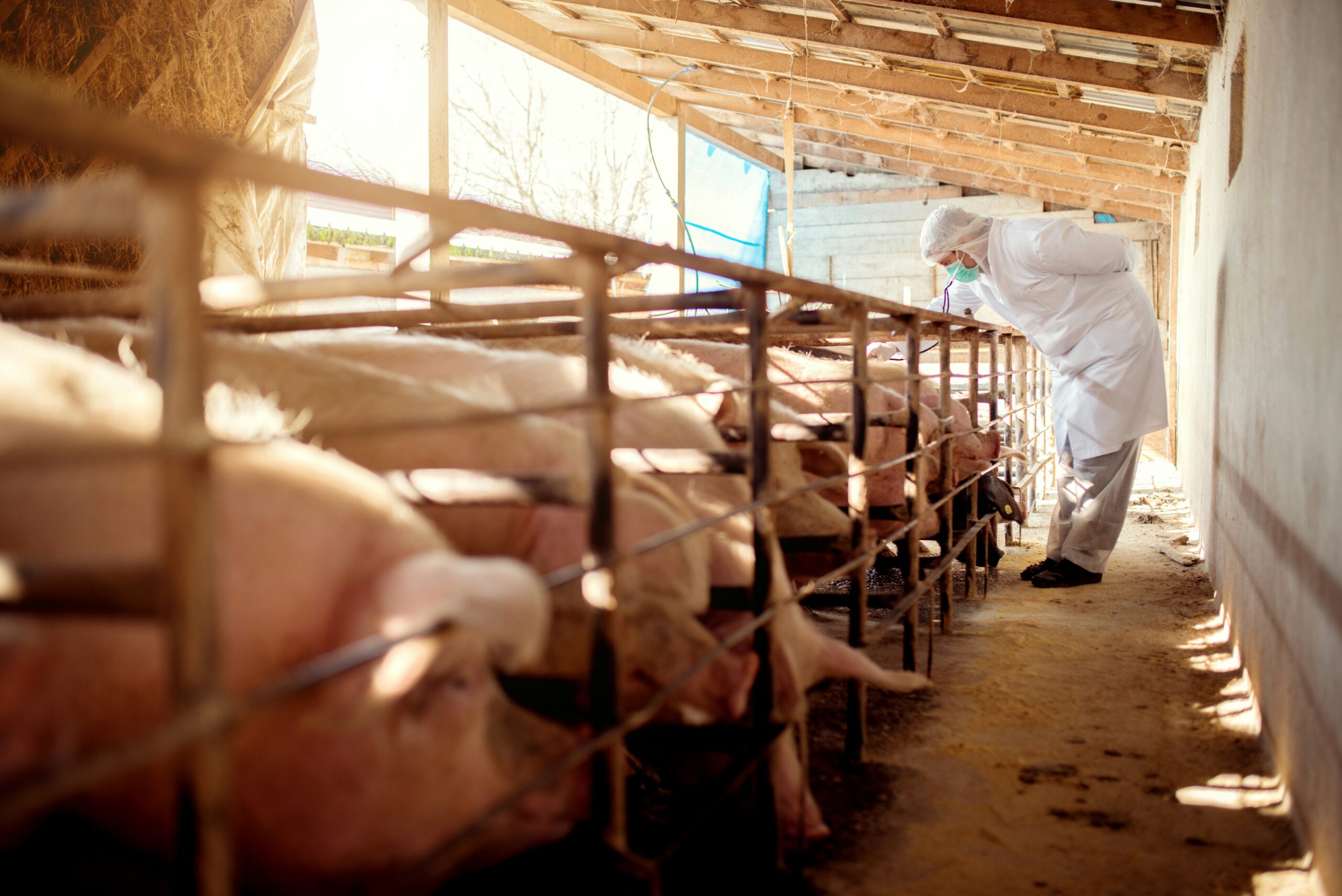
Critics of factory pig farming say that the overcrowded, unsanitary conditions found on some farms allow diseases such as salmonella to flourish. The use of antibiotics to manage illnesses – or compensate for poor husbandry – then encourages the emergence and spread of drug resistant variants, they say, with farms effectively acting as “incubators” for drug resistant diseases in humans.
Graphic footage released by campaigners, obtained on a number of pig farms in Northern Ireland that had previously been contaminated with salmonella, highlights what they describe as “squalid conditions” with “filthy, crowded sheds, and apparent neglect”.
The pictures, published earlier this month, appear to show numerous dead and decomposing carcasses, including piglets and adult pigs found in walkways, skips, and farrowing [birthing] crates. There’s also images of pigs with apparently untreated injuries and others showing what campaigners say are unsanitary conditions “with animals born into excrement, built-up faeces, and dilapidated facilities.”
The conditions found seem at odds with veterinary guidance which says that good hygiene standards on farms are important for preventing and controlling animal diseases.
It’s not just campaigners who have raised concerns: an inspection report contained in the published AFBI data noted that on one farm “in view of the […] high prevalence of disease on the premises, there may be concerns regarding hygiene, stocking density and infection management, even back to farrowing [birthing] conditions.”
Investigators say that six different classes of antibiotics appeared to have been in use on the farms, including some substances classified as being critically important to human medicine. These are vital drugs used to treat diseases in people which some experts say shouldn’t be used in livestock farming, or only used in exceptional circumstances.
They also raised questions about the manner in which some antibiotics were being administered on the farms, including that some drugs were apparently being mixed into pig feed or drinking water. This enables groups of animals to be treated in one go. Such practices spark particular alarm as there’s a risk of healthy animals being dosed unnecessarily, further fuelling the spread of drug-resistance.
Responding to the findings, Dr Steven McCulloch, a veterinary specialist in animal welfare science at Winchester University, said what many people may be thinking: “We must ask why governments, the veterinary profession and society prioritise cheap pork and bacon over life-saving antibiotics?”
Dr Ron Daniels, founder and chief medical officer at the UK Sepsis Trust, and a leading voice on antibiotic resistance, said that whilst the UK has banned antibiotics for growth promotion, “entire herds can still be treated when just one animal is sick. We urgently need legislation – and a fundamental rethink of our consumption – to protect our future.”
One source previously told the AGtivist that whilst such findings in meat were worrying they were to be expected as “the genie is out of the bottle” when it comes to antibiotic resistance, and was often the legacy of “years of usage”.
The UK pig industry maintains it has significantly reduced its antibiotic use in the past decade, particularly the usage of drugs regarded as being the most critical to human healthcare. Centralised data collection has also been put in place, enabling the government and veterinary experts to monitor trends.
No government agencies, supermarkets or food companies contacted about the findings disputed that AFBI had detected salmonella, or antibiotic-resistant salmonella, in meat products and on farms.
A spokesperson from the Food Industry Initiative on Antibiotics (FIIA), which represents Asda, Aldi, Cranswick, Karro, Finnebrogue and Tesco, described the published dataset as being “very small” and “showing only the positive results from tens of thousands of tests taking place on products and animals every year”. Taken on its own, the body said, the data was very hard to interpret.
“What we can see is that around half the samples show some resistance to one or more antibiotics, which is entirely in-keeping with what we’re seeing across animal and human medicine as our antibiotics come under increasing threat from the complex challenge of resistance.”
They stressed that over the past 10 years “UK farming has established a world-leading reputation for scrutiny and care in using antibiotics responsibly on farms. So much so, a 60 per cent reduction in use [has been recorded] to among the lowest levels globally. The pig sector has reduced use even further. “
FIIA added that “data such as this from AFBI feeds into an annual government report which shows resistance levels in the farm and food setting are also falling in response to all this .“
M&S didn’t address the AFBI contamination findings in its response.
Philip Kennedy from the Food Standards Agency in Northern Ireland said that the risk to public health from diseases such as salmonella, e.coli and campylobacter in raw meats “is considered low when proper food handling and cooking practices are followed.”
The Department of Agriculture, Environment and Rural Affairs NI stated it “takes all reports and concerns relating to animal health and welfare extremely seriously. Any allegations received are investigated and action taken as necessary.”
Ten years on from the landmark O’Neill review, and despite the progress that’s undoubtedly been made in its wake, it seems there’s much to do to tackle the scourge of antibiotic resistance on farms. “Superbugs” in our food shouldn’t become the norm, whatever some may tell you. Consumers deserve better.
The AGtivist is an investigative journalist who has been reporting on food and agriculture for 20+ years. The new AGtivist column at Wicked Leeks aims to shine a light on the key issues around intensive farming, Big Ag, Big Food, food safety, and the environmental impacts of intensive agribusiness.




0 Comments