
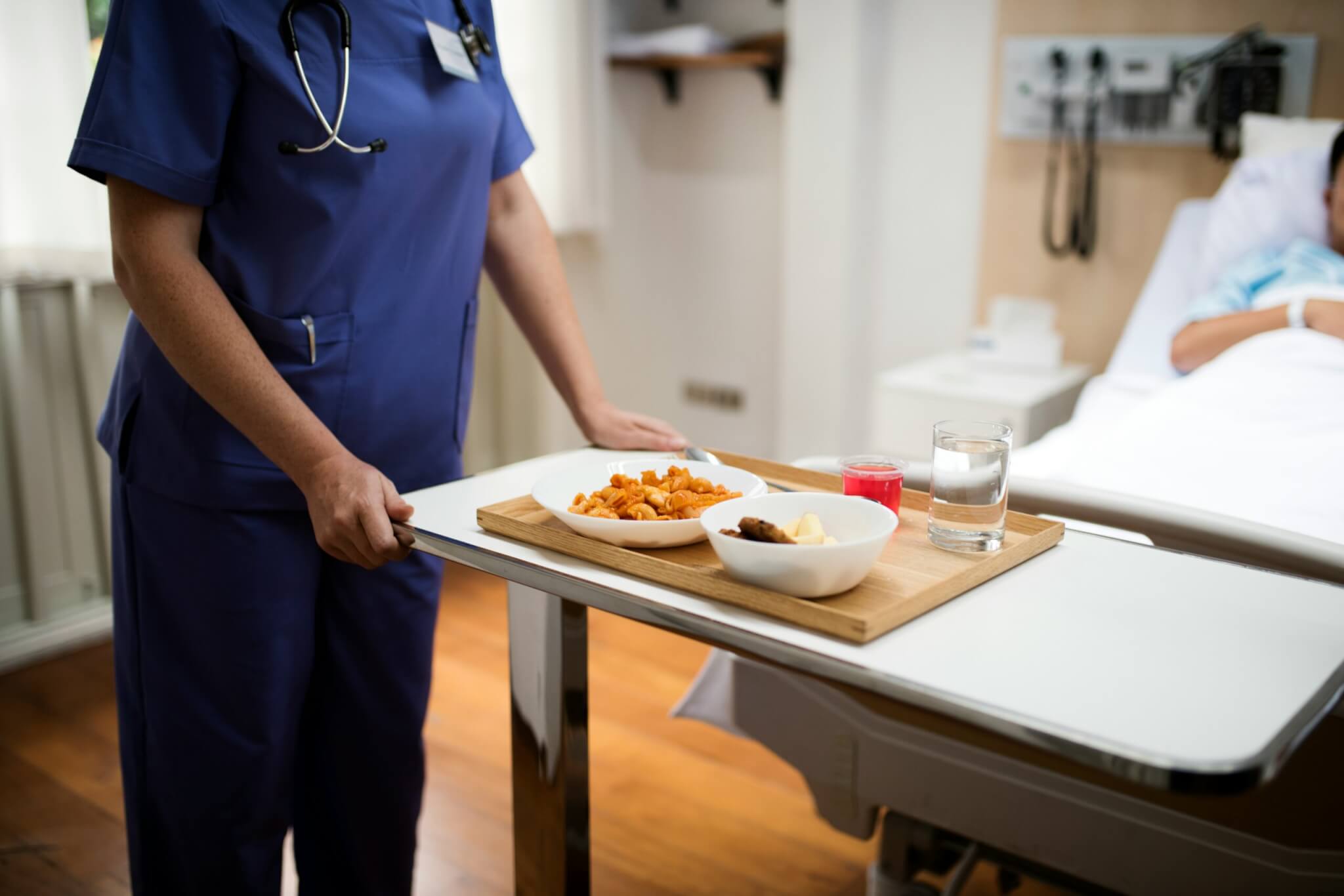
It is well documented that high quality, nutrient-dense and fibre-rich food plays a vital role in patient outcomes – the NHS is pivotal to this. Every year, more than 195 million meals are offered up to patients and visitors – that’s over 370 meals a minute. The cost? One media report puts it at £830 million, across an incredible 1,000 hospitals and outlets.
Then there’s hospital retail, most of which is food and drink sales, estimated to be worth up to £3 billion a year. The UK government says it is committed to the economic, environmental, social, and health benefits of sustainable food procurement in the NHS and upping its game when it comes to food catering, but this doesn’t always translate into best practice.
More freshly cooked meals on-site, a greater abundance of fruit and veg isn’t always on the menu, and food provision can still be highly variable. However, there are bright spots in the mix, with 25 exemplar NHS trusts, improving their catering and boosting the nutritional value of served food, with more healthy options. There’s even an NHS ‘chef of the year’ competition.
“There are a number of sites in England, that do not offer, what I would even say is a basic level of food provision, but we are making great steps to change that now,” explains Tim Radcliffe, Net Zero Food Programme Manager at NHS England.
He adds: “Traditionally hospital food hasn’t had the right or best profile in wider society. Very few people are even aware that there is even a career path in the NHS for caterers and chefs who can now make a real difference. It’s time we changed perceptions.”
Could do better to best
While Addenbrooke’s Hospital in Cambridge still has a Burger King in its food court, there are now 20 hospital trusts now supporting the Soil Association’s Food for Life Served Here certification, which aims to transform food culture in public settings. Part of this programme involves cooking from scratch using minimally processed, seasonal ingredients and a commitment to organic produce.
But the wheels within the NHS turn slowly. It is a behemoth, catering to a huge number of staff, patients, and visitors. It is also the largest employer in Europe, with over 1.5 million on its payroll and nearly 23 million patients admitted each year. The challenges encountered are summed up well, by the former boss of Compass, a food service provider, a few years ago: “Imagine a restaurant where 1,000 people must be fed at once, where your kitchen is half a mile away, where your chefs cannot season the food without written permission, where half your customers feel ill and none of them want to be there anyway,” states Steve Cenci.
He continues: “Where menus must include options to satisfy dietary, medical, ethnic, and religious demands, where 66 per-cent of diners are between 65 and 90 years old, and where your budget for a three-course meal and a drink is £2.49. Welcome to the world of patient catering.”
Food waste in the NHS is also a big issue, 9.5 million tonnes are left on plates or disposed of each year – that’s 18% of all food purchased. Waste levels may be lower than the hospitality sector and general households, yet this is still a significant cost. And let’s not forget the NHS caters for the sick, which creates issues in itself: not everyone is able, or wants, to eat in hospitals.
So is there room for more locally sourced, agro-ecological produce? And for hospitals to really up their game? Radcliffe seems to think so. Unlike schools and prisons, NHS trusts have more flexibility on the meals they serve too.
“We don’t have very many massive procurement handcuffs, that’s a little bit of a myth. Trusts are all autonomous and independent. They can purchase virtually anything they want. Plant-rich menus are now a big talking point and it’s something we are keen on pushing forwards. Yet local sourcing at a certain level can be challenging, particularly from small producers,” details Radcliffe.
NHS catering sometimes isn’t set up for such producers or to cope with an inconsistency of local, seasonal supply. Another big issue is cost. Food inflation and energy price rises are increasingly eating into limited catering budgets. At the same time, hospital kitchens are themselves being asked to find year-on-year savings.
Imagine a restaurant […] where menus must include options to satisfy dietary, medical, ethnic, and religious demands, where 66 per-cent of diners are between 65 and 90 years old, and where your budget for a three-course meal and a drink is £2.49. Welcome to the world of patient catering. Steve Cenci, former Global Healthcare Lead, Compass
Slashing food waste
But if the NHS can reduce food waste it can unlock money for better sourcing. Electronic menu ordering is helping this process – including pictures on menus has helped guide patient choices and led to less waste.
24 NHS Trusts across the UK – including Solent, Sheffield, and Stockport – have successfully piloted bright blue plates to improve mealtimes for patients with dementia and cognitive impairment. Research by the Dementia Centre at the University of Stirling revealed that plain blue crockery provides a stark visual contrast against pale-colored foods (like chicken, porridge, and mashed potatoes). This helps patients living with dementia see what they are eating, which can increase their daily nutritional intake by up to half a pound. The trials also demonstrated a 14% to 26% increase in empty plates returned to kitchens, along with a 20% to 29% reduction in food waste. Patients also reported an improved, restaurant-like dining experience.
The big debate now is around choice architecture and making popular hospital dishes more healthy and with lower emissions – by stealth rather than radically changing what’s on offer. For instance, the humble cottage pie has beef swapped out for wild venison (a trend we’ve explored here), the meat quotient is then reduced with an extra dose of lentils; the same with curries.
“How do we take something that’s familiar to a patient and make it healthier? It’s about getting the nutrients into meals that people recognise, but we’re also trying to bring in more organic, more local, more seasonal beans and vegetables for instance,” says Caron Longden, Head of Business Development at Soil Association Food.
Chef and catering staff development is also key to change within the NHS – there have been great gains in many schools and some prisons on this front. Longden thinks there is a sea change afoot especially among the exemplar hospitals. “There’s a big buzz around hospital food at the moment and what it could be, as well as where it’s going,” she says.
The biggest irony – according to a report by the Food, Farming and Countryside Commission, the UK’s growing addiction to unhealthy food costs £268 billion a year – more than the NHS budget itself.
“If we can’t showcase the way that we believe the general public should be eating for better health and for sustainability, I don’t know who can. The NHS is committed to prevention over sickness in part of their ten-year plan. Part of the cancer plan is also about prevention, and what people eat plays a key role in this. So, yes, it absolutely should be the way forward,” concludes Dr Shireen Kassam, founder of Plant-Based Health Professionals UK.






Says it all Burger King in an NHS Hospital when we have an obesity epidemic. Does not Compass run this whom Cenci worked for?
20 trusts only soil association accolade out of over 300! Says it all yet Radcliffe says this is success! Maybe he should stop naval gazing! I was one of the first trusts to get this 10yrs ago!
Procurement is a laugh! Again Foodbuy run this and they are compass owned. I tried to by local meat along with my late friend Mike Duckett and we both faced battles and laughter.
Do we know the cost of poor nutrition of patients in Hospital… I doubt it! An elderly patient sent into hospital, from my experience, is put into bed. put a tray of food in front of them, they eat the ice cream as it’s they best bit and the rest is taken away. No encouragement to eat and a lot is unappetising, unhealthy stodge. No wonder they leave hospital with muscle loss and need rehab. Hospital care is a disgrace (also the post op patients and sick need the right nutrition). Where are Jamie or H F-W on this?