
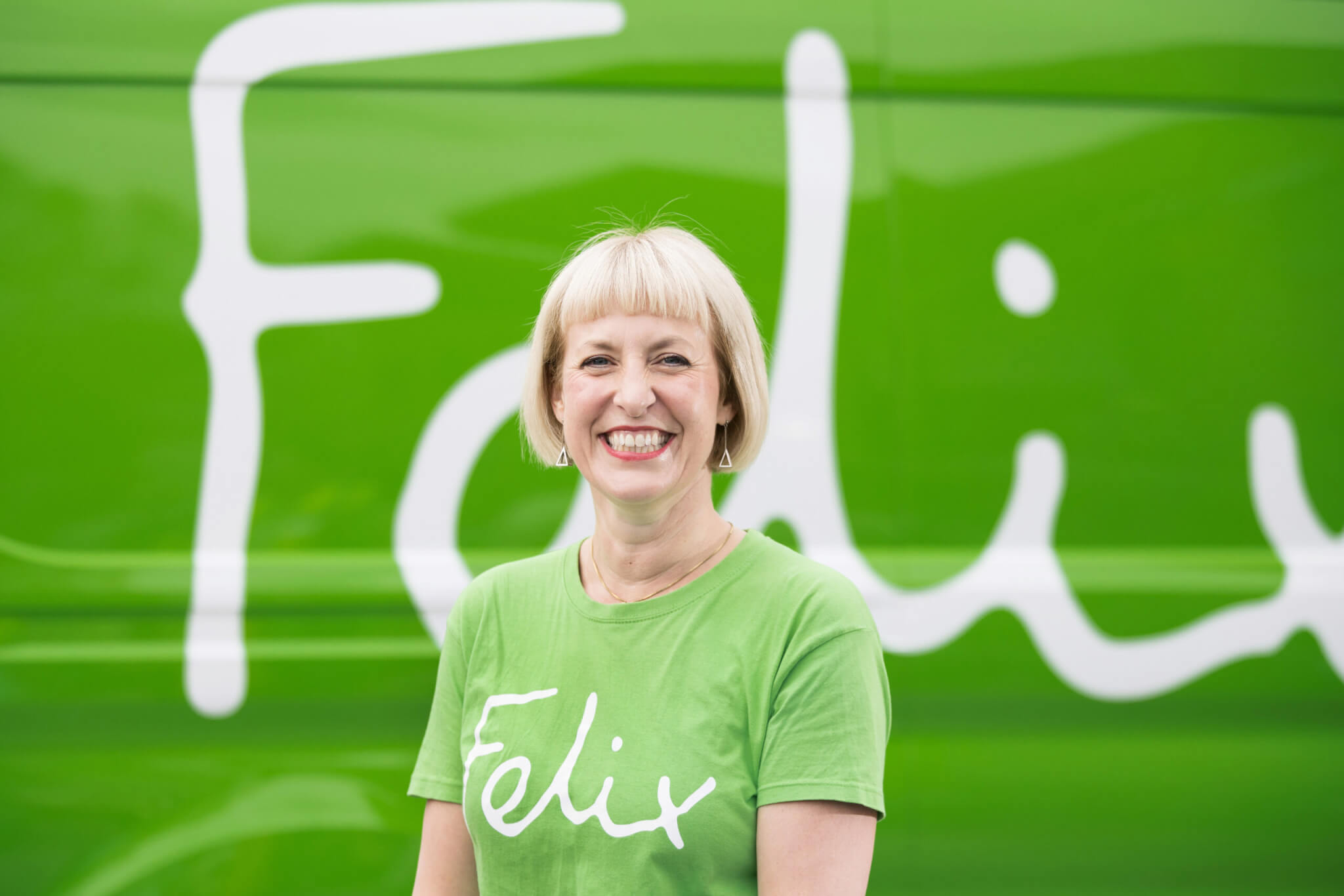
If there’s one thing that motivates the Chief Executive of one of Europe’s largest organisations tackling food insecurity, it’s the children and families that go hungry in our towns, cities, and rural areas every day. Three million young people and eight million adults (that’s more than the population of South East England) are now food insecure. Yet the UK is the sixth largest economy on the planet.
“We have a serious child poverty challenge in this country. And we are definitely seeing an increase in demand for our services. At the same time, a third of the food we produce globally is thrown away. So there’s an absolute travesty going on here. This is due to a broken food system at the moment,” explains Charlotte Hill, CEO of The Felix Project.
She adds: “But right now the redistribution of food is so much easier than the redistribution of wealth.”
Bright green vans with the Felix logo emblazoned on their sides scour the nation’s capital for good-to-eat surplus food that can be redistributed – either as basic products or family meals via their network of 1,200 community organisations. Started in 2016, The Felix Project is now London’s largest food redistribution charity.
A brutal environment for families
Along with FareShare, which they’ve just merged with, they serve up the equivalent of 148 million meals a year – more than four meals a second. FareShare is countrywide and is the UK’s largest charity fighting hunger and food waste – together they support an astonishing one million people across Britain.
“A few years ago we used to support the homeless, cancer-afflicted families and those escaping domestic violence. Today it’s people who are actually in work and the only elastic part of their outgoings is money spent on food. It’s why parents are skipping meals. The cost of living crisis is impacting the bottom 30 percent of the UK population the most and it’s getting harder for them to survive. There’s definitely been a shift,” states Hill who heads up the charity.
She adds: “The gap between those for whom the cost of living crisis means they might have one less holiday a year, versus those who simply cannot afford to make ends meet is widening. It is also a significant proportion of the UK population. Food insecurity is present on every single street and in every community. It’s also happening to people who you would never expect to be food insecure.”
The brutal impact of soaring inflation and price rises for basic commodities, energy, rent, and council taxes, which aren’t matched by increases in wages or benefits, means that people have to make stark choices between paying bills, heating, or eating. Just getting enough calories trumps any consideration for purchasing healthy, nutritious produce, which can be twice as expensive as ultra-processed foodstuffs.
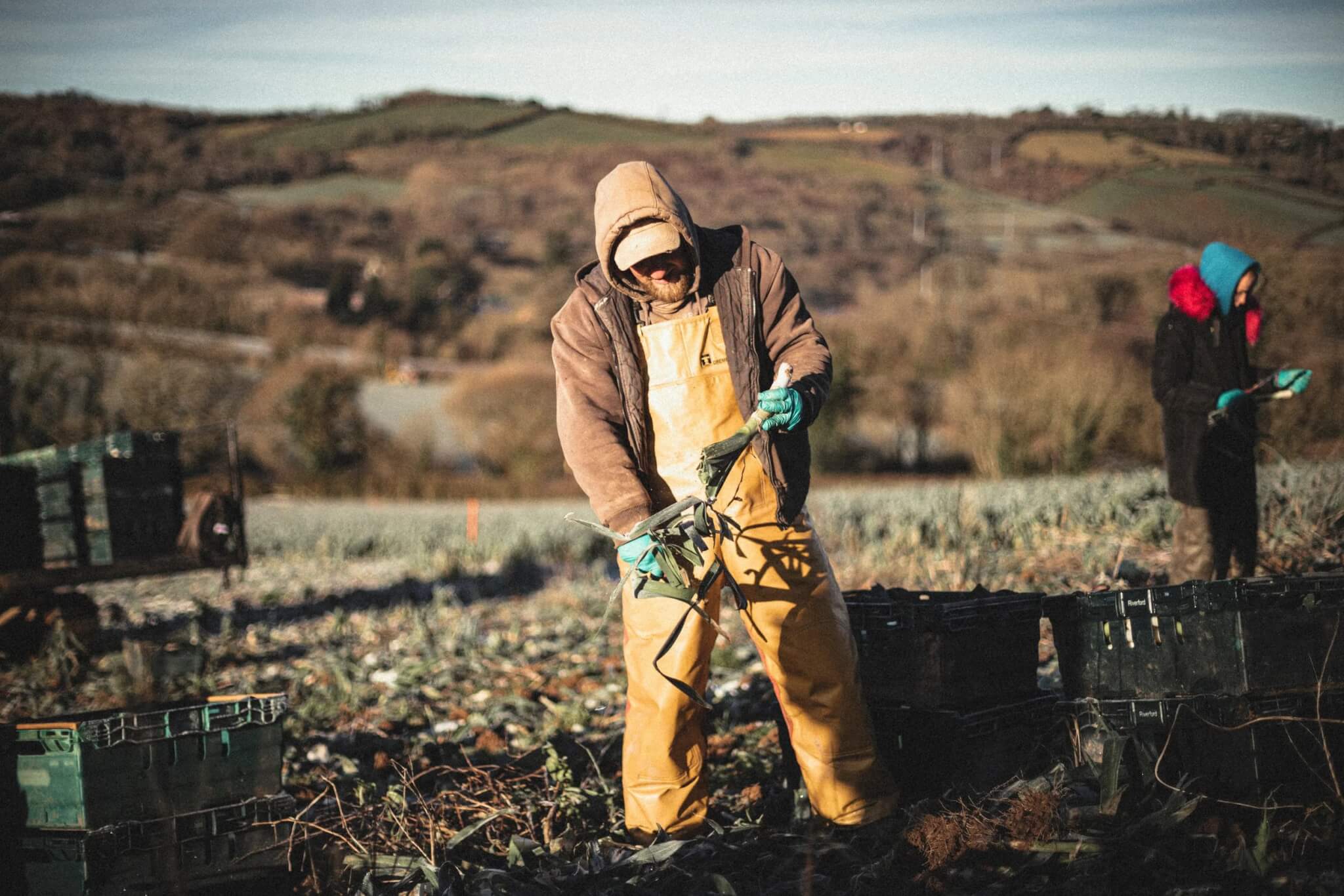
“One of the things people often wrongly think about surplus food that the Felix Project redistributes is that it’s end of life products, prepared goods, or ready meals. Half of all the food we redistribute is from the farm gate. It is fresher than you will get from the supermarket,” points out Charlotte Hill who received an OBE for her services to young people five years ago.
A key challenge is at the farm gate
Each year, the UK wastes 10.7 million tonnes of food. Astonishingly, less than one per cent of waste from the UK food industry is recycled for human consumption. Food on farms is also a big issue, over three million tonnes of food are estimated to be wasted. With only four percent of the food redistributed from farms directly. The Felix Project is looking to change this, but legislation is key.
“Firstly, the government could make some easy decisions around the incentives they give farmers so we get more amazing produce. At the moment, the only financial incentive for a farmer with surplus is to send it to an anaerobic digestor for £100 a tonne. Instead that fruit and veg could be feeding people. For instance, donating food must be baked into the Sustainable Farming Incentive and there should also be tax breaks,” suggest Charlotte.
She continues: “Right now, there are no tax incentives for farmers if they offer up food for redistribution. Secondly we want the government to make food waste reporting mandatory for businesses. Thirdly we would like legal protection for food donors – this would reassure businesses on their liabilities for the food they donate. This would then unlock so much more redistribution.”
At the moment, the UK redistributes a lot less than the U.S, which is close to seven percent, or France and Spain which are near four percent. Britain does not have a Good Samaritan Law either; the U.S. has one, which means companies cannot be sued if the food they donate makes people ill, while in this country, there is a high degree of liability.
Alongside FareShare, the Felix Project is now looking to rescue up to 270,000 tonnes of farm surplus. Currently, most of this is either ploughed back into the soil, used as animal feed, or sent to anaerobic digesters for energy production. Two thirds of this tonnage is already harvested produce, but is considered ‘out of specification’ by supermarkets and cannot be sold; this is equivalent to an incredible 285 million meals.
“We would love to work with more farmers across the country. We are always trying to appeal to growers who have surplus and to think creatively about how we can support them. We send groups of 40 or so volunteers, particularly corporate volunteers, a day out to glean produce, such as picking apples. We are also looking at new incentives for farmers,” states Hill.
The Felix Project and FareShare have now been awarded £9.3 million by the UK government in order to incentivise surplus food supplies from the farm gate. It is already working with three fruit farms that have been unable to turn a profit due to increasing production costs, low prices, and onerous contracts with supermarkets.
Dealng with the three-legged stool
So what keeps Charlotte up at night? “We’ve got to have three things to make this work. It’s like a three-legged stool. We’ve got to have food, we’ve got to have money, and we’ve got to have people. In London alone, we have 13,000 volunteers who help us move that food,” she states.
She adds: “But there’s no point in having loads of food if you don’t have the money to be able to move it around and you certainly need volunteers to do the work. So we have to grow our volunteering base, our food supply, and our funding equally. So this is the challenge that keeps me awake.”
These are not small operations either. FareShare has a turnover of £23 million, the Felix Project £15 million. They are the size of some considerable businesses; part of their success could be due to the fact they are as professional as the businesses they collect from.
“We try and reflect the food trade, which is open 365 days a year, seven days a week. Industry wants us to be as agile as they are. They also want us to take all of their surplus when they have it. The more we can professionalise and provide that service the better. This is about the friction we’re removing, so there’s no excuse as to why the trade should be wasting surplus food,” details Charlotte Hill.
She concludes: “We’re not going to lift those millions of children out of poverty overnight. It will take decades. Of course, we want to live in a fair and equitable society where people aren’t relying on surplus food to live. But in the meantime, whilst there is all this food being thrown away, it’s our moral responsibility to try and get that food to the people who need it the most.”
If you would like to make a donation to FareShare you can do so here.



0 Comments