
“I’m pleased that businesses are committed to enhancing their ongoing work across welfare and the environment.” So said Allen Simpson, chief executive of UKHospitality, last week as he announced that eight of his member businesses were setting up the “Sustainable Chicken Forum”, which “will play a vital role to make even more progress, as well as overcoming this shared supply challenge”.
The statement also confirmed that the businesses – between them the owners of 18 high street brands including Burger King, Frankie & Benny’s, KFC, and Wagamama – were dropping out of the Better Chicken Commitment (BCC). This is the promise these companies, and others in the UK, plus hundreds across Europe, made to give the birds in their supply chain more space, longer, more fulfilling lives and the most humane death.
With eight dropping out, this leaves 14 UK companies still signed up (Compassion in World Farming, which runs the commitment, could not tell me whether this was accurate). Greggs, Subway and Pret are still ‘in’, so too the Azzurri Group, which runs Zizzi and Ask pizza chains, and Marks and Spencer. To date, Waitrose is the one to have met all six commitments in full, as the chief operating officer Charlotte Di Cello explains: “Fresh and frozen, sandwiches, pizza, ready meals, gravy – all Waitrose brand chicken [have met BCC criteria].”
The deadline for everyone else to catch up is the end of this year. The chances of many following Waitrose’s lead are slim. The likelier bet is on more UK companies following the eight out of the door (Unilever seems to have now dropped out too). That the brands enjoyed plenty of positive PR in signing up around 2020 – and since – is quickly forgotten.
Compassion in World Farming had already started handing out extensions as last year KFC led others to complain that the timeframes were not viable. Shifting supply chains to slower growing breeds – shown to be higher welfare – was proving particularly problematic: for example, of the millions of chickens sourced by KFC just 0.7% were slower growing, according to the company’s recent animal welfare progress report.
Others have struggled too, especially the foodservice companies who have long argued that their share of the market is too small to affect change. That is fair, but only to a point.
Supermarkets and foodservice companies buy chicken from the same sheds, with the supermarkets taking around 65% to 70%. The biggest chains like Tesco and Sainsbury’s and Asda are not signed up to the BCC so what they want matters. Still, that leaves over 30%… so to suggest the likes of KFC have no say in the chicken they buy is folly. Indeed, chicken consumption across foodservice is actually growing, and fast, which should give the sector more power, not less.
Chicken shop surge
The chicken shop sector led the openings in fast food in 2025, according to Maria Vanifatova, chief executive and founder of Meaningful Vision. Writing in Propel 500 – 2026, the report covering the top 500 hospitality companies in the UK, Vanifatova said the segment showed 6.4% growth in site numbers. Looking ahead, she expects new openings to continue to support traffic growth for fast-food brands, with chicken concepts, bakeries, and coffee shops still having room for expansion. “In 2025, the growth areas were premium fast-food and fast casual restaurants, which benefited from consumer downshifting. This trend will continue in 2026,” she said.
In other words: cheap chicken is flying and will likely go higher still. “The whole thing really worries me,” the Chief Sustainability Officer at a major food business told me this month. “We can source sustainable fish but chicken? Is it better to buy British birds reared only to Red Tractor standard or to go overseas for slower-growing ones raised to far higher welfare standards? And how do we communicate all this to our customers?”
This is a fair point, and whether consumers care about chicken is unclear. They have embraced free-range eggs wholeheartedly, but how many question the provenance and production system for the Sunday roast at the pub or midweek Thai on the high street? There has to be more transparency, otherwise more chicken shops will open and more cheap, intensively-reared chicken will be added to menus.
“In a consumerist world where the onus is seemingly on individuals to ‘make the right choice’ rather than on businesses to provide better options, the rise in fried chicken is unsurprising,” explains Dan Crossley, executive director at the Food Ethics Council.
Indeed, fried chicken is everywhere but the costs of this are often hidden. “{…] it saddens me greatly to think that in spite of efforts to publicise the deleterious effects of intensive poultry farming, the massive lobby behind industrial commodity production has secured growth in one of the sector’s most damaging operations,” notes Tom Tibbits, who is involved with the Friends of the River Wye group, which has been monitoring water quality in an area that is a hotspot for poultry production and a hot potato because of the damage being done to the wider environment as a result.
Less or more?
But ‘more people want more poultry’. This is the argument the chicken industry is making at the moment – and not only for dropping welfare commitments that were years in the making. More chicken means less beef, which means fewer greenhouse gas emissions. More intensively-reared chicken, so their argument continues, also means fewer emissions than higher welfare chicken.
“UK farmers simply don’t produce enough of these [slower-growing] birds and switching would almost double the carbon footprint, as they need more feed, more space, more time to grow,” Nando’s, another of the BCC drop-outs, told The Sunday Times last weekend. It’s not clear where that emissions figure comes from; UKHospitality put forward the 24.4% higher emissions figure from a report commissioned by the Association of Poultry Processors and Poultry Trade in the EU Countries (AVEC) for ADAS.
That study was picked apart by some campaigners and scientists. Carbon footprinting is rarely clear-cut. What is clear is that there is a tension between improving chicken welfare and minimising greenhouse gas emissions. The slower the chicken grows the more feed it will need. However, alternatives to feed exist – for example insects rather than soya – which could dramatically reduce emissions. As one of those involved in the new sustainable chicken forum told me: this shift will take years, not least because of the regulatory hurdles involved. “Currently, there are more obvious routes to decarbonise beef than chicken,” they add.
Whatever you do, pound for pound, beef will have a heftier footprint than chicken. In fact, emissions from chickens are so low, Swedish academics noted in their 2025 paper What is better chicken?, that it begs the question: is the need to minimise greenhouse gas emissions of broiler production as “pressing” as improving broiler welfare?
This week, CIWF, The Humane League and the RSPCA published an open letter to the brands that have dropped their BCC pledges. In it they outline that slower-growing breeds are “the foundation that underpins all other BCC welfare criteria. Without transitioning from fast-growing breeds to more robust, slower-growing strains, birds are physically unable to fully benefit from the improved environment and additional space you may provide.”
Extra space to move and carry out natural behaviours is great, but fast-growing birds may not be able to take advantage of it: “Poor mobility, leg disorders, cardiovascular problems and other health issues associated with rapid growth severely limit their capacity to move, explore, perch, and engage with enrichment,” the organisations wrote. “Changing breed also brings wider socio-economic and environmental benefits that should be part of any credible sustainability assessment, such as lower mortality, fewer carcass downgrades (reducing food and feed waste) and reduced antibiotic use – supporting both animal welfare and public health,” they added.
A fowl failure
Brands like KFC and Nando’s have failed to drive real improvements in welfare, especially for slower growing birds. They have tinkered around the edges and Compassion in World Farming has done little to prevent that.
Admittedly, it is hard to change business models that are working economically. The current business models are set up to fail on welfare and environmental protection: they rely on keeping chicken cheap so they can open more restaurants and sell more chicken to make more profits. This is ‘fast food’ after all.
Supermarkets are doing the same (apart from those two premium chains still signed up to the BCC). The whole system is dominated by a few very large agribusinesses (think Cargill and the like) that have their farmer suppliers tied in a chain that offers them small but fairly secure income and some regular profit – which is better than many farmers can expect.
Don’t get me wrong, poultry producers have been squeezed by fluctuations in feed prices as well as bird ‘flu. “It’s all been piling up,” as the British Poultry Council put it recently, adding: “and it is really down to us as an industry to provide the food security of the nation”.
Safe in our hands?
Food security is the term now bandied about regularly by all those who want to wash their hands of environmental responsibility. The mantra is: more food (and in this case more chicken) is a social good. This is short-term economic thinking, not long-term economic, environmental, and social sustainability.
For this reason, I cannot see a hospitality industry-led forum for sustainable chicken making any difference at all. Looking at the statement and the supporting quotes from its launch, this will simply be a lobbying front that joins others, including the IGD (Institute of Grocery Distribution) and the British Poultry Council and the NFU (National Farmers’ Union), in pushing for changes to planning laws that accelerate the building of sheds, giving birds a little more space (they may not even be physically able to use) and no more time to grow and explore.
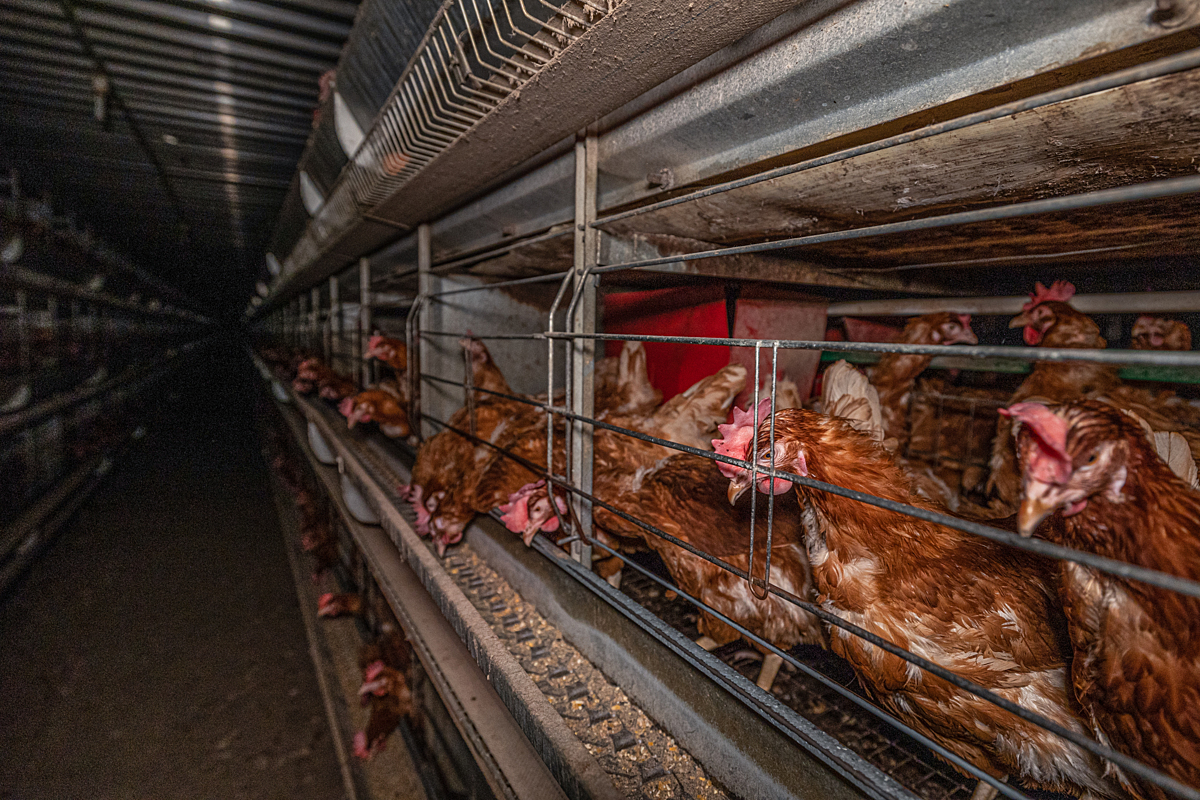
Under the better chicken commitment, 30kg/m2 is the maximum permitted. UK laws permit 39kg/m2 but many supermarkets have committed to 30kg/m2 whether they are signed up to the BCC or not. To keep chicken capacity at its current levels this means an extra 20% or more of extra space in sheds is needed, and the industry claims current planning policies are holding this expansion up.
The threat is that we will go hungry: “Welfare-driven capacity reductions and planning delays could see the UK lose more than 300,000 tonnes of poultry meat per year – equivalent to a 20% loss in shed volume,” says IGD. The Institute is certainly very keen to push for more poultry production, and it worth publishing its threat to the government in full:
“UK poultry anchors the national food system, employing 110,000 people and generating £2.8bn in annual production value. Poultry, meat, and eggs are now the UK’s dominant protein, with consumption still rising, as more consumers switch from other forms of protein. This switching is supporting the transition to net zero and supporting consumers to make healthier choices. However, the sector is at an inflection point. Without decisive, coordinated investment and targeted policy, economic activity and jobs will shift overseas. There is a better path: unblock planning and invest in manure management. These steps will lift productivity, unlock private capital, and add UK jobs.”
Putting aside the fact that chicken shops and fast food have seemingly become the ‘healthy choice’, or whether more meat of any kind really helps us tackle climate change, the message is clear: let us build more broiler sheds or jobs will be lost and chicken will be imported. Indeed, the IGD reckons another 5.8% growth in poultry production is possible by 2030 – higher still if people eat more.
The IGD says in its special report in September 2025: “The UK’s per capita chicken consumption is the third highest among G7 countries at 35kg per capita per annum, behind the United States (53kg) and Australia (49kg). This suggests that we have not reached our maximum chicken consumption.” Not that, just maybe, the Americans, Australians and we Brits are all eating too much?
IGD wants 7,000 more chicken sheds to help “plac[e] poultry at the heart of the UK’s protein future” and support “rural jobs”. It’s among those pushing the government to develop “a national spatial plan to pre-identify optimal locations for poultry shed expansion based on infrastructure, environmental impact and market access”. Restrictions relating to ammonia and manure should also be relaxed, IGD suggests.
To suggest this is a risk is putting it lightly. Consider what has already happened in areas like The River Wye thanks to a collective failure to properly regulate the expansion of poultry production, and the widely ignored unintended environmental and social consequences of this. Polluted rivers. Choked biodiversity. Natural spaces ruined. The whole thing is a disaster, according to Ruth Westcott, at food and farming campaign group, Sustain.
Increasing chicken production is not a food security saviour, it is a huge risk, she says. “The government is swallowing the industry’s line,” she explains, but in reality “we need to stop expanding, reduce the stocking densities, pay farmers more and the big agri-food companies less. That would support the protein transition we need to see,” she tells me.
IGD’s report also raised the prospect of ditching the BCC, urging industry to “postpone the transition to slow-growing breeds until additional production capacity is secured”. However, it seems that the extra space is not for the benefit of the poultry or the producers but the profits of the big businesses that dominate the chain. Should we not be adapting the planning system so it supports agro-ecological approaches and those smaller farmers that continue to struggle to survive, wonders Westcott?
Fast-growing birds mean fatter profits. That is the rub. The debate over the environmental consequences will be clouded by the ‘intensive chicken has a low CO2e footprint’ argument. The notion that less chicken reared to higher standards will have even fewer emissions will be lost. The idea that we could eat fewer but ‘better’ (happier) birds and more beans laughed off.
This is in part what prompted a group of food industry insiders to blow the whistle on some of the UK’s biggest food retailers, producers and manufacturers whose commercial strategies i.e. to sell more cheap, processed meat, are misaligned with their health and climate ambitions. Food security, they argued, is also being put at risk as large agri-businesses dominate the supply chain, demanding more intensive production at large facilities which squeeze out smaller farmers.
These whistleblowers are people who understand how decisions are made, the structure of incentives and board conversations at play. As one senior retail executive from the group told me: “Very few people are making money from selling meat, yet meat is a strong perception driver of value and quality in public minds. It is the devil you know.”
Protein push
Meat is very much in the ascendancy, and fast food chains and supermarkets, as well as their major suppliers like Cargill, Avara Foods, JBS et al, are hell-bent on making the most of it.
Last week The Guardian reported that many of the same high street brands dropping out of the BCC are also dropping their plant-based options as meat – thanks to the food industry’s protein push – is favoured. Traditional meat mains grew in prominence, with pizzas and burgers recording an uptick, for example. High-protein chicken dishes were a key driver, the report noted, increasing by 4.2 percentage points of mains share over the period analysed.
How much of this – if any – was higher welfare, let alone BCC aligned, is as ever unclear: supermarkets will proudly present British chicken on shelves but how often have you seen such a claim on a fast food or high street restaurant menu? Free-range, slower-growing, and organic options are almost non-existent (though some recent reports have suggested an uptick in demand for organic chicken, which is good news).
Don’t we deserve to know where our chicken comes from and how it was raised? Or that BCC birds for example have more space than ones on Red Tractor farms, at 30kg/m2, but less than free-range (27.5kg/m2) or organic (21kg/m2). KFC, by comparison, is currently at an average of 34.1kg/m2.
We have a problem with poultry in this country, but it is not the one industry is presenting to policymakers and politicians. Their present mantra on meat is ‘more and more; the message that bigger is better’. And the (big) food industry is shouting it louder than ever.
Launching another commitment to entrust improved animal welfare to businesses that have collectively failed to deliver meaningful progress on the areas that matter is akin to putting the fox in charge of the hen house. And we all know how that ends.
In January, the UK’s Food and Environment Secretary Emma Reynolds promised, as part of the new animal welfare strategy, to “work with industry to promote the use of slow growing meat chicken breeds”. George Eustice, who held the same post from 2020 to 2022, called the BCC drop-outs a “kick in the teeth” for the animal welfare strategy; their withdrawal, he added, “is now a direct challenge to the authority of ministers” who had hoped progress could have been made through voluntary agreements. “It may be that tougher legislation is now the only viable option left to improve welfare outcomes for broiler chickens,” he added.
That is an easier call to make when you are a former minister than the incumbent. Maybe the power lies with us, the buyers, rather than the bureaucrats.





Gosh, yes! How can we turn the tide on this? An improvement in our nation’s health CAN be attained through a reliable supply of safe, humane & affordable animal protein such as chicken, but it just isn’t happening. Consumers CAN vote by boycotting cheap chicken but is that realistic? Short answer; not b***ly likely.