
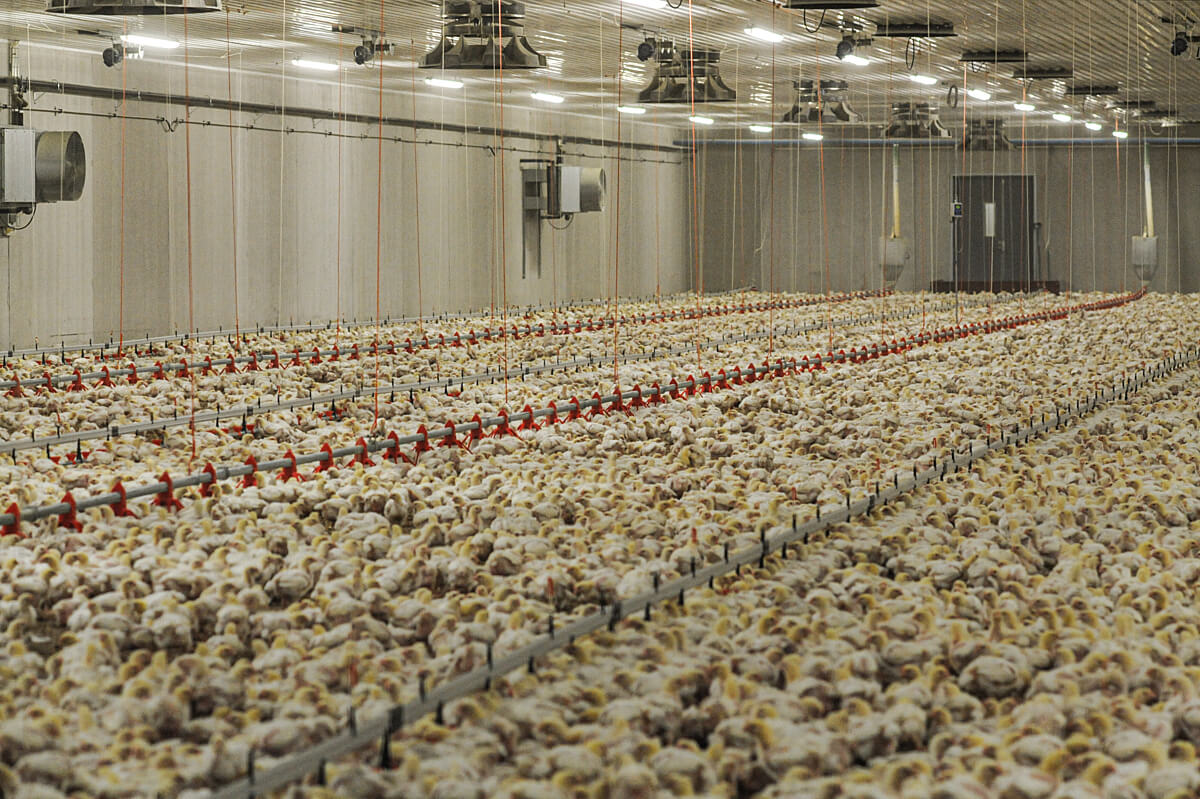
We probably all like to think our food is produced in a wholesome way, sourced locally and ethically, with animals treated well, farmers paid a decent wage for their efforts, and environmental impacts minimised. Yet the reality, as the AGtivist has reported week after week in recent months, is very different, with many of our day to day foodstuffs linked to appalling impacts on people, farm animals and the natural world.
Now, worrying new research spanning the UK, Spain and Italy has revealed that meat, eggs and dairy products are increasingly produced by a small number of giant corporations, dubbed the new “meat tycoons”, that utilise controversial industrial farming methods and wield growing and immense power with often-multibillion pound supply chains.
This should concern us all. For farm animals, more industrial farming almost always means more suffering, according to critics. For people, economists warn, the risk of corporate consolidation is that cost savings become profits, not lower prices, even as payments to farmers are squeezed. For the environment, the situation – and the accompanying “race to the bottom” – is equally worrying.
Amongst the most prominent findings in the new research is almost complete market domination of UK poultry supply by just three companies, while just eight businesses control about 70% of the UK’s meat processing turnover overall. In Spain, seven companies control half the pork slaughtering business, while five account for nearly half of total dairy turnover. In Italy, the investigation found that only five companies control half the poultry, pig and beef meat supply chain, from slaughtering onwards.
The increasing corporate grip of swathes of Europe’s food supply follows investigations that revealed how intensive livestock megafarms have swept across the European Union (EU) and UK in recent years. In 2025, using public records, internal EU data and freedom of information responses, a cross-border team of journalists revealed that there were more than 24,000 industrial-scale chicken and pig farms running across the EU and UK. These are farms housing 40,000 or more poultry birds, 2000 or more fattening pigs or 750 or more breeding pigs.
The largest type of farms, known as Concentrated Animal Feeding Operations (CAFOs) or “megafarms”, were also, for the first time, identified in many European countries. Some of these units can hold more than 1 million chickens or 30,000 pigs. The investigation also uncovered Europe’s emerging factory farm hotspots, including Spain, Italy, France and Poland, which have seen a growth in industrial animal production in recent years.
Consolidation
Corporate consolidation occurs when a few companies come to dominate a sector, often by buying other companies, creating a concentrated marketplace of a few big players. Risks from this kind of concentration stem, in large part, from the power companies enjoy when “market power builds along the chain,” as former chief competition economist for the European Commission’s competition authority, Tommaso Valletti, says.
“Imagine that a concentrated group of processors is able to pay farmers less for their products. If the resulting cost savings are not passed on, they become higher margins for the processors instead,” says Valletti, now Professor of Economics at Imperial College London. If that happens, he explains, farmers can end up with a smaller share of the pie, while consumers might not benefit from lower prices. Other consumer effects, he added, could include less choice and lower quality.
Dominant companies that expand by vertical integration – essentially buying suppliers, which, in the animal protein sector, might be feed producers or genetic businesses for example – could also make life harder for rivals, says Massimo Motta, who also served as Chief Competition Economist for the European Commission and is now Professor of Economics at the Barcelona School of Economics.
Although there can be efficiencies from integration, he claims, modern research points to risks that “firms enjoying significant market power might foreclose access to important inputs to rival firms.” Foreclosure describes the ability of one company to limit another’s access to resources, such as livestock inventory levels.
Motta adds that globally, the animal protein sector “has indeed known levels of excessive concentration and deeper vertical integration, with inputs from fertilisers to logistics, from patents to market information in the hands of very few conglomerate companies.”
Narrow margins
Others argue, however, that while having fewer, bigger companies dominating the market might indicate reduced levels of competition, it may also mean the market has all the businesses it can cope with. Commenting on excerpts from the UK research, Cesar Revoredo-Giha, Professor of Food Supply Chain Economics at Scotland’s Rural College, says that concentration could mean “the market cannot have more firms operating” at the same time because they might lose money.
His view, he adds, is that the current structure of the UK meat and dairy market is the result of how narrow the profit margins are due to competition.” This means companies are trying to “capture greater market share to expand their business” and scale up to lower costs.
The increasing concentration and consolidation being seen across the meat and dairy sectors goes hand in hand with the expansion of factory farming, according to some critics, a phenomenon which itself has multiple drivers, including controversial regulatory frameworks, agricultural subsidies, and growing consumer demand for cheap meat. At the same time, internal divisions within the European Commission have hindered meaningful reform, according to campaigners (although just this week progress against phasing out cages in some animal production systems has been made). They say the focus has generally remained on growth and competitiveness over sustainability and ethics.
Those behind intensive livestock farming argue that such production models are necessary to feed growing populations, meet demand for cheap meat and dairy, and ensure food security. They claim that larger farms are typically tightly controlled with high welfare, health and environmental standards and ongoing investments to mitigate problems.
But in reality, as industry whistleblowers themselves have previously said, industrial animal farming is often accompanied by a catalogue of harms, including pollution of rivers, land and air, poor animal health and welfare standards, the spread of disease – including antibiotic resistant bacteria – economic impacts (including price squeezing) on conventional livestock farms, and increasing conflicts in rural areas between corporate-owned farms and local communities.
Acquisitions
One of the clearest examples in the UK of how companies spread control over their supply chain is Cranswick. Since 2014 it has acquired ten smaller companies, boosting its control over pig and poultry supply chains, with 20% of the company’s revenue now coming from poultry. Purchases included Blakemans, a sausage maker, JSR Genetics, a supplier of breeding pigs, boars and artificial insemination services, Elsham Linc, a meat poultry business, and Crown Chicken, a poultry meat and feed producer.
More broadly, in the UK, just eight businesses control about 70% of meat processing turnover, worth an estimated £22 billion, while five companies account for nearly 60% of dairy processing turnover worth nearly £12 billion. The meat companies are Cranswick, Pilgrim’s Europe which includes Moy Park, Karro Food Group (owned by Sofina Foods Limited), ABP Food Group, Dawn Meats, Kepak Group, the 2 Sisters Food Group and Avara Foods. The dairy companies are Arla Foods UK, Müller UK & Ireland, Ornua UK, Saputo Dairy UK and Dale Farm.
Pork and poultry processing is even more concentrated, research found. In the pork sector, four companies, Cranswick, Pilgrim’s Europe, Karro and Dunbia UK, control about 90% of processing turnover, while poultry is dominated by the Brazilian-owned Pilgrim’s Europe and Moy Park, the 2 Sisters Food Group and Avara Foods. By itself, Pilgrim’s controls about 30% of sector turnover.
Separately, a report from the UK government’s Competition and Markets Authority (CMA), found 80% of the UK’s chicken supply is “concentrated” and relies on three firms, Moy Park, Avara and the Boparan Group which owns both the 2 Sisters Food Group and Banham Poultry. In another report, the CMA says the Boparan Group “is estimated to be the largest supplier of chicken in the UK and has few significant rivals.”
The CMA did not respond to an interview request and none of the UK meat and dairy companies commented on the specific findings sent to them. A spokesperson for the 2 Sisters said they could not respond without reading all three research reports.
British Poultry Council chief executive, Richard Griffiths, said that consolidation in the UK poultry meat sector was “neither new nor surprising” and that “more robust supply chains” had “driven productivity, investment, and the uptake of technology,” creating a secure sector that is “trusted by tens of millions of consumers.” The council, which represents the poultry industry, did not immediately respond to follow up questions about animal welfare or river pollution by poultry farms.
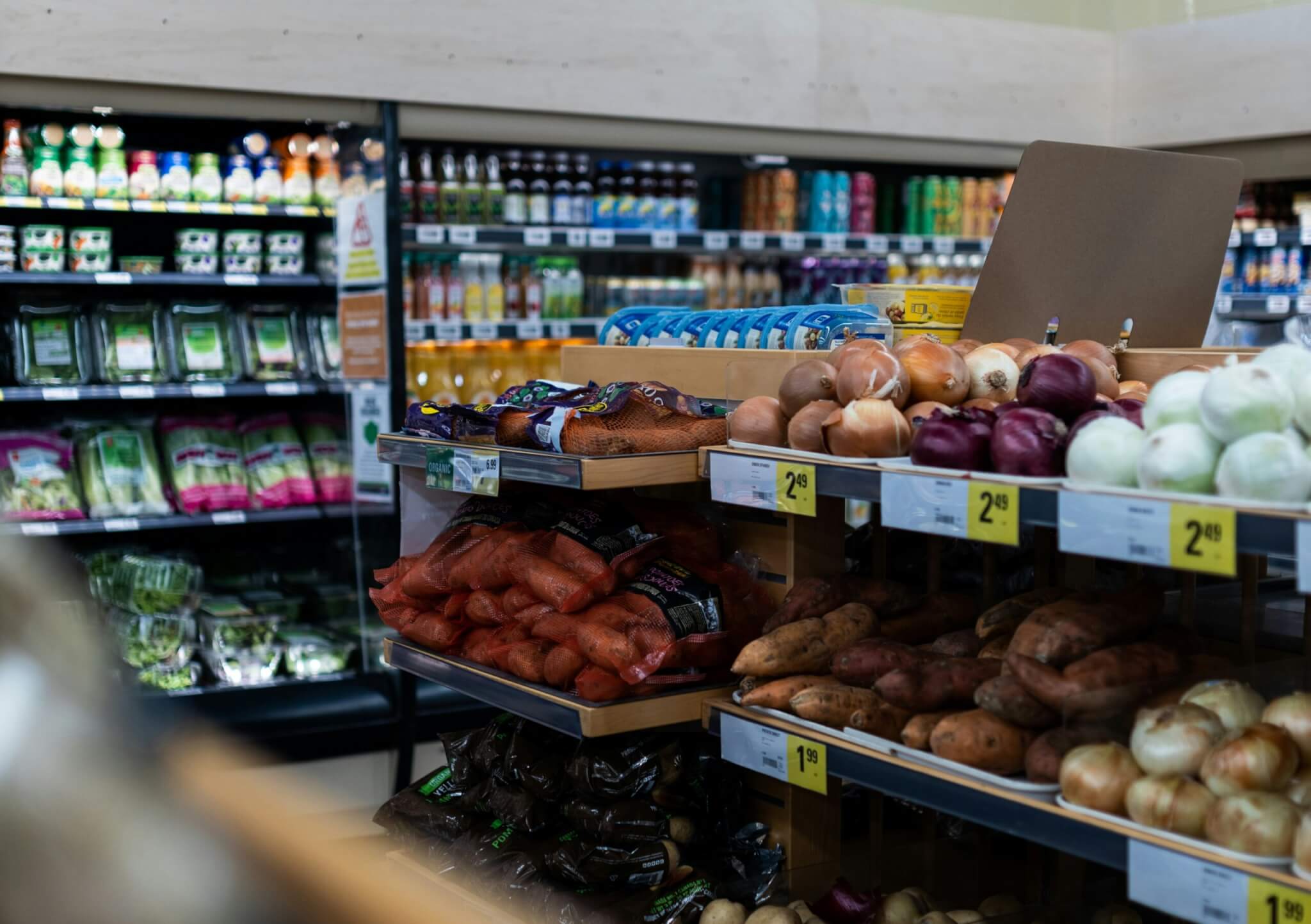
Whilst this latest research doesn’t provide any easy solutions to reforming our broken food systems, it does help join the dots between what we buy at the supermarket checkout and the ever-smaller number of so called “meat tycoons” who control swathes of our food supply and apparently profit handsomely from the current direction of travel.
The AGtivist is an investigative journalist specialising in food and agriculture issues who’s been covering this beat for 20+ years. The AGtivist column at Wicked Leeks shines a light on the key issues around intensive farming, Big Ag, Big Food, food safety, and the environmental impacts of intensive agribusiness.


0 Comments