
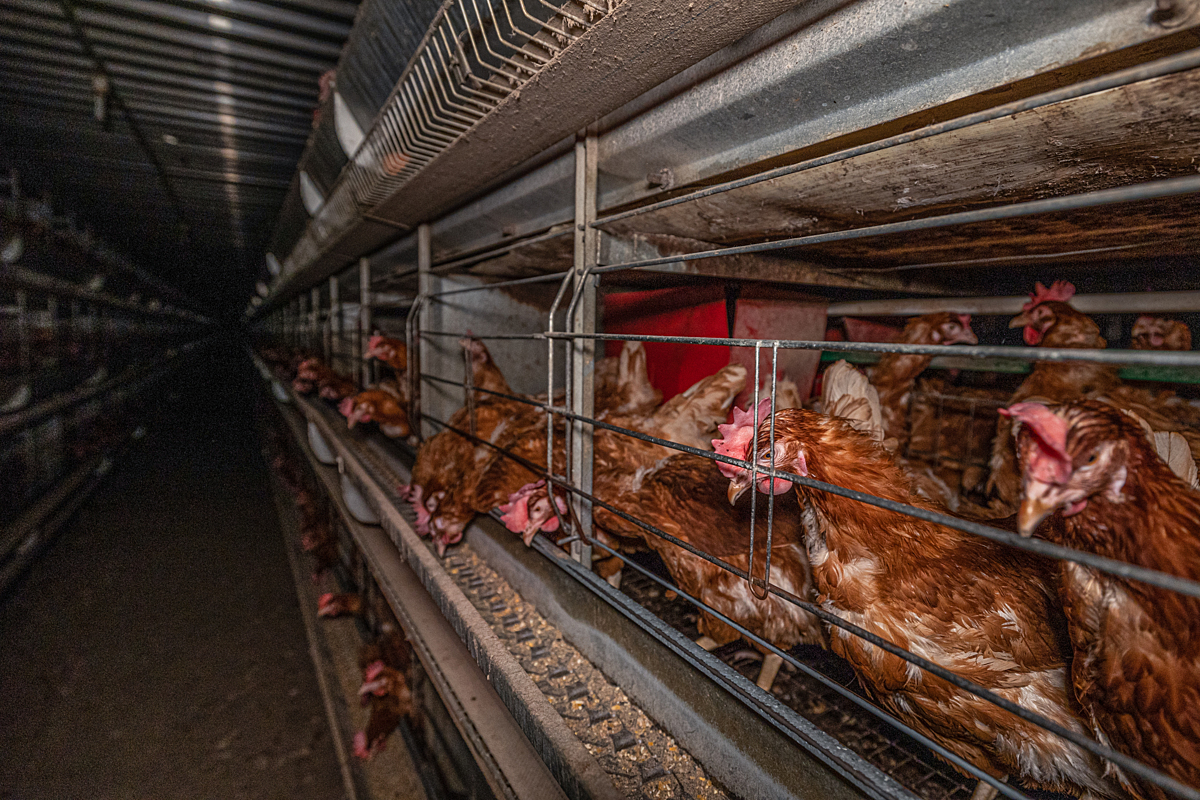
It may not be immediately obvious, but in the UK each year we import significant volumes of pork, beef and poultry meat from across the English channel, with exports of these key foodstuffs from European Union countries totalling more than 1.4 million tonnes in 2025. In addition, millions of EU-produced eggs find their way to Britain every year, many destined for use in manufacturing and catering.
How EU-produced meat and eggs are produced therefore matters to UK consumers, whether it’s animal health and welfare standards on farms, during transport and at slaughterhouses, environmental impacts, or the treatment of workers within the supply chains that serve us.
Recent years have seen a stream of revelations connected to all these aspects (and more) of the EU’s mighty meat and livestock machine, shining a much-needed light on parts of the chain that industry chiefs would prefer remain hidden.
But now another, virtually invisible, consequence of EU meat production has emerged, one that threatens not just environmental fall-out across Europe, but, potentially, the health of its people too.
An investigation has revealed that air pollution linked to industrial livestock farms is surging across swathes of the EU, with emissions of ammonia – a toxic gas emitted by livestock and farm waste – recorded at intensive poultry and pig farms found to have increased in at least 12 countries in recent years. These include Poland, Denmark, France, Greece, Portugal, Romania, Ireland, The Netherlands, Finland and Belgium.
Ammonia is an invisible gas that can mix with other pollutants to form fine particulate matter (PM2.5), one of the most perilous forms of air pollution. Long-term exposure has been linked by some studies to heart disease, stroke, respiratory conditions, type 2 diabetes and dementia, as well as other medical issues. Indeed, groundbreaking research by scientists from the Max Planck Institute for Chemistry previously estimated that as many as 50,000 lives across Europe could be saved every year if emissions from farming were cut by half.
Ammonia can also harm biodiversity and ecosystems. Excess nitrogen from ammonia deposition – a process which sees the gas move from the atmosphere back onto land and water surfaces – can acidify soil, fuel algal blooms, as well as, according to some experts, degrade forests, wetlands and freshwater habitats.
Industrial meat “hotspots”
Many of the countries found by researchers to have witnessed increases in factory-farm linked ammonia pollution – including France, Poland, Romania and The Netherlands – are, unsurprisingly, amongst the emerging European “hotspots” for industrial meat production, with some of these nations experiencing dramatic increases in numbers of the largest type of intensive livestock units, often known as “megafarms”.
Researchers analysed emissions data from thousands of individual farms, compiled from public registries and responses to freedom of information (FOI) requests. Pollution totals for the different countries were then measured over two distinct timeframes, a five year period spanning 2020 to 2024, and a two year period spanning 2023 to 2024, enabling them to identify those experiencing increases in ammonia pollution linked to factory farming.
Last year it was revealed for the first time how Europe (including the UK) was now home to at least 24,000 factory pig and poultry farms large enough to require an environmental permit. The size threshold for requiring a permit is 40,000 or more poultry birds, 2000 or more fattening pigs or 750 breeding pigs and above. Many farms were found to confine far more animals than this, with more than a million chickens or 30,000 pigs documented at some sites.
The new research found that the highest levels of air pollution linked to intensive farming overall were in Spain, France, Germany, Romania and Hungary. Whilst not included in the analysis, the UK’s farming sector isn’t immune from the problem, as the AGtivist has previously reported, with communities living in some areas saturated with livestock farms reporting a range of adverse impacts associated with ammonia pollution.
A regulatory loophole in both the EU and the UK means that ammonia emissions from factory cattle farms – both dairy and beef – are not currently recorded, meaning the true scale of pollution is likely to be far higher.
Responding to the latest findings, campaigners and experts told researchers that much more needed to be done to tackle air pollution tied to intensive livestock farming. Isabel Paliotta, Senior Policy Officer for Sustainable Food Systems at the European Environmental Bureau, said: “This very timely research is yet another reminder of how the accelerating industrialisation of EU animal farming is jeopardising public health, along with animal welfare and vital ecosystems. With the number of individual farmers free-falling and the number of animals remaining quite stable, it is clear that farms are getting bigger, dirtier, and concentrated in fewer and fewer hands.”
She said that the EU’s Livestock Strategy (still being finalised) meant the block had “an opportunity to step up and ensure that animal farming works for farmers and animals, and does not impact people’s right to clean air.”
The Bureau has warned that if ammonia emissions from agriculture aren’t cut, “we will never get to comply with the WHO recommendations on air quality, and that’s very indicative of where priorities should be and what is actually not reflected in the current political debate”
Professor Mark Sutton, from the UK’s Centre for Ecology & Hydrology, told researchers: “A long-term rise in demand for cheap chicken meat and eggs underlies the continuing increase in intensive poultry farms. This in turn is increasing ammonia emissions with adverse effects on human health and natural ecosystems.”
He said there were many technical measures available to reduce ammonia emissions, and the same upscaling of farm businesses means that many such measures are economic to be implemented by farmers. “The key is to see manures as valuable nutrient resources. By reducing ammonia loss, less chemical fertiliser is needed, making farming systems more resilient against price volatility, such as seen in response to the Iran war,” he said.
He added: “It is only logical that upscaling farms to save money should be accompanied by a commitment to use the best emission mitigation technology. At present, this is sadly too often not done, damaging human health, ecosystems and trust in intensively managed livestock farms. Ultimately, we should all ask: how much meat, eggs and dairy do we need to eat?”
Whilst recognising the problem highlighted by investigators, Professor Alistair Lewis, Professor of Atmospheric Chemistry at the University of York and the National Centre for Atmospheric Science (NCAS), said there were caveats: “I’m generally fairly confident in overall national emissions estimates for ammonia, but I’d have a degree of caution about interpretation of year-to-year variability within individual sub-categories (like intensive farming). These can be subject to methodological and reporting changes in different countries […] with emissions moving around between sub-categories between years.”
He continued: “This isn’t to discount the significance of ammonia emissions from farming which have reduced far less than most other air pollutants and remain a critical precursor to PM2.5 pollution and cause ecosystem damage and biodiversity loss. Compared to reduction in other pollutants, say SO2 (sulphur dioxide) which has been reduced by more than 90% from its peak, progress in Europe has been far too slow.”
Lewis said that for intensive farming specifically “it is possible to capture ammonia emissions, and there is an argument that it should be treated similarly to industrial processes with stricter caps on what can escape into the air from a particular farm installation. More widely, huge amounts of ammonia are lost to air from excess fertiliser use and inefficient use of nitrogen-rich animal wastes. Not only is this environmentally harmful, it is lost value to the farmer.”
Meanwhile, Inês Grenho Ajuda, the Farm Animals Programme Leader at Eurogroup for Animals, told researchers that the EU cannot address air pollution, biodiversity loss or public health risks without first “tackling the structural impacts of industrial animal farming.” She said that the expected modernisation of animal welfare legislation must be seen as part of a broader transition towards healthier, more resilient and more sustainable food systems.
The European Commission declined to comment on the researcher’s specific conclusions, instead pointing to EU initiatives designed to tackle the issue more widely.
Whilst industry chiefs will almost inevitably downplay the latest findings, and argue that factory farming represents just a small proportion of overall ammonia emissions, the investigation does, once again, highlight another consequence of the ongoing trend of intensification. One in an ever-growing list.
Image c/o We Animals
The AGtivist is an investigative journalist specialising in food and agriculture issues who’s been covering this beat for 20+ years. The AGtivist column at Wicked Leeks shines a light on the key issues around intensive farming, Big Ag, Big Food, food safety, and the environmental impacts of intensive agribusiness.




0 Comments