
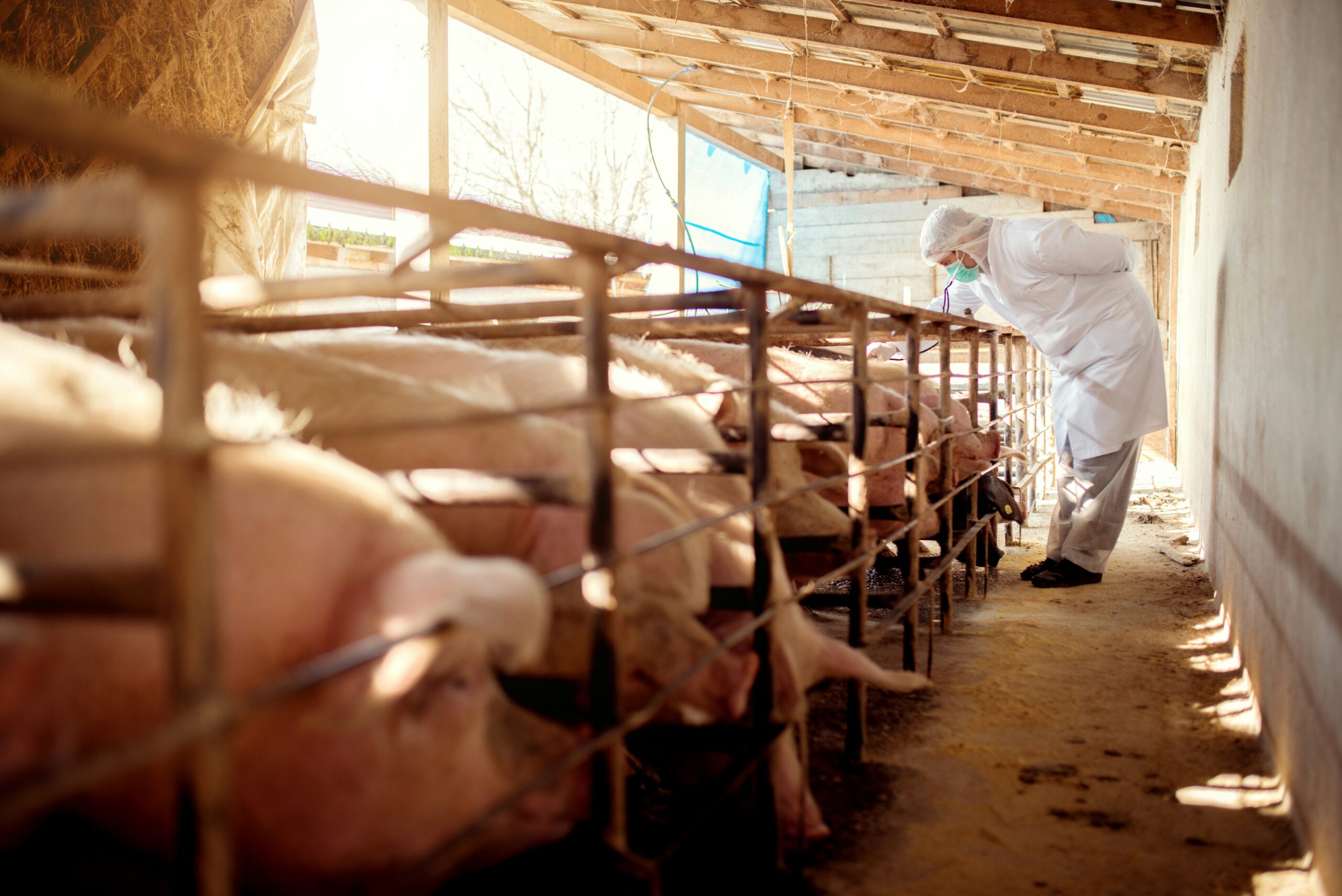
A potentially harmful superbug linked to the overuse of antibiotics in livestock production has quietly gained a foothold across the UK in recent years. It has contaminated farm animals, been found in abattoirs and discovered in supermarket meat. It’s also been detected in people in greater numbers than previously disclosed, new evidence seen by the AGtivist shows.
The disease, known as Livestock Associated (LA) MRSA CC398, is a variant of the more commonly known MRSA associated with hospital infections. In Denmark, CC398 has been linked to multiple deaths and more than 12,000 human cases. There, the issue has been described as a health crisis, with as many as 90% of the country’s pig farms infected and a significant proportion of all human cases of MRSA recorded found to be the CC398 variant.
Although UK cases are thought to be well below those in Denmark and other European countries, critics say a series of government failings have effectively provided a “free pass” for the superbug to become established within domestic supply chains, and warn that a lack of robust surveillance has meant that neither farming nor health chiefs have any real idea of its prevalence. Meanwhile, government scientists and livestock bodies maintain that LA MRSA poses little risk to public health, amid accusations of “sensationalist” claims.
The superbug can be transmitted from infected farm animals directly (putting livestock workers at the highest risk) and handling contaminated meat (although thorough cooking kills the bacteria), and from other people carrying the MRSA. Studies have shown that in some cases patients have had no contact with livestock, raising further concerns about community transmission.
Although pigs and other livestock can carry CC398 without visible symptoms, as can humans, the MRSA variant can cause serious health problems for some people, particularly those suffering from existing medical conditions. Many develop skin complaints, and some can contract life-threatening infections, including pneumonia and blood poisoning. CC398 is resistant to many antibiotics, including in some cases those important in human medicine, which can complicate treatment in the most serious cases.
Yet in what some regard as a significant error, successive governments have declined to routinely monitor British farm animals (or meat) for LA MRSA, despite calls from some experts and campaigners to step up surveillance. Consequently, no one has any real idea of the extent, or spread, of the superbug. This information gap, say critics, should concern us all, particularly as the wider problem of antibiotic resistant disease represents a looming global health crisis.
Apparent complacency
The apparent complacency can be traced back to a 2008 study, carried out as part of a Europe-wide probe into the prevalence of the disease in the continent’s pig populations. The study detected no LA MRSA at UK pig farms tested. Yet even as UK farms were given the all clear, it was a different picture across the Channel, with LA MRSA found in as many as 50% of herds tested in some European countries. Alarm bells should have rung louder than they did.
Indeed, the UK situation changed after the disease was discovered in British pigs in Northern Ireland in 2014, and again, in 2015, in East Anglia. Although the source of the Northern Ireland infections was never pinpointed, imported pigs for breeding purposes were blamed by some industry sources, and it later emerged that loopholes in border regulations meant that LA MRSA-infected pigs were free to be brought into the country with little, if any, checks.
An investigation had established that there was no mandatory screening in place for live breeding pigs being brought into the UK from Denmark, despite widespread contamination in the country. Researchers identified at least one regular Danish supplier of pigs to England that had seen its animals contaminated with LA MRSA.
Following confirmation of the East Anglia case, animal health agencies convened and internal records of the subsequent meetings show that whilst “passive surveillance” had successfully identified the Northern Ireland outbreak in pigs (and another involving turkeys in England), the lack of any comprehensive screening meant that officials could only surmise that it was “plausible” that the prevalence of the disease “may have increased” since the 2008 survey.
They did however warn that the detection of LA MRSA was “significant” because of its “zoonotic potential”, noting that the superbug “can colonise humans, in particular those in regular contact with infected livestock, and can, on occasion, cause disease, most commonly seen in immunocompromised individuals, or those undergoing elective surgery.”
Officials concluded that the presence of the disease in the UK pig population would represent “a potential public health risk.”
In addition to this, efforts to contain outbreaks that were confirmed were hampered by a lack of legal powers. Although animal health officials were able to carry out laboratory surveillance of bacteria and access farms for sampling, additional measures – such as imposing movement restrictions on livestock, restricting the disposal of farm waste, slaughtering animals and curtailing the prescription and supply of antibiotics – were not available because LA MRSA wasn’t classified as a notifiable disease, in contrast to salmonella or other illnesses.
Had these tools been at the disposal of those managing the outbreaks, the risks of LA MRSA spreading from contaminated farms would have been much reduced, views contained in government records show.
Contaminated meat
Either way, once LA MRSA had arrived on UK shores, the genie was effectively out of the bottle: cases of pigs – as well as cattle, sheep, horses, poultry and even cats – were subsequently reported as a result of ad-hoc veterinary investigations, with infected animals discovered the length and breadth of the country. Repeated cases in Northern Ireland provoked particular concern, in part because of the region’s high concentration of factory farms and apparently high usage of some veterinary antibiotics.
From farms, the MRSA would go on to spread throughout some meat supply chains. Pork produced from UK pigs and publicly on sale was found to be contaminated during tests, prompting headlines and clashes between the pig industry and campaigners.
In one 2016 study, testing found the superbug was present in British-produced pork mince sold by two leading supermarkets. In response, industry bodies said the headlines were “sensationalist” and that LA MRSA represented only a “negligible” risk to public health. Some experts disagreed, and called for the UK government to take urgent action to avoid a situation unfolding such as that seen in Denmark.
Yet even whilst the pig industry sought to downplay the superbug threat publicly, behind closed doors there were admissions that tackling the wider problem posed by antibiotic resistant disease on farms would be difficult owing to biosecurity challenges and highly intensive production systems.
Minutes from a workshop held between Government officials and industry representatives in 2016 highlighted that on many pig farms “the design and state of older [livestock] buildings means they are almost impossible to successfully clean and disinfect. It’s possible all that’s easy to do has been done and only the difficult, expensive things are left.”
“A barrier to improving herd health is continual production systems in some sectors. These are an issue as they provide no natural break in the infection cycle,” the documents stated. “How can a break be introduced to allow proper cleaning and disinfection of premises? Some diseases may only be tackled through a complete overhaul in farming systems, which is unlikely to happen.”
Although the UK pig sector has reduced antibiotic usage considerably in recent years, and some studies have found that pig farms with higher levels of antibiotic use have higher levels of MRSA, much remains to be done, according to campaigners.
They cite an industry-sponsored study, published in 2021, which found isolates of LA MRSA in more than 40% of pig batches tested at a number of UK slaughterhouses, as evidence that the disease has become well established in parts of the UK pig herd.
Some of the information gaps are expected to be filled, at least in part, following a recent government study in Northern Ireland, carried out to determine the prevalence of LA MRSA in healthy pigs at slaughterhouses, part of a wider EU project.
Human toll
Despite all this, there’s been surprisingly little attention paid to the human toll of the disease in the UK. Establishing the true number of human cases of LA MRSA is challenging, if not currently impossible, say campaigners, as, similar to the situation surrounding farm animals, there has been no ongoing or dedicated public health screening programme. Instead, until 2023 at least, it appears that government scientists largely had to rely on voluntary submissions of human MRSA samples from external medical professionals in order to undertake the detailed laboratory analysis needed to ascertain if cases were livestock in origin.
Academics at Cambridge University attempted to raise the stakes in 2022 with new research that reinforced how the disease can jump the species barrier and infect people. “Cases of LA MRSA in humans are still only a small fraction of all MRSA cases in human populations, but the fact that they’re increasing is a worrying sign,” one scientist involved said.
And a government report published a year later underscored the worrying potential for person to person spread, detailing how a dozen patients in a specialist burns unit were found to be carrying LA MRSA. Genome sequencing suggested that the bacteria had spread between people within the hospital, potentially after being introduced by staff and transmitted to patients.
In a 2017 Food Standards Agency risk assessment of LA MRSA it was reported that, to date, just three cases of the disease had been identified in people in England. There have been few updates since. But the AGtivist has learnt that, in 2024, when officials from the government’s Veterinary Medicines Directorate (VMD) approached the UK Health Security Agency (UKHSA) for help with establishing a more detailed picture of the disease’s spread, a significantly higher figure began to emerge.
Citing the absence of “routine, active surveillance of LA MRSA in food producing animals,” VMD officials requested access to existing UKHSA records as well as quarterly updates on any ongoing LA MRSA findings.
Documents and figures finally released earlier this year after a lengthy freedom of information case – the UKHSA apparently delaying the release of the records for more than six months – revealed that at least 131 human cases of Livestock MRSA CC398 had been confirmed in England. The absence of figures for Scotland and Northern Ireland, both of which have previously acknowledged human cases, as well as Wales, means the true figure will inevitably be higher.
In addition, some experts say there will have almost certainly been “underreporting”, owing to the fact that at least some of the findings were discovered only as a result of clinical cases (after symptoms had begun), not via routine screening programmes. One source pointed out that in contrast, Danish surveillance figures for LA MRSA includes data derived from both screening and clinical cases presenting in hospitals or surgeries.
Although acknowledging that the UK has fewer cases than Denmark, when asked if we should be worried about the UK figures, they said “absolutely”. Another source said, somewhat more bluntly, “they don’t know how many cases there are as they haven’t been looking. […] It could be ten, twenty or even more times higher than [the] figures suggest.”
When questioned about all this, the UKHSA maintained that LA MRSA is currently considered a “low public health risk” in the UK, but said that “we need to take a One Health approach to tackling the infection in animals and livestock now to prevent it from becoming a more significant risk to human health in the future.”
The agency further noted that the disease can pass between animals and humans, often without causing symptoms, and “only occasionally results in infection.” Given what we know, and indeed don’t know, let’s hope it stays that way.
This is an edited extract of a longer story on pig farming and antibiotic use due to be published by a consortium of journalists in several EU countries.
The AGtivist is an investigative journalist specialising in food and agriculture issues who’s been covering this beat for 20+ years. The AGtivist column at Wicked Leeks shines a light on the key issues around intensive farming, Big Ag, Big Food, food safety, and the environmental impacts of intensive agribusiness.








0 Comments