
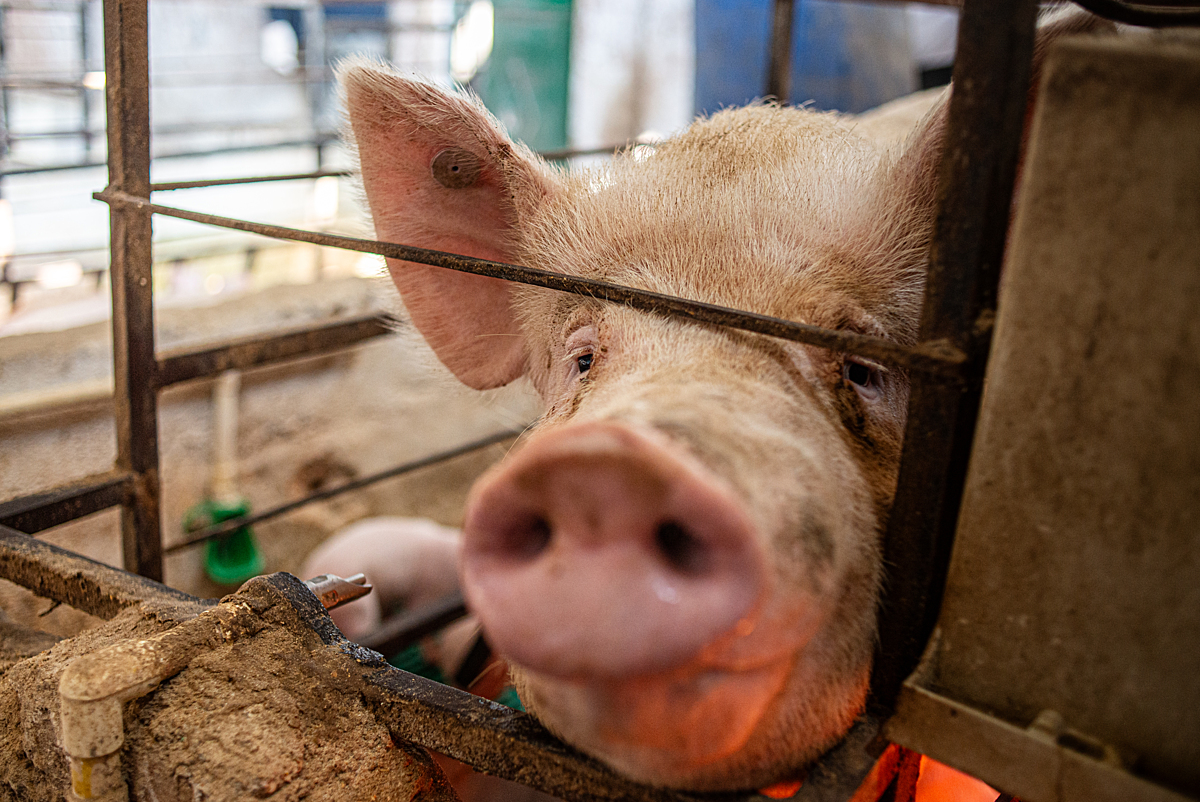
The following article contains descriptions of intensive pig farming that readers may find upsetting.
Cheap sausages, bacon, and other pork products often come with a largely hidden price tag, particularly when it comes to animal health and welfare.
In order to raise awareness of the plight of pigs reared in Britain’s factory farms, campaigners from the Animal Rising group this week announced that one of their activists would be swapping her home for a purpose built cage in Trafalgar Square, central London.
She will be confined inside what is known in the industry as a “farrowing crate” – a common feature on many intensive farms designed to facilitate the birth of piglets – for an apparent three week stint. She will eat, sleep and live in the crate 24/7, in conditions that Animal Rising say will be both highly restrictive and physically and psychologically challenging.
The activist is doing this, according to the group, because over the past few years, she has spent hundreds of hours reviewing footage obtained inside factory farms as part of efforts to expose the cruelty they say is taking place behind closed doors. “I’ll be in this crate for 21 days, and I know it’s going to be tough, she said this week, “but at the end, I get to walk away, […] pigs don’t get that choice.”
The announcement of the stunt coincided with the publication of undercover footage obtained inside a UK pig farm documenting the story of one female pig, and its offspring, over a month-long period. The video, captured by Animal Rising at the dedicated “farrowing” hall on the farm, appears to show the reality of this key but little known aspect of industrial pork production. This includes the birth of piglets onto barren flooring, the day to day monotony for adult animals confined in metal cages, unable to move around freely, as well as farmworkers apparently performing, according to the campaigners, controversial procedures on the newborn animals, including teeth clipping (designed to minimise injuries to both adult pigs and younger animals) and the removal of pigs’ tails (to prevent tail biting, a problematic occurrence amongst pigs that can lead to painful infections).
The footage will be eye-opening for many viewers, yet offers only a glimpse of one part of the overall intensive pork chain, which is often riddled with cruelty and suffering, as numerous exposés have demonstrated in recent years.
To fill in some of the gaps, and highlight some of the other many problematic conditions and practices that afflict many pigs in the UK, the AGtivist this week turned to an undercover investigator who has had the dubious honour of witnessing all this for himself, up close and personal, during covert assignments on multiple factory pig farms, including some supplying supermarkets.
His account – both about the nature of the jobs undertaken and the production systems in place – makes for disturbing but necessary reading, and whilst the pig industry will no doubt disagree, powerfully reinforces arguments being made by some critics for factory farming to be completely outlawed in the UK by 2040.
“Securing a job in the pig industry requires patience and wears you down. During my deployment on this particular assignment, I visited dozens of farms across swathes of the UK, leaving CVs and asking for work. Door-knocking proved more effective than applying through agencies, I found. Once hired, the hard reality of the work sets in immediately. All manual jobs in pig farms are highly physical. They often involve working inside overcrowded, claustrophobic sheds, hauling heavy, water-logged hoses, high-pressure washing equipment, metal gates, and handling kilos of live, moving, animals. The pigs are often resistant to moving, which requires constant effort. The sheer fatigue of the labour, compounded by the mental effort of maintaining a cover story, leads to an inevitable exhaustion which makes it harder to stay alert and manage your reactions.
My first full undercover placement was at a massive pig finishing [fattening] operation housing thousands of pigs. The work of washing the pens was dirty and demanding in equal measure: high-pressure washing kicked up a mist of faeces and urine, and the noise of the water hitting the metal slats was loud, layered over the constant grunting of the animals. Here, the sheds lacked natural light. Workers routinely turned the lights off when leaving a section, leaving the pigs in semi-darkness. The floors were fully slatted with no straw, and the only “enrichment” was a single hanging chain that the pigs ignored. The animals stood still, appearing lethargic and unresponsive.
The next placement was in a pig breeding unit which presented even poorer conditions and tested my ability to maintain my cover. The straw litter was heavily saturated with waste, creating a layer of mush underfoot. The pigs were visibly unwell, with red eyes, drooling, and covered in filth. I observed pigs with severe diarrhea. The noise level was also significantly higher, consisting of sustained, high-pitched vocalisations.
Biosecurity here was poor too; boots were pressure-washed rather than disinfected, and showers were optional. The psychological toll of the environment was heightened by the casual attitudes of the staff. A shift manager stated matter-of-factly that if up to 35 pigs were placed in a single stall and one died, the others would eat it. Later, while mucking out, I found a small pig bone in the muck.
I had to step away and sit in my car for a period to reset. Maintaining a neutral expression and acting as a compliant worker while witnessing and hearing these things required constant, self-control. Hiding a camera and managing my own reactions was a continuous drain.
By the time I worked at another farm rearing pigs from birth through to slaughter, the fatigue really was setting in. The isolation experienced during undercover work is difficult. While I had a handler to debrief with [as is normal for journalistic assignments such as this], the day-to-day reality is entirely solitary. You cannot discuss what you are seeing with anyone on the outside, which creates a heavy sense of isolation.
The conditions at this site were particularly poor. Walkways were flooded with standing water, and the pens were overcrowded. The work involved handling sows [female pigs] through wet, slippery alleys. The farm manager noted that the sows were producing such large litters that they were simply “wearing out.” He also admitted to weaning piglets at three weeks, acknowledging it was against best practice, but shrugged it off.
My final placement was at another fattening unit. Initially, it felt like a more manageable environment. However, underlying welfare issues remained. A worker showed me a pig that could not move its legs, stating its “back end had gone.” The pig had been seen by a vet and was given pain relief, but it remained immobilised in the straw. Filming here highlighted a complex reality: the physical limitations of the animals were evident, and “care” in this context simply meant managing a paralysed animal in a pen.
Even once deployment ends, the sights and smells of the sheds linger long after. The heavy, sweet density of ammonia and wet slurry seems to settle into your very pores, and in quiet moments, your ears still ring with the phantom, high-pitched screaming of the weaning units or the low-frequency grunting of the finishing sheds. Ultimately, what stays with you is not just the worst conditions at some of these sites, but the sheer normality of the entire system. The realisation that this is not just a few isolated incidents, but the baseline of the entire industrial pork sector, is a difficult weight to carry.”
As the AGtivist has previously reported, suffering and bad practices are not confined to pig farms. Poor conditions during transport to UK abattoirs are all too common, and even then, during the unloading and subsequent slaughter process, breaches of welfare rules can occur.
This week’s publication of footage from a single pig farm, and the related publicity stunt, is only the start of the Animal Rising campaign, with further stories and revelations expected in the coming days and weeks. Of course, as with all campaigns, there are clear agendas at play: in this case the abolition of all factory farms, as the pig industry continues to present a very different image of itself, maintaining that animal health and welfare standards on UK farms are high, and better than in many other countries where imported meat originates.
But judging by the latest revelations, and the relentless stream of welfare and cruelty scandals that have hit the industrial pig sector in recent years, its cheerleaders have something of an uphill struggle ahead, and it could soon be curtains for British factory pig production in the not too distant future. Let’s hope so.
Image c/o We Animals
The AGtivist is an investigative journalist specialising in food and agriculture issues who’s been covering this beat for 20+ years. The AGtivist column at Wicked Leeks shines a light on the key issues around intensive farming, Big Ag, Big Food, food safety, and the environmental impacts of intensive agribusiness.



0 Comments