
The River Wye winds its way along the Welsh/English border, and through the collective cultural imagination of its human neighbours, as it has done down the centuries.
From its first bridge, which dates back to Roman occupation, its vital role as a pre-road transport network and communication route, and its bucolic popularity as a beauty spot from the 1700s, to the agricultural and industrial mills which once perched upon its fast-flowing tributaries – its relationship with its bank dwellers is intimate, layered and longstanding.
More recently though, intensive poultry farming, an ensuing ecological disaster and a landmark ongoing High Court Case have dominated headlines around the Wye, which has become something of a poster child for the plight of the UK’s rivers and waterways.
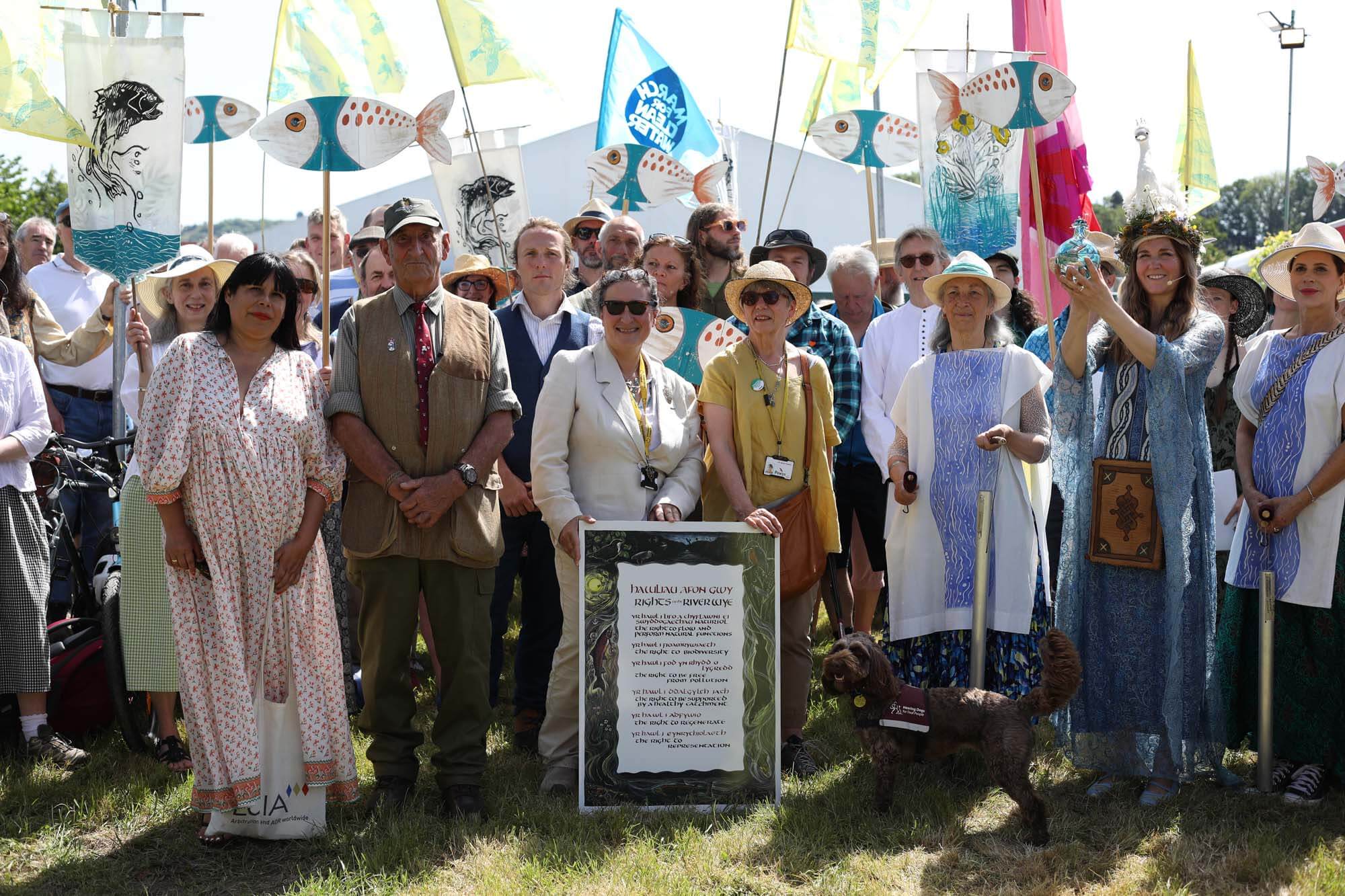
In May though, its story took a different course: the Wye became the first river in the UK to have its rights formally recognised by local authorities across its catchment, by way of a charter. Representatives from both sides of the English/Welsh border, from Monmouthshire, Forest of Dean and Powys Councils, Herefordshire County Council, the Wye Valley National Landscape and Bannau Brycheiniog National Park all gathered to sign the pledge. The ceremony took place at the famous Hay-on-Wye festival. And far from a dull council document signing, it was marked by costumes, giant puppets, a parade and offerings made to the river.
It followed the River Ouse, in Sussex, which in 2025 became the first river in the UK to have its rights recognised by Lewes District Council.
The charter recognised six key rights for the Wye – its right to flow and maintain its natural course, to sustain biodiversity, to be free from pollution, to be supported by a healthy catchment, to regenerate, and to have its voice represented.
“What’s amazing about it is that it goes beyond what’s happened before,” says Paul Powlesland, lawyer and co-founder of Lawyers for Nature.
“It’s multiple councils and official bodies across the catchment, which is the first time that’s ever happened. Also, it’s a strong recognition of the rights. How effective it is will depend on what happens next. However, given the strong guardianship with the Friends of the River Wye and the existing energy around the river, interesting things are probably likely to happen there, and it’ll be a great case study for what recognition of the rights of river can look like at a local level.”
This sentiment was echoed by campaigner and author of Is a River Alive?, Robert Macfarlane, who said: ““Change is rising from the riverbank upwards, and change from below is almost always the most durable kind of change. What especially impresses me is the catchment-wide nature of this initiative. Having four councils and two landscape-scale organisations behind it is testimony to the alliance-building power of the river rights vision.”
It’s not the only landmark ‘first’ within the Rights of Nature movement this year. In April, Maidstone Borough Council, in Kent, became the first council in the UK to formally adopt a Rights of Nature framework. Meaning that nature’s intrinsic right to exist and thrive will be embedded across its governance and decision-making.
“By embedding Rights of Nature within our governance, leadership and delivery frameworks, rather than treating it as a symbolic statement, Maidstone is setting a new precedent for how councils can act as genuine stewards of the places they serve,” said Councillor Rachel Rodwell, MBC’s Cabinet Member for Nature and Climate Transition in a council statement.
“Like all local authorities, we must meet national requirements for development and housing delivery, and ensure our borough remains a place where people can live, work and thrive. But recognising the rights of nature means those decisions cannot be made in isolation or at nature’s expense.
“This framework ensures that as we plan for growth, we also give proper weight to the health of our rivers, the protection of our trees and habitats, and the long‑term resilience of the natural systems that sustain our communities. It is about striking a fair, responsible balance, meeting government targets while making sure nature’s voice is embedded at the heart of our decision‑making, now and for the future.”
From grassroots, rather than top-down
While the charter and framework represent the Rights of Nature being built into governing systems, Paul Powlesland says that much of the activism that’s driving the change is coming from grassroots groups, rather than top down decisions, and he thinks we’re at a juncture when it comes to the growth of interest in the Rights of Nature.
“As we go further and further into all the different environmental crises, people are seeing that the current system doesn’t work, and they’re looking for alternatives,” he explains. “This is the very obvious one when you realise that it’s not just a few laws that are wrong; it’s a worldview based on entirely the wrong basic outlook around how we view nature.”
It’s this realisation that led Powlesland to co-found Lawyers for Nature seven years ago, after he provided legal advice and support to tree protectors in Sheffield, who were seeking to stop trees in the city from being destroyed.
“That made me realise that current nature protections are not sufficient, or even beginning to be sufficient,” he says. “As a result of that experience, I began looking for other systems that did things differently, and I came across the Rights of Nature as a concept.
“There’s an amazing Wendell Berry quote: ‘Whether we and our politicians know it or not, Nature is party to all our deals and decisions, and she has more votes, a longer memory, and a sterner sense of justice than we do.’”
The Rights of Nature movement is simple in its concept – in essence, it’s the recognition that Nature, including trees, seas, animals and landscapes, have rights in the same way that human beings do (or should).
“We’ve invented human systems that don’t take Nature into account at all,” says Powlesland. “Our current system is largely based on protecting nature for human ends; we protect rivers because we need clean water from them, or we protect trees because they’re nice to look at. But ultimately, that is not sufficient protection. The point about Rights of Nature as well is that it’s not about prioritising nature’s rights over human rights. It’s about finding a way to ensure that nature is represented and heard within our systems. And that wherever possible, nature’s rights and interests are balanced against human rights and interests.”
While Lawyers for Nature works with organisations, systems and governance structures, to support them in building Nature’s rights into their decision making, Powlesland is an advocate for the concept of Nature Guardianship – a practical model where anyone can involve themselves in protecting the Nature around them. He tells me that when we finish speaking, he’ll be pulling on his waders, and heading out along the banks of the River Roding, in East London, where he lives aboard a narrowboat, to identify unmapped locations of sewage outlets.
“There’s a lot of sewage going into the river, that’s actually illegal,” he says. “The river already has, in a sense, a right to be free of sewage pollution – that is literally what the law says in most instances. And yet that’s not being upheld.
“The deeper issue though is not even about the law. It’s about the practicality; there are loads of sewage outlets on the river that the government didn’t even know about. And we can’t uphold the river’s right to be free of sewage pollution if we don’t actually know where it’s coming from, or what the problem is. So I went out and found them, and I’m about to do that again right now. That’s directly upholding the river’s right to be free of pollution in a very practical way. It doesn’t rely on a law change. It just relies on me putting on a pair of waders and going out.
“Rights of Nature is not a top-down thing where the government says, ‘Here’s the Rights of Nature’, and the lawyers wave a magic wand and make everything ok. It’s something that we can and must all bring into our lives, into our businesses, into our work and volunteering and everything else. The River Guardian movement is amazing. The rights of the River Wye being recognised by councils is really important, but without the actions of River Guardians on the ground, enforcing them and bringing them about, they might not mean as much.”
Meanwhile, down in Cornwall, Garden of Tomorrow presents Solstice, is a new festival taking place this month, featuring Nature as both its headliner and curator. It’s aim is for “music, art, ceremony and conversation [to] unfold in dialogue with the land, led by a carefully curated programme of musicians, artists and thinkers exploring our relationship with Nature.” 100% of profits from the festival will be donated EarthPercent and the Sounds Right Conservation Fund, to support Nature restoration.
Festival headliner, new charters and frameworks, and a network of Guardians advocating for her rights – does this mark a shift in how we are starting to see Nature across our political, personal and cultural systems?
Image c/o Save the Wye, taken at the River Wye Charter Launch




The book Is a River Alive really impressed me. We, society. have for too long viewed a river to be a place to dump all sorts of things. Nature is us and a river whatever we decide about them are described as dead or dying so it follows that at some time they were alive. Let’s give them more respect at least and to see clear waters free from pollution supporting abundant wildlife is such a wonderful sight.