
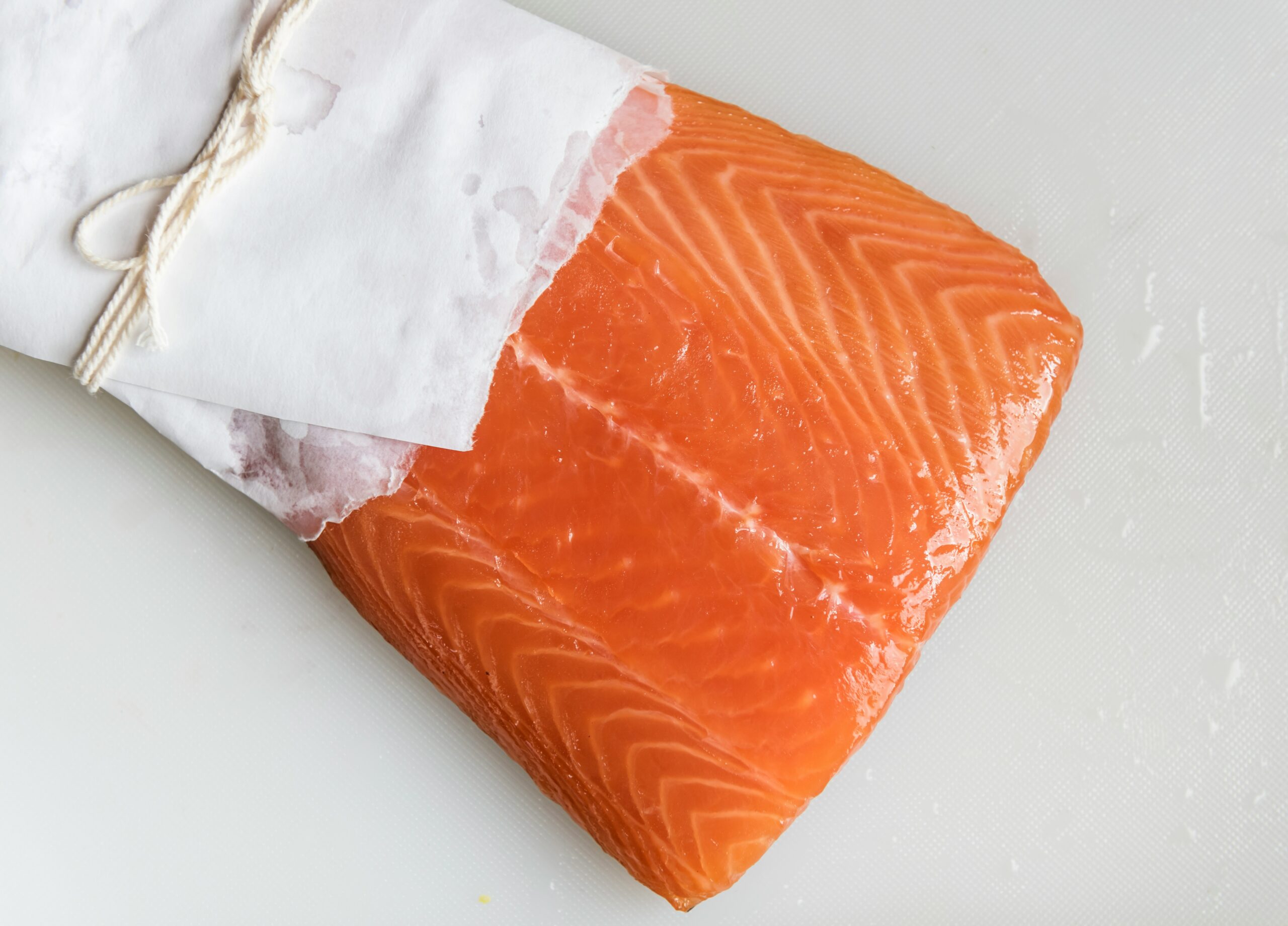
The spotlight has been turned on the UK’s most popular fish, as the Soil Association announces that farmed organic salmon will no longer carry its logo.
Their withdrawal comes as no surprise. Following an 18-month review that concluded last year, the Soil Association gave the organic salmon industry 12 months to demonstrate they could make progress on welfare, feed and environmental impact. It was described as “make or break time” by the SA, in May last year.
Today, Chief Executive of the Soil Association, Helen Browning, tells Wicked Leeks: “We simply can’t put our name to this”.
This doesn’t mean organic salmon is disappearing from our shelves. Organic remains a legally recognised standard under UK and EU regulations, and accounts for around 7% of UK salmon production; certification is likely to continue in one form or another.
The problem with organic salmon farming
However, it does raise the question of what we are eating when it comes to farmed salmon – both organic and non-organic.
Many consumers will be surprised to learn that the salmon they buy is farmed and not wild. Farmed salmon makes up over 92% of salmon sold in UK retail by value and the amount of wild caught salmon consumed continues to decrease year-on-year despite being significantly cheaper than farmed. According to a report by Seafish “of the ‘top five’ species (salmon, tuna, prawns, cod, and haddock) the average price of the farmed species is £18.57/kg, 80% higher than the average price of the wild caught species (£10.30).”
This misconception is not accidental. Scottish salmon companies won the right to drop the word “farmed” from their packaging last year and now packets typically say: “responsibly sourced”.
The salmon industry successfully portrays themselves as an extension of nature providing a luxury product, but ultimately organic salmon farms are grappling with many of the same problems as conventional ones. Leading campaigners for the Soil Association’s withdrawal from salmon certification include Chris Packham and Riverford founder, Guy Singh-Watson, who said in a recent customer newsletter: “The welfare standards for all farmed salmon are horrific – mortality rates on individual farms are commonly above 50% and in Scotland, only 61.8% made it to harvest in 2024. The industrial fishmeal industry is also destroying marine food chains around the world as it hoovers up the krill and other small fish that form the basis of farmed salmon’s diet, and at a local level, the faeces, waste food, chemicals used to control lice, and antibiotics included prophylactically in their diets, devastate the formerly pristine loch and coastal waters that host their cages.”
Then there’s the issue of warming seas to contend with, which is already increasing parasite outbreaks and disease as well as blooms of micro jellyfish, all leading to higher fish deaths.
What this means for the future of salmon
Although many believe the decision should have been made sooner, campaigners have largely praised the Soil Association for the move. “I think the Soil Association today is a stronger, more creditable, and more respected business than it was yesterday,” says Rupert Evelyn, Campaign Director at The Green Britain Foundation.
He adds: “This is a potential watershed moment because we can now say whichever way you cook it, salmon farming is a form of intensive factory farming in which animals routinely suffer, which depletes wild fish stocks, and is awash with toxins and chemicals.”
Nick Measham, CEO of charity WildFish, is also taking a moment to celebrate the Soil Association’s withdrawal. But, he is acutely aware “this represents only the tip of the iceberg” for the salmon industry.
“I suspect only a small proportion of consumers will be rethinking their attitude to purchasing all farmed salmon as a result of what’s happened,” he says, maintaining there remain plenty of other certifiers, including RSPCA Assured, who are helping the industry to greenwash. “We’ve got much more work to do to challenge the industry’s marketing of its product and persuade retailers to start to rethink their position on it.”
The fact that the Soil Association is stepping away from certifying organic salmon farms is an indictment of a whole industry: organic and non-organic. It is an inconvenient truth for people for whom salmon is a tasty and affordable protein and for restaurants and retailers for whom it forms a key part of their revenue. But, it is a truth we each have to acknowledge if we want to turn the tide. After all, salmon dominates seafood sales because we keep eating it.
Salmon is a keystone species. Linked to salmon farming, numbers of wild salmon in Scotland’s rivers have declined by 70% over the past two decades, and global populations of wild Atlantic salmon have declined from 8-10 million in the 1970s to just three million today.
If that doesn’t stop you from supporting conservation efforts by no longer buying farmed salmon, then maybe a reminder that 38.2% of farmed salmon didn’t make it to harvest in 2024 will make you reconsider how healthy the salmon you’re eating actually is. On your plate are those that have managed to survive the lice and the chemicals – and whose greying flesh may even have been dyed a more palatable pink. Bon appetit.
Lizzie Rivera is the founder and chief purpose officer at Live Frankly. Alongside her work for Wicked Leeks, she has been writing for mainstream publications for 10 years, specialising in sustainability and ethics since 2014.

0 Comments