
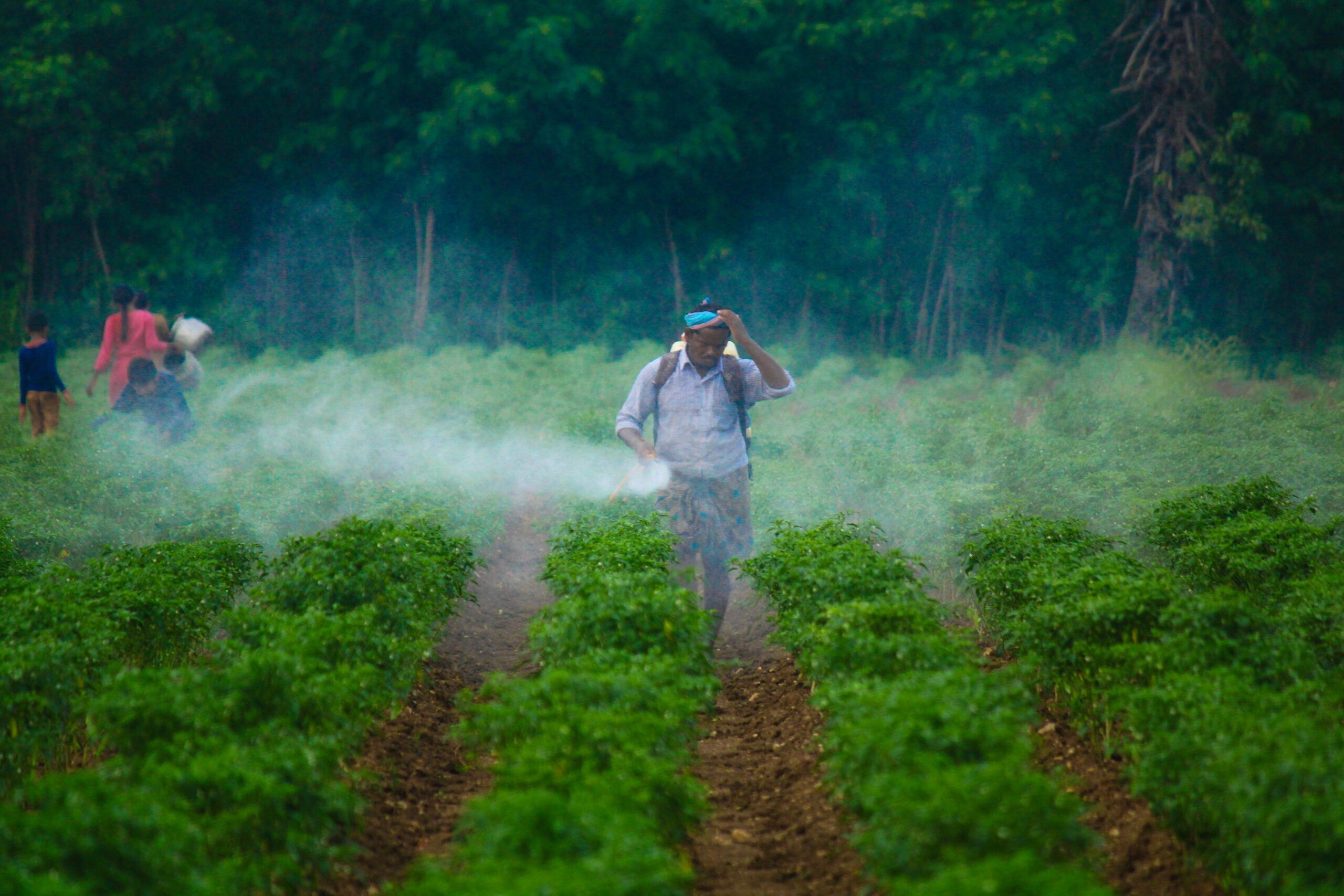
Nearly one in every two (46%) of the world’s farmers are being poisoned by pesticides every year, with the highest numbers of cases in southern Asia, south-eastern Asia, and east Africa. These are countries the UK relies on for crops like coffee, vegetables, fruit, rice, and spices.
The figures are from “shocking” research published in the journal Frontiers in Public Health by experts from the Pesticide Action Network (PAN) in Germany, Malaysia, and the US.
Using data on pesticide poisoning from 139 countries, the researchers found over 400 million incidents of the world’s farmers and farmworkers suffering from acute pesticide poisoning annually. And this total excludes the 84 million children working in global agriculture who “are even more vulnerable” to toxic chemicals than adults, as well as rural families exposed through spray drift and environmental exposure.
“Some of these farmers are reporting not just one case, but six, eight, or even 10 in a single season,” Sheila Willis, head of international programmes for PAN UK, told Wicked Weeks. It’s all the more “shocking” she added, because national authorities and the UN are “turning a blind eye” to this issue.
The last time the World Health Organisation (WHO) looked at these pesticide poisonings in detail was in 1990: it estimated that about one million unintentional pesticide poisonings occur annually, leading to approximately 20,000 deaths. A systematic review in 2020 found that about 385 million cases of unintentional, acute pesticide poisoning (UAPP) were occurring every year.
That study published by the same authors, in the journal BMC Public Health in 2020, was retracted in 2024 and updated following complaints from the pesticide industry, namely CropLife International, which represents large producers of agro-chemicals, and Bayer.
“We would like to understand the numbers provided in this article, which appear to overestimate the global burden of pesticide poisonings. We also feel that addressing the benefits of these chemistries is important for a complete evaluation,” the industry representatives explained in a letter to the journal’s editor.
The four authors, Wolfgang Boedeker, Meriel Watts, Emily Marquez, and Peter Clausing, all disagreed with the retraction. In their current paper’s introduction, they wrote: “We, the authors, provided evidence from the estimate indicating that even if the critique was right, it would affect the results only negligibly. The process raised important ethical questions with regards to what issues merit a retraction, as well as a journal’s duty in supporting and promoting scientific dialogue and debate.”
Poisons
Their new paper is designed to provide a more up-to-date picture of the issue of pesticide poisoning among farmers, using the available data from the WHO mortality database and hundreds of scientific articles, spanning the period from 2006 to 2023.
They found total fatalities around the world from unintended pesticide poisonings are estimated at around 11,000 deaths per year. Nearly 60% of these occurred in just one country, India, indicating “serious problems” with pesticide use.
“Behind these staggering numbers are farmers, workers, and families paying a terrible human price for pesticide exposure,” said Jayakumar Chelaton, executive director of PAN India. “South Asia is bearing an enormous burden, with highly hazardous pesticides such as paraquat implicated in devastating poisoning incidents. This research puts a human face on a crisis too often overlooked and makes clear that safer, non-chemical alternatives must become the priority to grow our food,” Chelaton added.
The highest single national incidence was in Burkina Faso, where nearly 84% of farmers and farmworkers experienced UAPPs each year. In Europe, cases were far lower but there is a lack of data from countries including the UK, said Willis. “With all these chemicals sloshing about in the environment, we are all exposed,” she said.
Concerns about chemicals in our foods, clothes, and the environment are increasing; and this has led to supermarkets starting to look more closely at chemicals in their supply chains, said Willis. Some are for example “trying to address pesticide use in their fresh produce. There is more willingness to look at this,” she explained. There has also been strong growth in sales of organic foods across large UK grocers in the past year. These businesses have “a responsibility to the people in their supply and the environment”, Willis noted.
Poured on
Still, use of pesticides continues to rise globally. The researchers from PAN said their worldwide estimates of UAPP follow from a better coverage of countries and data sources compared to earlier studies. The increase of pesticide poisoning could have resulted from the two-fold increase in global pesticide consumption between 1990 (1.8 million tonnes) and 2023 (3.8 million tonnes), they concluded.
This includes increases of 210% in the Americas and 185% in Africa, compared to a decrease in Europe of 5%. Based on the large increase in global pesticide consumption, many more farmers and workers are “now likely to be exposed to pesticides globally, or more often exposed through more frequent use”, they wrote, adding: “Our estimates are based on the size of the agricultural population provided by the World Bank, which is calculated by a given share of the total employment. It has to be pointed out that these estimates are probably too low because ‘employment’ is for some countries too narrow a definition, as it might not include informal employment or people engaged in subsistence farming.”
Indeed, there are millions of ‘invisible’ farmworkers, especially in low and middle-income countries, that include women and children from the families of farmers. There are also farmworkers who only carry out spraying and will be particularly exposed to chemical poisoning.
As previously reported by Wicked Leeks, considerable quantities of chemicals banned in the UK and the EU are also manufactured here for use overseas where regulations are looser. These are applied to commodity crops, like coffee, cocoa and cotton. “These are farmers’ cash crops, so they tend to be more willing to spend on chemicals to protect them,” Willis explained. “There is pressure to put more pesticides on,” she added.
Some of these pesticides can be found sold alongside food at local stores, or by agricultural retailers that have little knowledge of the applications or safety procedures, according to Willis. In West Africa, she highlighted the child labour problems in the supply chain and use of chlorpyrifos, an organophosphorus insecticide to kill pests on coffee and other crops, that has been linked with health concerns among children and adolescents. One recent study, conducted in New York, US, “identified a concerning connection between prenatal exposure to chlorpyrifos […] and lasting changes in brain structure as well as reduced motor function in children and adolescents”.
Chlorpyrifos has already lost its approval for use on plant protection products in the EU. In June, it was formally listed in Part A of Annex I to the Persistent Organic Pollutants (POPs) Regulation ((EU) 2019/1021), “establishing a limit value of 0.01 mg/kg (0.000001% by weight) for its presence as an unintentional trace contaminant in substances, mixtures, and articles”.
The addition of chlorpyrifos reflects a broader trend in global chemicals management, according to Neeta Verman, Director at compliance and regulatory firm Accuris, based in India. “Regulatory decisions are increasingly driven by scientific evidence, international cooperation and greater expectations for supply chain transparency,” she explained.
Pesticide policies
PAN called for removal of the most poisonous pesticides from agriculture and their replacement with safer alternatives. Governments and companies must “make good on their commitments globally to phase out highly hazardous pesticides from agriculture by 2035”, the campaigners said, as well as support farmers to transition to safer and more sustainable practices, including agroecology and organic.
In response to the republished report, CropLife International said: “We are aware of the re-publication of yesterday’s study, following its retraction some years ago. We are assessing the changes to this edition, but do need some more time to process the extent of the findings.”
What’s clear is that better health monitoring by the Department of Health and an acknowledgment that UK farmers and farmworkers are at the highest risk from acute and chronic health impacts of pesticides, is also needed, urges PAN. Manufacturing and export of pesticides banned here and in the EU should also be prohibited, and there must be “an end to the UK importing produce that has been grown using pesticides that are banned here on human health or environmental grounds”.




It seems to me that the price is too high. Workers and ultimately consumers need to be considered. As Guy has said his farming career is littered with chemicals that were pronounced, initially, to be completely safe yet subsequently withdrawn when found not to be.
The absurd situation of British companies manufacturing chemicals, which are banned in this country, being exported for use abroad and then the treated food being allowed back in this country really beggars belief.
Delete ‘unintentional’ from UAPP?
Our world has one mad – chemicals not safe for use here, still ,manufactured for others, then food with these chemicals on sent back for us to eat – As Terry Wogan used to say IS IT ME?
The study reports that 385 million cases were reported, not “over 400 million farmers.”
The word cases can’t be swapped for people because one person can experience several cases of poisoning. Please stick to what the study actually says; it’s alarming enough.
The 2020 study reported 385 million cases. The latest study states: “In total, we estimate that between 402 and 433 million cases of UAPP occur annually world-wide including about 11,000 fatalities.” Thank you for your point re “cases” and individual farmers – duly noted and edits made accordingly.